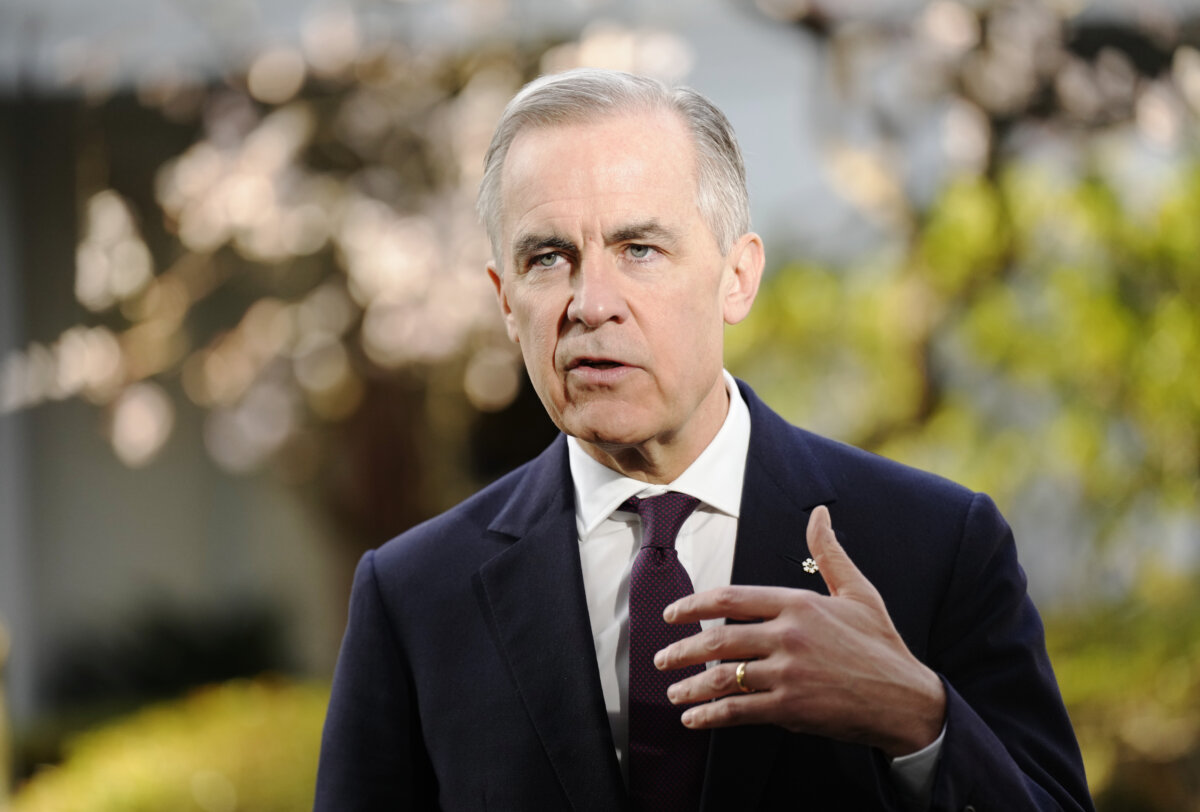

Prime Minister Mark Carney spoke with U.S. President Donald Trump over the weekend as trade talks between Canada and the United States ramp up and global stability is roiled by the war in Iran.
The Prime Minister’s Office (PMO) said the two leaders held a conversation on a “range of issues” on March 8. Topics covered included the economy, developments in the Middle East, and bilateral trade relations.
The two leaders “agreed to remain in close contact,” the PMO said. The U.S. side didn’t issue a readout, and Trump did not comment publicly on the call.
The latest conversation between Carney and Trump took place shortly after Canada-U.S. Trade Minister Dominic LeBlanc visited Washington, D.C., on March 6, to meet with U.S. Trade Representative Jamieson Greer.
After the meeting, LeBlanc said the “constructive and substantive” discussions centred on the review process for the United States-Mexico-Canada Agreement (USMCA) and broader bilateral trade issues. The USMCA review will formally begin on July 1 and talks between parties are intensifying.
LeBlanc also introduced two newly appointed Canadian officials at the meeting, who will play a key role in the trade talks: Janice Charette, Canada’s chief trade negotiator to the United States, and Mark Wiseman, Canada’s ambassador to the United States. Charette is a former Clerk of the Privy Council and High Commissioner to the United Kingdom, while Wiseman is a long-time friend of Carney and former executive with BlackRock investment firm.
Carney said it was “not surprising” that talks between LeBlanc and Greer had been “constructive” and “substantive,” while responding to reporters’ questions about the developments while in Japan on March 7.
The prime minister said there have been “beneath the surface” exchanges between the two sides over the last year on a number of issues, such as unspecified trade irritants and other “big structural issues,” and LeBlanc’s latest meeting was “an advancement of that.”
Carney’s answer was in response to a question related to a United States Trade Representative announcement on March 5 that a first round of bilateral discussions with Mexico in preparation for the USMCA review will begin the week of March 16. A similar announcement has not been made for Canada.
Carney said he understands why bilateral discussions are taking place ahead of the review of the trilateral deal, noting that the United States’ list of trade irritants with Canada differs significantly from those it has with Mexico.
“So we don’t necessarily need to be at the table for the issues with Mexico,” he said. Meanwhile, Canada has increased bilateral engagement with Mexico ahead of the USMCA review, with LeBlanc leading a large delegation to the country in February.
Carney added he believes the trilateral aspect of the trade talks will be focused on the automobile sector, given its deep integration across North America.
Trump has imposed universal tariffs on cars and auto parts in a bid to bring back manufacturing to the United States. The Canadian car industry has been impacted, even if some tariff exemptions have been granted under the USMCA.
U.S. Trade Representative Greer has said it’s unlikely that Canada will avoid tariffs as the White House pursues a re-shoring strategy. Greer in late February touted the strategy as having re-energized the U.S. steel sector, with his country overtaking Japan in 2025 as the world’s third-largest producer. Trump has also credited tariffs for boosting domestic car manufacturing.
“If Canada wants to come in and participate in this type of re-shoring we’re trying to do, we’re happy to have those discussions,” Greer told CBC News on Feb. 24. He mentioned dairy products as an area where Canada could open its market as part of a trade-off with the United States.
Canada’s supply management system for dairy and poultry products, which imposes tariff-rate quotas on U.S. products, has long been a trade irritant for successive U.S. administrations. Carney and opposition parties all support supply management. Parliament passed a law last year to protect the system in trade negotiations.
 Friends Read Free
Copy
Facebook
Tweet
Friends Read Free
Copy
Facebook
Tweet