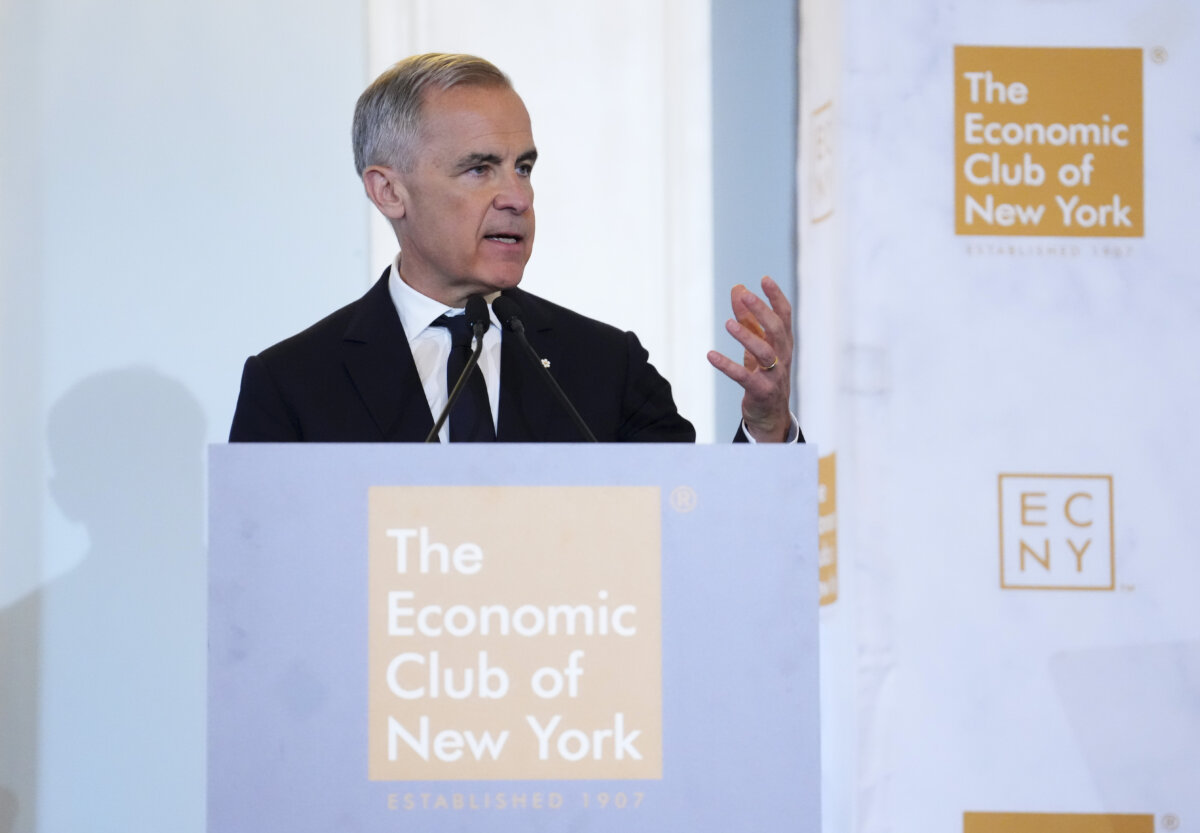

Prime Minister Mark Carney told a crowd of New York business leaders that Canada’s efforts to build partnerships with other countries can strengthen its independence and resilience, ultimately making it a more effective ally to the United States.
Carney made the comments in a speech to the Economic Club of New York on May 28, making his case for a new relationship between Canada and United States.
“This is good for all Canadians, but it is also good for the United States, because a stronger Canada is a better ally,” Carney said in the speech. “We know that when Canada and the United States have had our differences over the centuries we have always worked and eventually worked through them, because we share values and common interests run deep.”
The prime minister told the crowd that Canada and the United States should work together on areas like automobiles, critical minerals, and energy.
“Let’s be absolutely clear: Canada strong will help make America great again,” Carney said, mixing his own catchphrase with U.S. President Donald Trump’s campaign slogan.
Carney’s speech comes as comes as Canada and the United States have made little progress on renegotiation of the Canada-United States-Mexico Agreement (CUSMA) and as Carney is also about to meet the Chinese foreign minister in Ottawa this week in a bid to strengthen Canada-China ties. The U.S. administration has sharply criticized recent moves by Ottawa to get closer to China.
Carney told the Economic Club that Canada’s “dense web of international partnerships abroad” will allow the country to be a stronger partner for the United States.
The Liberal government has vowed to double its non-U.S. exports by 2035, and has recently signed trade agreements with the European Union, Japan, and the United Arab Emirates. Carney also travelled to China in January, where he signed signed agreements with Beijing on electric vehicles, law enforcement cooperation, energy, finance, and other areas.
“Our reputation as a reliable, predictable partner has rarely been more valuable in a world where transactions are replacing relationships. We are blessed with many commodities in Canada, but we have earned the most valuable one, which is trust,” Carney told the audience.
The United States has not formally launched CUSMA negotiations with Canada, but is currently in trade talks with Mexico. U.S. Trade Representative Jamieson Greer said on May 26 that significant trade issues remain with Canada, but he has been in regular contact with Canadian trade officials.
Greer also said U.S. tariffs on Canada and Mexico would remain in place despite both countries being part of the continental trade agreement. The trade representative also criticized Canada for having retaliated with counter-tariffs, while almost every other country had accepted them.
If the three countries agree to a renewal of CUSMA, the agreement would remain in place for 16 years. If that does not happen, it could trigger annual reviews for a decade until the deal expires in 2036. The withdrawal of one or more countries from the agreement could also lead to bilateral agreements.
Carney also told the audience at the event that Canada had been attempting to rebuild relations with China. Carney said that as part of a “reset” in relations, Canada agreed to open its markets further to Chinese electric vehicles (EVs), while China reopened its agricultural markets to Canadian products.
In January, Ottawa announced a deal with Beijing where tariffs on Chinese EVs would be reduced from 100 percent to 6.1 percent on 49,000 vehicles per year. In exchange, China lowered tariffs on Canadian canola to a combined rate of 15 percent from the current levels of roughly 85 percent “until at least the end of this year.”
Canadian canola meal, lobsters, crabs, and peas are also not subject to tariffs from March 1 until the end of 2026. Beijing has not yet lowered tariffs on canola oil.
Trump said in late January that Canada is “systematically destroying itself,” by boosting ties with China, and that the “China deal is a disaster for them.” Trump also said Canadian goods exported to the United States would be hit with 100 percent tariffs if Canada makes an unspecified “deal with China.”
 Friends Read Free
Copy
Facebook
Tweet
Friends Read Free
Copy
Facebook
Tweet