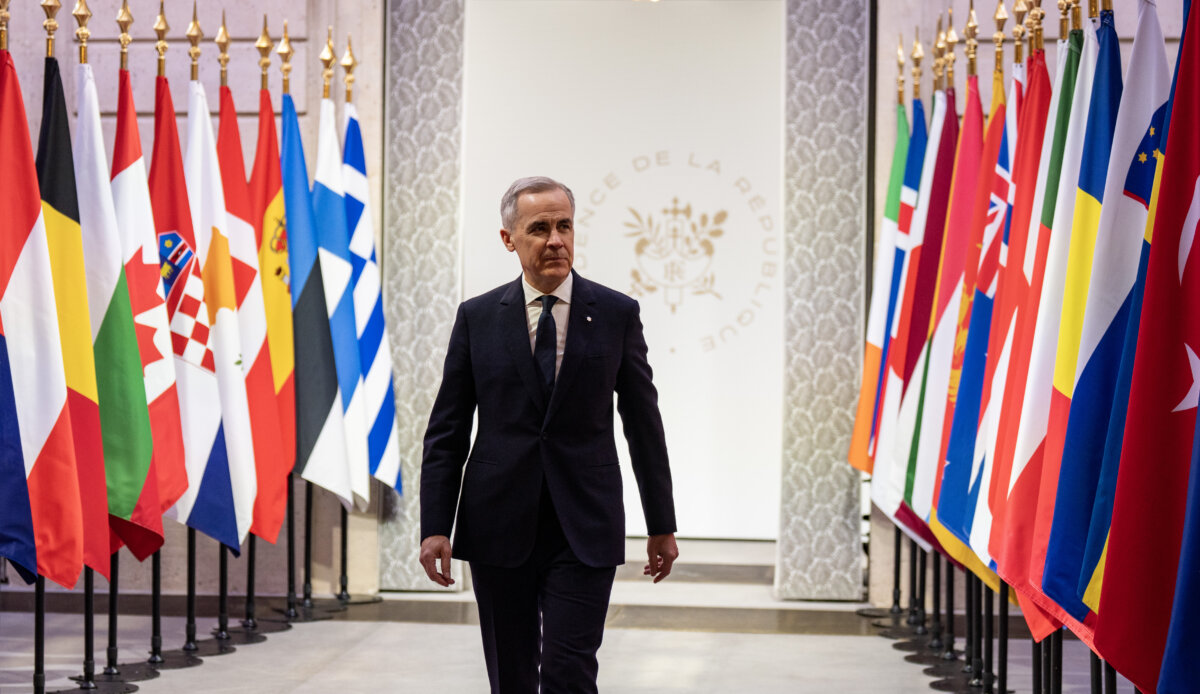
Prime Minister Mark Carney says Canada will continue to expand its military in the years ahead, in part to provide security guarantees for Ukraine.
Carney met in France with fellow leaders of the “Coalition of the Willing,” comprised of approximately 35 nations that have pledged to provide political, military, and security support to Ukraine in its ongoing war with Russia. The meeting on Jan. 6 was expected to facilitate discussion on terms of a peace agreement between Ukraine and Russia.
The main objective of the meeting, which was attended by Ukrainian President Volodymyr Zelenskyy and U.S. representatives of the proposed peace process, was to “finalize the security guarantees amongst ourselves,” Carney said at a Jan. 6 press conference at the Canadian Embassy in Paris.
Carney cited previous comments from Zelenskyy saying the negotiations on peace and security guarantees for Ukraine are “90 percent of the way there.” The remaining elements need to be negotiated by the United States, Ukraine, and Russia, he added.
Asked by reporters whether Canada has the “military bench strength” to supply troops to Ukraine, Carney said “we’ve been building that bench, and we’re going to continue to build that bench.”
“The largest military buildup in generations coming over the course of the next five years, an additional $80 billion of investment, in part because of issues like this,” Carney said.
A senior government official told reporters on the plane to Paris that Canada has been in discussions for months about making an “appropriate and serious contribution” to Ukraine security guarantees.
In terms of what Canada can provide to Ukraine, Carney said that it starts with training. He noted that Canadian troops provided training to thousands of Ukrainian soldiers in Poland.
The Canadian Armed Forces have trained more than 47,000 Ukrainian soldiers since 2015 as part of Operation Unifier, including approximately 13,000 of whom have been trained in various locations across Europe since Russia launched its full-scale invasion of Ukraine in 2022, according to Canada’s defence department.
Additionally, Carney said Canada can provide Ukraine with “logistics, surveillance, and cyber” support. The prime minister also said Canada will seek to expand weapons production through joint ventures with Ukraine.
Regarding putting Canadian troops on the ground, Carney said it’s “a possibility,” as part of a “multilateral force” including Ukraine allies and the United States.
“That means that our contribution has a much bigger effect than, obviously, that we would if we were on our own,” Carney noted.
Chief of the Defence Staff Gen. Jennie Carignan has been discussing with her counterparts in the coalition for months, and intensively over the last few weeks, to develop the operational elements of the security guarantees, Carney said.
After the meeting concluded on Jan. 6, the Prime Minister’s Office released a statement saying the Coalition of the Willing, the United States, and Ukraine are “ready to commit to a system of politically and legally binding guarantees that will be activated once a ceasefire enters into force.”
The guarantees will include participation in a U.S.-led cease-fire monitoring and verification mechanism and continued support for the Ukrainian military, including defence packages and financing the purchase of weapons, among other measures, the PMO said.
Additionally, the guarantees will include a multinational force for Ukraine involving members of the Coalition and the proposed support of the United States, as well as binding commitments to support Ukraine in the case of a future armed attack by Russia in order to restore peace, and a commitment to deepening long-term defence cooperation with Ukraine.
Asked by reporters if the meeting would be considered a failure if the security guarantees were not finalized on Jan. 6, Carney said, “we don’t expect to fail.”
He said he believed the security guarantees would be finalized, but if they weren’t it would have been “because we’ve identified issues where they could be improved or adjusted, and then we would come back and work on this.”
“This is not a make or break… There is a lot of momentum in this process, and that’s why it’s important that Canada is here,” Carney said.
Carney also met with numerous world leaders, including Mark Rutte, secretary-general of NATO, and heads of state from Denmark and Finland.
Reuters and The Canadian Press contributed to this report.
 Friends Read Free
Copy
Facebook
Tweet
Friends Read Free
Copy
Facebook
Tweet