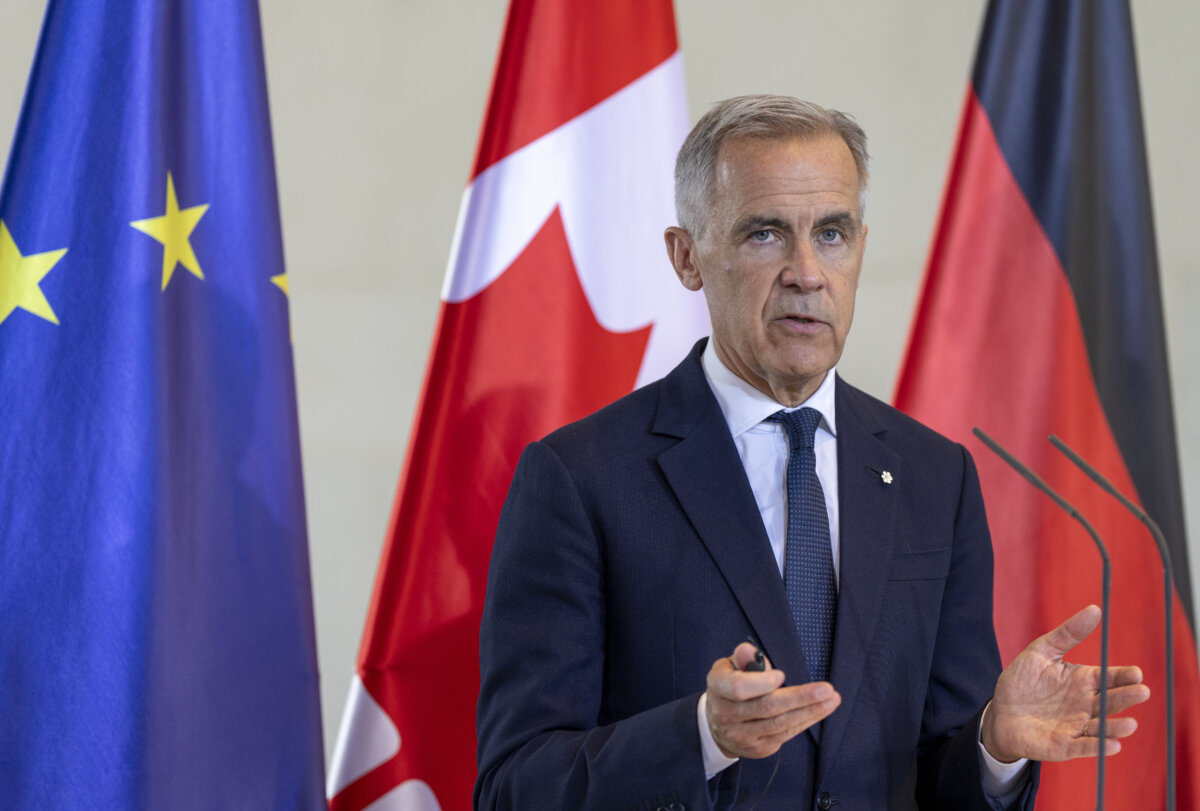

Prime Minister Mark Carney says the federal government is set to announce investments in Canadian ports that could be used to ship Liquid Natural Gas (LNG) to other countries, including investments in Manitoba’s Port of Churchill.
“Our government is in the process of unleashing half a trillion dollars of investment in energy infrastructure, port infrastructure … the first of which we will be formally announcing in the next two weeks,” Carney told reporters while visiting Germany on Aug. 26.
The prime minister said there are near-term opportunities relating to exporting critical minerals and metals to European countries, as well as “medium-term opportunities” to export energy products like LNG and hydrogen. Carney said Ottawa will be “reinforcing and building on” a new port in the northern Manitoba town of Churchill, which would “open up enormous LNG, plus other opportunities, and other East Coast ports for those critical metals and minerals.”
Carney also said Ottawa will make investments toward a new port in the city of Contrecoeur in southwestern Quebec. The Montreal Port Authority said in a press release last month that it could begin work on the port as early as the end of September. They said the expansion, to be completed by 2030, would “significantly” increase container-handling capacity and position the province to diversify and expand its trade markets.
Parliament recently passed Bill C-5, also known as the One Canadian Economy Act, which intends to support the development of major projects of national interest. The bill allows projects to bypass provisions of certain laws to be built faster, with the legislation intending to reduce approval times for projects from five years to two.
Carney had not previously announced what specific projects would be approved, saying after a meeting with premiers on June 2 that the list would be refined over the summer. Carney noted the premiers discussed projects such as a Western and Arctic corridor to connect energy, critical minerals, and trade infrastructure; an Eastern energy partnership; critical minerals pathways; small modular reactors; and other port and rail projects.
One of the potential projects that has received support from premiers is the Port of Churchill, with Manitoba Premier Wab Kinew calling for a “northern trade corridor” to transport resources to external markets through Hudson Bay. Alberta Premier Danielle Smith has also said she wants to ship oil products to refineries on the East Coast through Hudson Bay, which would be a more feasible way for the landlocked province to export its oil products internationally, since British Columbia and Quebec have signalled opposition to building new pipelines on their land.
The Manitoba government announced in February that it would be investing $36.4 million over two years in port and rail developments for Churchill, while Ottawa announced in March that it would provide $175 million over five years to support the operations of the Hudson Bay Railway linking Churchill to the rest of Manitoba.
While Churchill can deal with larger ships than those that can be brought through the St. Lawrence Seaway, it has a limited shipping season due to ice in Hudson’s Bay. The shipping season could be extended further with icebreakers, but it will be several years before Canada builds and acquires the ships to complement its current fleet of 17 icebreakers.
During an Aug. 26 press conference in Latvia, Carney said the new port in Contrecoeur “could be one of the first projects” built under Bill C-5, but added, “I’m not saying it’s definitively one of the first projects.” Carney also said Churchill has the potential to unlock “major indigenous leadership and participation” and the shipping of critical minerals to Europe.
 Friends Read Free
Copy
Facebook
Tweet
Friends Read Free
Copy
Facebook
Tweet