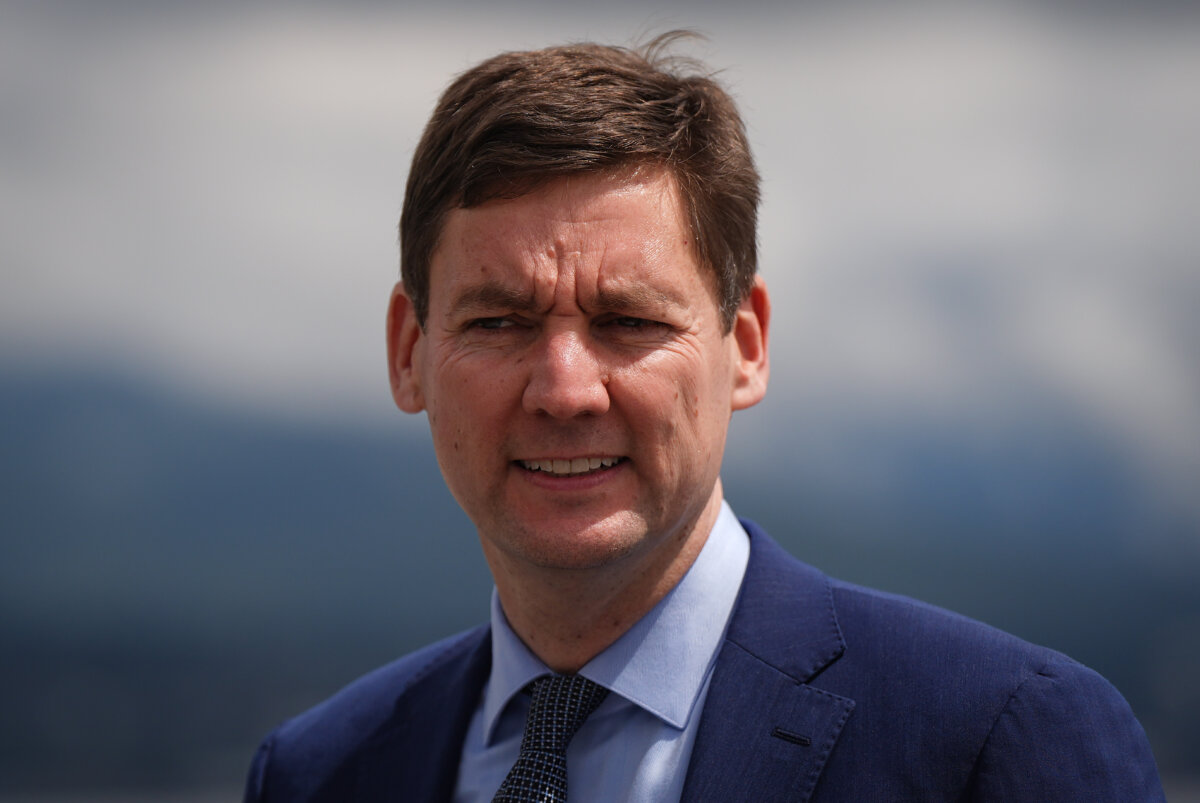

British Columbia Premier David Eby says he’s not blocking Alberta Premier Danielle Smith’s plan to build a pipeline to his province’s northern coast, but that there is currently no proponent or money for the project.
“I’m not the one who stands between Premier Smith and a pipeline to the coast. There’s no proponent, there’s no money, there’s no project right now,” Eby said during a June 9 press conference in Seoul, South Korea at the end of a 10-day trade tour through Asia.
Eby says that if Smith succeeds in securing a proponent and funding, then B.C. “will certainly cross that bridge.” He added there were “countless” other projects that B.C. could work with Alberta on to achieve prosperity for the western provinces.
Smith has been advocating for an oil pipeline running from Alberta to B.C.’s north coast. Last week, Eby appeared to dismiss the idea when he told reporters it wasn’t his role to tell Smith that her proposal for a pipeline across the provinces was “many, many years off.”
“It’s not my job to come in and tell Premier Smith that her vision for a north coast pipeline is many, many years off and there’s no proponent,” he told reporters in Osaka, Japan, on June 3.
Eby added that the province already contains the “massive taxpayer-owned” Trans Mountain pipeline, which carries crude and refined products from Edmonton to the B.C. coast. The federal government purchased the pipeline expansion project from Kinder Morgan in 2018 for $4.5 billion after the company abandoned the project, citing opposition in British Columbia.
During a June 4 press conference, B.C. Energy Minister Adrian Dix also said the idea of another pipeline in the province “doesn’t make sense to us.”
Carney, Poilievre on Pipelines
Prime Minister Mark Carney recently met with provincial and territorial premiers on June 3 to discuss infrastructure and energy project priorities. That meeting focused on streamlining the overall process for advancing projects, but did not conclude with any specific project commitments.
Carney has said there are opportunities for an oil pipeline that would bring “decarbonized oil” to markets in Asia and Europe, but has not explicitly confirmed whether he would approve a pipeline. He has previously called for Canada to become a “superpower” in both clean and conventional energy.
The Liberal government also introduced legislation on June 6 to bring down trade barriers within Canada and expedite the process for identifying and approving “nation-building” projects. Bill C-5 would support the development of major projects that align with national interests, contingent upon discussions with the provinces, territories, and indigenous groups.
The legislation would allow for a single assessment for projects that can deliver economic benefits, support clean growth, strengthen Canada’s autonomy and advance the interests of indigenous peoples. It aims to shorten the review process to reduce approval times for projects from five years to two.
Carney said the federal government would not overrule a province’s opposition to pipeline construction, and would seek out consensus from all relevant stakeholders before any project is approved.
Conservative Leader Pierre Poilievre said the same day that while he supported reducing the approval times for projects, he was concerned with Carney promising provinces “veto” power over resource projects and pipelines.
On June 9, Poilievre said he didn’t believe there needed to be a consensus to go forward with projects like the oil pipeline Smith has been advocating for.
“We’ve got to get it done,” Poilievre told reporters on Parliament. “We need a pipe.”
“At the end of the day, if you wait until everybody agrees on everything, nothing will happen,” he added.
 Friends Read Free
Copy
Facebook
Tweet
Friends Read Free
Copy
Facebook
Tweet