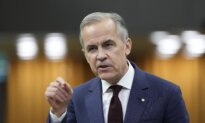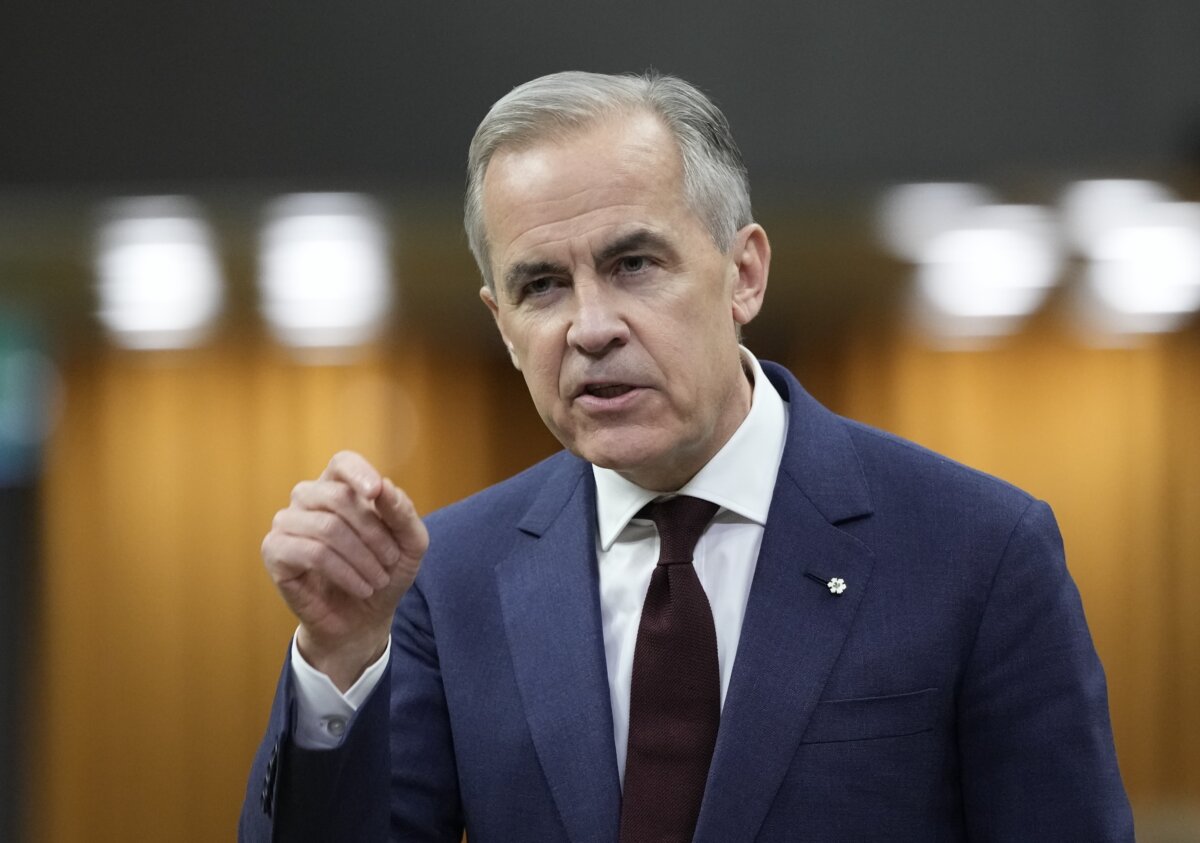

Prime Minister Mark Carney says he will update Canadians regularly about the government’s plan to attract new investment and strike new partnerships abroad in an effort to pivot away from the United States.
In an address to Canadians, Carney said the United States has “fundamentally changed” its approach to trade by raising tariffs, and Canada “must respond.” He noted that workers continue to be affected by U.S. tariffs in the automotive, steel, and lumber sectors.
“Many of our former strengths, based on our close ties to America, become our weaknesses—weaknesses we must correct,” Carney said in the April 19 video address posted on YouTube, titled “Forward Guidance with Prime Minister Mark Carney.”
The prime minister pledged to talk with Canadians “directly and regularly” about the government’s plan in the weeks and months ahead, and to “never sugarcoat our challenges.”
Carney said the government’s plan is to attract new investment and strike new partnerships abroad to sell to new markets, while “taking back control of our security, our borders, and our future.”
“There are some who say there’s no need for a comprehensive plan,” he said. “They believe we should wait it out in the hope that the United States will return to normal, the good old days will come back.”
“Hope isn’t a plan, and nostalgia is not a strategy.”
The prime minister argued that Canada cannot rely on one foreign partner, control the “disruption” from its neighbours, or hope that the disruption will “suddenly stop,” but it can control what happens at home.
He also noted that younger Canadians’ lifetimes have been “marked by a series of shocks and crises from abroad,” such as the war in Iraq, the 2008 global financial crisis, and the COVID-19 pandemic.
Aside from mentioning various initiatives his government has undertaken, Carney pointed to figures in Canadian history who have resisted “U.S. expansion,” saying he is reminded that Canadians are united and “can withstand anything.”
“It’s our country, it’s our future, we are taking back control to build Canada strong,” he said, adding that Canada has “faced down threats like this before.”
Reactions
Reacting to Carney’s address, Conservative Leader Pierre Poilievre said that the video is “another illusion” and that the prime minister wants a permanent rupture with Canada’s biggest customer “while he keeps 90% of his personal investments in the U.S.”
“He has doubled the deficit, negotiated no new free trade deals with any other country, approved no pipelines, and given Canada the worst food inflation, the worst household debt, the worst housing costs, and the only shrinking economy in the G7,” Poilievre said in an April 19 post on X.
“Fear is not a plan. We must reverse Liberal taxes, deficits, and anti-resource laws so we can be affordable, safe, and strong at home.”
Tory Deputy Leader Melissa Lantsman argued Carney’s address consisted of remarks he had already made in the past.
“Turns out his plan was to give the same speech over and over again until reality has improved,” Lantsman said in an April 19 post on X. She also posted a video in which she said Canadians “don’t need Forward Guidance,” adding that “they live in the real world, not the Bank of Canada press conference world.”
Bloc Québécois Leader Yves-François Blanchet also criticized Carney’s video address, saying Carney is “not some irresponsible political commentator who can say whatever he wants.”
“He can’t just list problems: he has to offer solutions. Ones that work,” Blanchet said in an April 19 social media post. “To date, he’s proposing nothing that will change the situation within 3 years, except for very risky debt. And the oil obsession is not a solution, especially not for Quebec.”
The Bloc leader said that while he also sees the value in diversifying markets, nearly 80 percent of Canada’s trade is tied to the United States, which he noted cannot change significantly in three years.
“Diversification is desirable, but it will be limited and long-term,” he said. “Enough with the complacency… Those who repeat and swallow the lies will pay the price.”
Blanchet said the government needs to negotiate a trade deal with the United States to end tariffs and create support measures for affected businesses and sectors.
USMCA
Carney’s address comes just two days after U.S. Commerce Secretary Howard Lutnick criticized Canada’s approach to trade talks and said U.S. President Donald Trump thinks the United States–Mexico–Canada Agreement (USMCA) is a “bad trade” that should be “reconsidered and reimagined correctly.”
He also said Carney’s January trip to China as a strategy to offset U.S. trade was “nuts,” given that the United States is the “consumer of the world” with a $30 trillion economy.
Canada–U.S. Trade Minister Dominic LeBlanc had told reporters last week that Canada would not be a source of delays in the USMCA negotiations and that Ottawa is “ready to do the work to get to a deal very quickly.”
LeBlanc also told a parliamentary committee that he had a “positive” 45-minute conversation with Lutnick, but he did not reveal details of their discussion.
Meanwhile, Poilievre has previously said having a free-trade agreement with the United States is important for attracting investments from other countries. His comments were in reference to Japan saying continued access to the U.S. market under the USMCA is “critical” for Japanese investment in Canada’s auto manufacturing sector.
Matthew Horwood contributed to this report.
 Friends Read Free
Copy
Facebook
Tweet
Friends Read Free
Copy
Facebook
Tweet