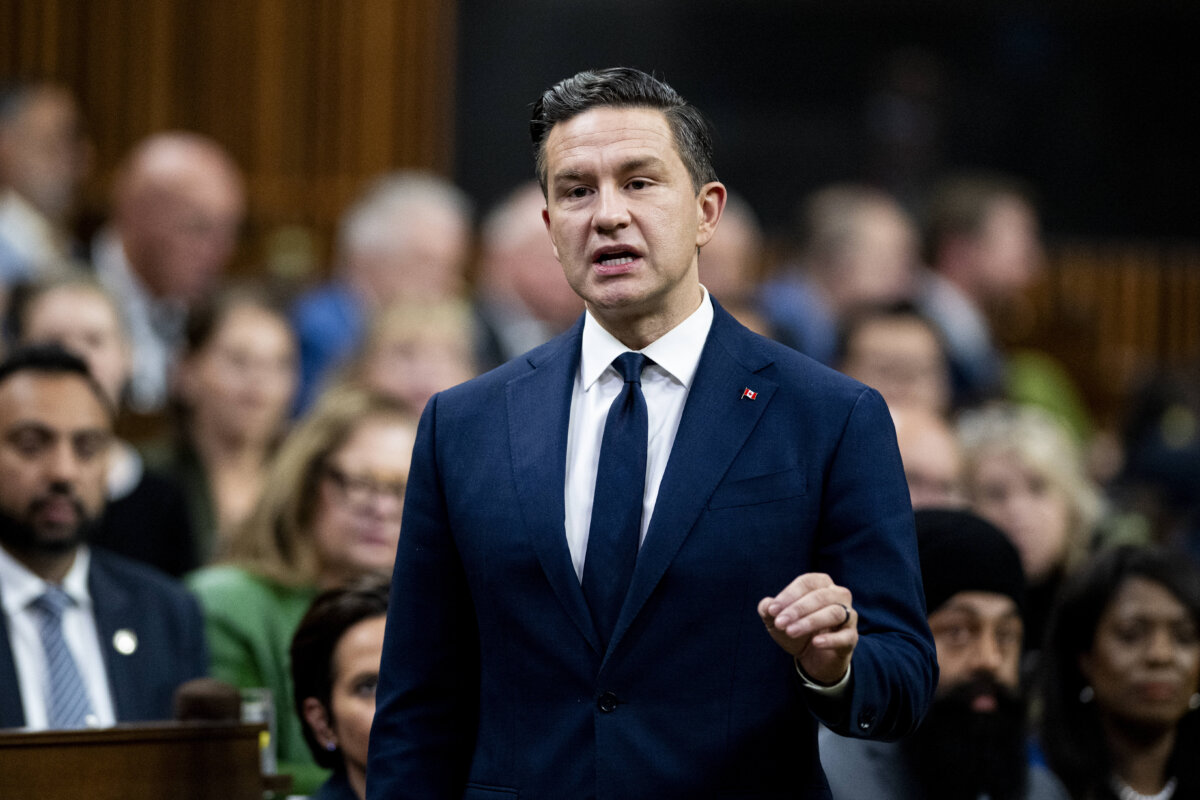

Conservative Leader Pierre Poilievre says that having a free-trade agreement with the United States is important for attracting investments from other countries, and that relations with the United States should not be ruptured by seeking closer ties with China.
Poilievre’s comments were made in reference to Japan saying that continued access to the U.S. market under the United States-Mexico-Canada Agreement (USMCA) is “critical” for Japanese investment in auto manufacturing in Canada.
“Japan makes it clear that Canada will not win more investment from Japanese automakers by rupturing with the U.S. in favour of Beijing,” Poilievre said in a Feb. 28 post on X.
“Our auto industry wins with a free-trade pact with the U.S. for our workers and our national interest.”
Japanese Ambassador to Canada Kanji Yamanouchi said during an interview with CTV News’ Vassy Kapelos, which aired March 1, that the USMCA is the “critical condition” to maintaining or increasing Japanese investment in Canada.
“Canada is, of course, a G7 country. Your GDP is one of the top 10 countries—$2.5 trillion. But you know the size of the U.S. market—$30 trillion,” Yamanouchi said.
“All those cars made in Canada, [are] of course sold in Canada, but at the same time exported to the U.S. market,” he added. “I think those companies, private companies, … they have to calculate to increase profit. So [USMCA] is a very important part of the calculation.”
Yamanouchi’s comments come ahead of the USMCA review, which is set to begin on July 1 and could lead to the agreement remaining in force until 2032 if all parties agree to its renewal. However, if the renewal is denied or delayed, the agreement could enter into a period of annual reviews.
In addition, if one or more countries withdraw from the trilateral agreement entirely, the three countries could then make bilateral agreements.
Canada-U.S. Trade Minister Dominic LeBlanc said on Feb. 26 that he is optimistic about the prospect of the USMCA discussions leading to a renewed trilateral deal.
LeBlanc said he was “not pessimistic” about the prospects of free trade because of a Feb. 20 ruling, in which the U.S. Supreme Court struck down U.S. President Donald Trump’s International Emergency Economic Powers Act (IEEPA) tariffs. When the United States announced new 10 percent global tariffs to replace the IEEPA tariffs, which took effect Feb. 24, it included a commitment to continue exempting USMCA partners as long as the rules of origin are met.
“It’s in the economic interest of all three countries to commit ourselves to a reliable, stable, free-trade agreement,” LeBlanc said.
Auto Tariffs, China Deal
Meanwhile, the United States imposed 25 percent tariffs on Canadian vehicles and automotive parts last year. Trump also said in January that the United States doesn’t need cars made in Canada or Mexico and that he wants to bring more manufacturing to the United States.
Canadian Vehicle Manufacturers’ Association President and CEO Brian Kingston told the House of Commons Industry Committee in October that Ottawa needs to prioritize getting the United States to remove the auto tariffs. He said that with 90 percent of Canadian automotive production heading south of the border, “there is no industry without U.S. access.”
Ambassador Yamanouchi’s comments also come after Carney visited China in mid-January and struck a deal with Beijing to slash tariffs on Chinese electric vehicles from 100 percent to the “most-favoured-nation” tariff rate of 6.1 percent on up to 49,000 vehicles in the first year. The tariff-rate quota will increase in the following years to reach approximately 70,000 after five years, with the expectation that the deal would drive new Chinese investment in Canada’s auto industry.
The U.S. administration has also criticized Ottawa’s pursuit of closer ties with Beijing, with Trump saying on Jan. 25 that Canada is “systematically destroying itself” by making a deal with China. He said it would “go down as one of the worst deals, of any kind, in history.”
Trump also said in late January that if Canada “makes a deal with China” it would be hit with 100 percent U.S. tariffs. In response, Carney told reporters that Canada has no intention of pursuing a free-trade agreement with China and has instead been rectifying some trade issues between Ottawa and Beijing in recent years.
Carney is set to visit Japan this week, where he is expected to meet with Japanese Prime Minister Sanae Takaichi and discuss partnerships in energy, critical minerals, and food security, as well as the strengthening of defence cooperation in the region.
Matthew Horwood contributed to this report.
 Friends Read Free
Copy
Facebook
Tweet
Friends Read Free
Copy
Facebook
Tweet