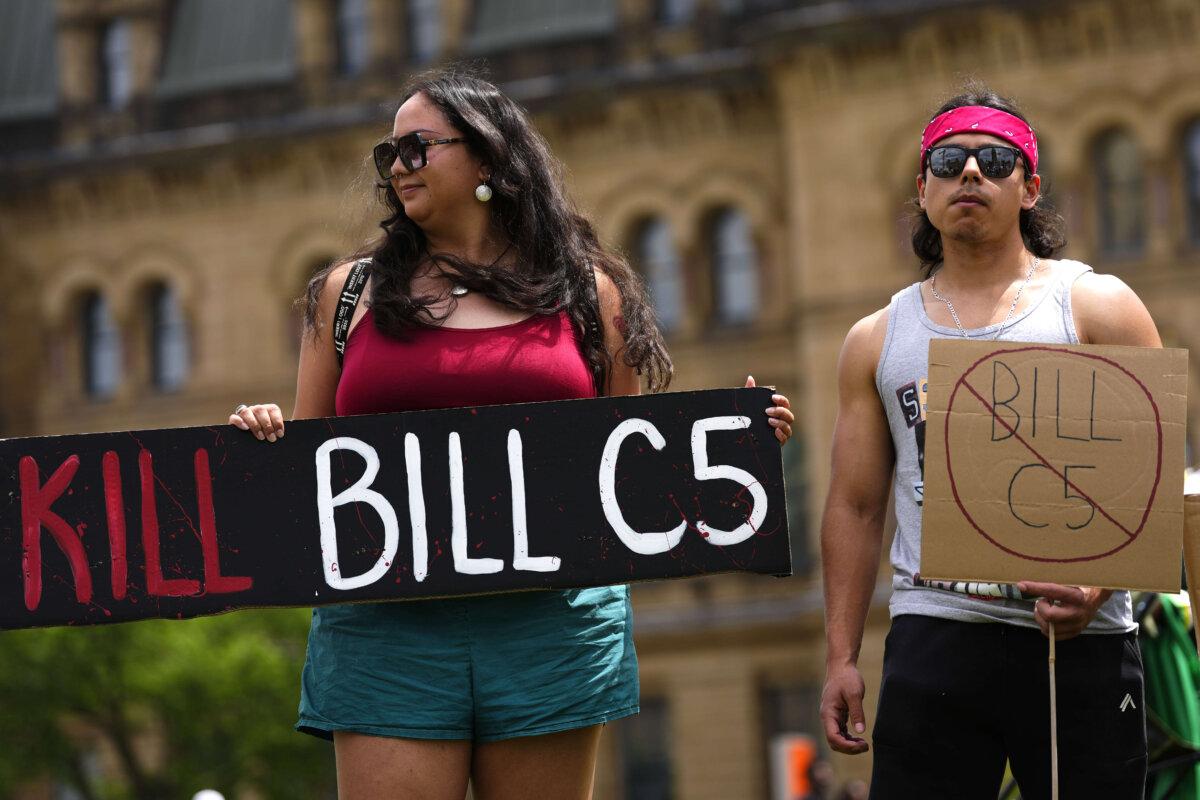
A court-ordered injunction is being sought by nine Ontario First Nations to prevent the federal and provincial governments from using recently passed legislation to expedite infrastructure initiatives.
The injunction was requested as First Nations are set to meet with Prime Minister Mark Carney on July 17 to discuss the major projects law.
A July 14 application to Ontario’s Superior Court of Justice from nine First Nations’ chiefs argues that the federal law, formerly known as Bill C-5, and Ontario’s Unleashing our Economy Act, allow Ottawa to “unilaterally ram through projects without meaningful or any engagement with First Nations.”
The chiefs said the laws violate the “constitutional obligation” of the government to advance reconciliation.
The applicants are seeking an injunction to prevent Ontario and Ottawa from declaring “special economic zones” or “national interest projects,” which would allow regions or projects to be exempted from existing laws to build infrastructure more quickly.
The claim states that aspects of the legislation are unconstitutional, and likens it to “authorizing commercial airline pilots to fly drunk, without knowing the flight path, and without having to engage with air traffic control.”
The applicants also seek $100 million in damages to repair harm done they say was done to the reconciliation process by the federal and provincial governments.
The nine First Nations requesting an injunction are lderville, Apitipi Anicinapek, Aroland, Attawapiskat, Fort Albany, Ginoogaming, Kitchenuhmaykoosib Inninuwug, Oneida Nation of the Thames, and Wabauskang First Nation.
PM Meeting With First Nations
Ontario’s Unleashing our Economy Act, formerly known as Bill 5, was passed by the government to allow the province to create “special economic zones” to bypass some environmental and municipal legislation to get projects built.
Ottawa’s new law, the One Canadian Economy Act, allows the government to support the development of major projects deemed to be in the national interest, such as pipelines, ports, and railways. Ottawa can allow some projects to bypass provisions of certain laws, and aims to reduce the approval times for projects to two years.
The government asked First Nations to submit the questions they would like answered as a way to highlight “shared priorities and bring the most pressing issues to the forefront” ahead of Carney’s July 17 meeting with First Nations.
Assembly of First Nations National Chief Cindy Woodhouse Nepinak said at a press conference on July 16 that economic growth and prosperity cannot come “at the expense of our rights and of the environment.” She said the chiefs have stated that consent from First Nations for major projects is “not optional.”
Woodhouse Nepinak said the federal government had “purposely excluded” indigenous stakeholders from discussions about Bill C-5 while it was being discussed in Parliament, so she hoped “the prime minister will make meetings with rights holders a more regular occurrence.” Carney promised to pass legislation to speed up approvals for major projects before Canada Day, resulting in Bill C-5 being rushed through the House of Commons.
Carney plans to meet with Inuit leadership in July and Métis leadership soon after to discuss concerns about Bill C-5. The Liberal government has also pointed to a new major projects office created by the legislation, which is made up of First Nation, Inuit, and Métis representation, as evidence that indigenous consultation is a priority.
Conservative Leader Pierre Poilievre said on July 14 that the best way to move ahead with major projects was with a “First Nations buy-in” to ensure they benefit from the projects. Poilievre proposed during the election campaign to allow businesses to divert a share of their federal corporate tax to local First Nations on whose lands the projects are built.
“First Nations wouldn’t have to go back to Ottawa to ask for money from federal bureaucrats. It would come directly to them,” Poilievre said. “So I think that is one example of how we can make these projects beneficial to First Peoples.”
 Friends Read Free
Copy
Facebook
Tweet
Friends Read Free
Copy
Facebook
Tweet