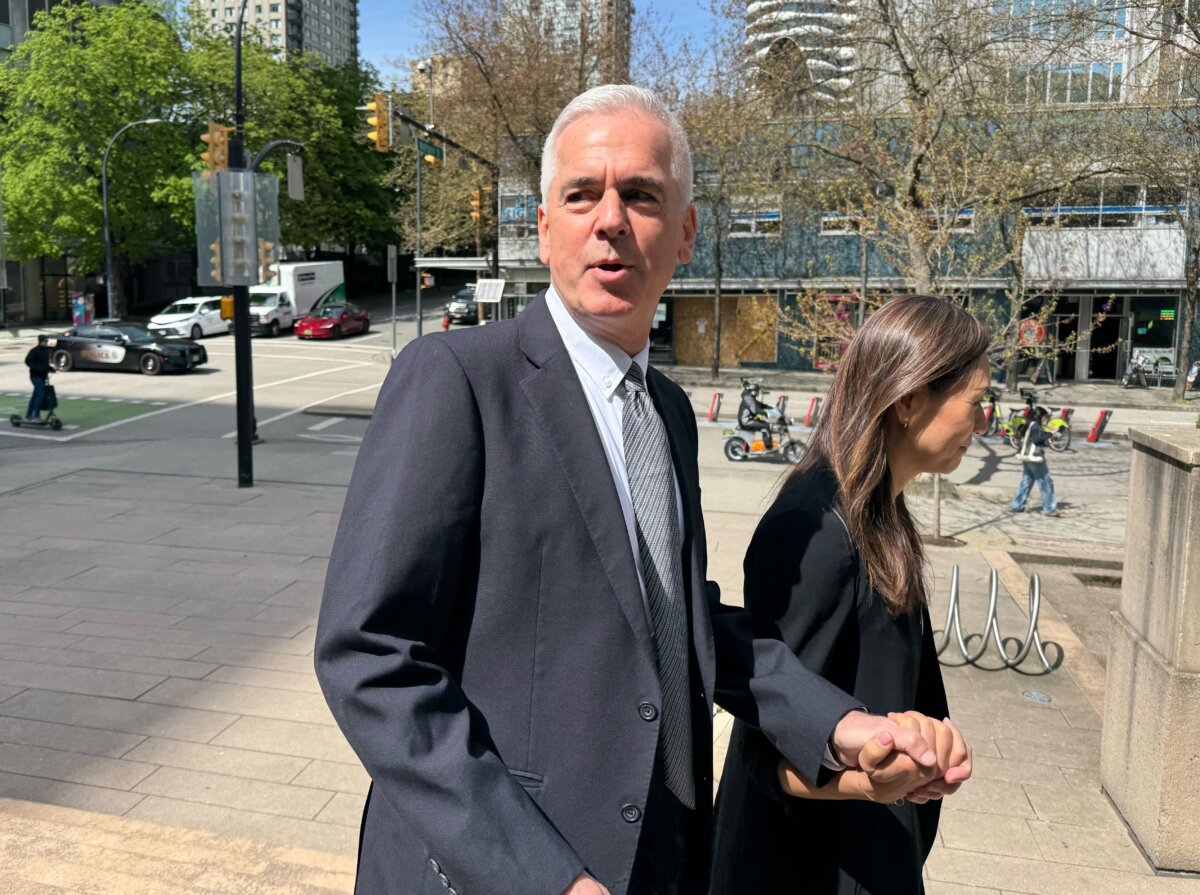

Three Chinese police officials went “missing” for six hours while on an RCMP-escorted visit in Vancouver in 2018, raising concerns they could be involved in repatriating people Beijing has targeted, a British Columbia Supreme Court trial was told on April 20.
The testimony came during the trial of former RCMP officer William Majcher, who has pleaded not guilty to allegations he helped Beijing in a scheme to “induce” a Chinese expat to turn himself over to China, where he was accused of financial crimes. His trial started on April 20.
Chinese Police in Vancouver
During the April 20 hearing, RCMP Supt. Peter Tsui said that in 2018, about 14 Chinese officers with the Chinese Ministry of Public Security were hosted by Canadian police in Vancouver and Toronto to work on “mutual files” related to fraud, money laundering, and “economic fugitives” cases.
The trip was facilitated by Tsui, an RCMP liaison officer who was based in Beijing at the time.
He said three of the Chinese officers didn’t show up to a scheduled meeting in Vancouver, with the RCMP having “no idea” where they were for six hours. He said authorities had put “safeguards” in place at the borders and airports because “there were certain individuals in Vancouver that we were concerned about being returned” to China.
Tsui said significant negotiations were involved in arranging the trip, and the episode affected “police-to-police trust” between the two countries.
He added that it occurred after the relationship had already “started to take a turn” in 2017 following Canada’s refusal to allow Beijing’s request to station two Chinese liason officers in Vancouver, in addition to the two it already had based in Ottawa.
Later in 2018, after Canada acted on a U.S. extradition request to arrest Huawei executive Meng Wanzhou in Vancouver on fraud charges, there was another “really significant impact” on the relationship.
Following Meng’s arrest in December, China detained Canadian citizens Michael Kovrig and Michael Spavor, holding them in captivity for more than 1,000 days until the United States dropped its extradition request against Meng.
Relations between the two countries remained strained for some time after this. However, Prime Minister Mark Carney has recently stated his government wants to seek a “strategic partnership” with Beijing.
When Carney visited Beijing in January, Canada signed a series of agreements with China, including on police cooperation. The RCMP says the agreement, which is confidential, deals with cooperation on “shared concerns, notably criminal activities in the fentanyl trade.”
The Conservatives have asked to see a copy of the agreement, with MP Michael Cooper raising concerns about signing a police agreement with China given its targeting of diaspora communities in Canada and its threats against the security of Canadians.
Majcher’s Case
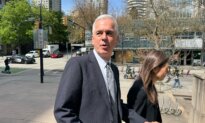
Crown prosecutors allege Majcher, 63, was preparing to use “threat, accusation, menace or violence” to target B.C.-based real estate mogul Hongwei “Kevin” Sun, “at the direction of, for the benefit of or in association with the People’s Republic of China,” according to court documents.
Sun is allegedly wanted in China for financial crimes “ranging into the hundreds of millions of dollars.”
Majcher was arrested at Vancouver International Airport on July 18, 2023, and is charged with one count of committing “preparatory acts” to commit an offence under Canada’s Security of Information Act. He pleaded not guilty on the trial’s opening day, April 20, in proceedings expected to last two weeks in the B.C. Supreme Court.
Majcher had worked in international policing and financial crime investigations with the RCMP until he retired in 2007. In 2016, he founded EMIDR (Evaluate, Monitor, Investigate, Deter, Recover), a Hong Kong-based corporate risk and asset recovery firm.
Majcher appeared in a 2019 episode of the Australian Broadcasting Corporation’s “Four Corners” series where he described himself as a “hired gun.”
“As long as the claim is valid and as long as we’re doing everything lawfully and properly, I’m a hired gun to help either large corporates or governments to get back what is rightfully theirs,” he said in the episode, which aired on Feb. 18, 2019.
The Crown’s case relies in part on an email Majcher allegedly sent to an associate in June 2017, as well as remarks he made in a 2015 speech to the Foreign Correspondents’ Club of Hong Kong, in which he allegedly said he had been approached by “someone close to senior state security.”
In the email, Majcher allegedly wrote that he had “signed legal agreements” with “entities associated to the Chinese Ministry of Public Security and Bureau of Public Security to assist on recovery of proceeds of crime that have fled overseas.”
The email also refers to a “fraudster,” which the prosecution alleges refers to Sun, saying they are a “major real estate mogul in Vancouver and we have located over $100M of assets.” It talks about a global arrest warrant issued by Chinese police and says, “I hope to have a copy of the warrant before it is issued so we can impress upon the crook that we hold the keys to his future.”
“I am meeting an associate of the target tomorrow in HK to see if he can help negotiate a settlement as the Chinese want to use this as a precedent case to settle economic crimes quietly and expeditiously,” it continues.
Majcher’s trial was set to take place before a jury, but a late decision was made to hold it by judge alone, which allowed the release of pre-trial decisions that were previously covered by a publication ban.
The judge hearing the case, Justice Martha Devlin, found the investigation prior to Majcher’s arrest had not collected enough credible and compelling information for prosecutors to “objectively believe in the probability, rather than simply the possibility, that Mr. Majcher had conspired to commit offences” under the Security of Information Act.
She also found that his arrest in 2023 was unlawful and violated his Charter right not to be arbitrarily detained, according to court documents. However, these findings will not stop the case from proceeding.
The trial is being closely watched as one of Canada’s most high-profile foreign interference cases involving China, amid growing concern in recent years about Beijing’s activities in Canada.
Parliamentary briefing materials from Public Safety Canada have confirmed RCMP investigations into alleged illegal activity linked to overseas police stations associated with China, including concerns they could pressure people in Canada to comply with Chinese authorities.
Global Affairs Canada has attributed multiple coordinated online influence campaigns—known as “Spamouflage”—to China-linked actors. Federal assessments conclude these campaigns have targeted individuals in Canada, including Chinese-language commentators and their families, using coordinated posts, impersonation accounts, doxxing, and AI-generated content.
Officials say the activity appears aimed at harassing and discrediting critics of Beijing while amplifying misleading narratives, prompting diplomatic engagement with Chinese officials and raising concerns about Canada’s information security environment.
Tsui’s Testimony
Sun is alleged to have committed financial fraud against the Industrial and Commercial Bank of China, yielding hundreds of millions of dollars, and then investing those proceeds in the Vancouver real estate market, the court document shows.
Prosecutors are expected to present documents showing that Sun was a Canadian permanent resident at the time of the alleged offence. China’s Ministry of Public Security had wanted to issue Sun a new Chinese passport facilitating his return to China, according to the court document. Canada does not have an extradition treaty with China.
Tsui testified that he first learned of Sun in 2016, after Chinese authorities flagged a “historical fraud” case originating in the late 1990s or early 2000s, in which someone had allegedly swindled the Industrial Commercial Bank of China out of RMB$2.8 billion (C$560 million).
Chinese authorities estimated that approximately $120 million had been moved out of China, and believed Sun was responsible, placing him in the Vancouver area, Tsui said.
While Chinese authorities initially requested that the RCMP arrest Sun, Tsui noted that they failed to supply enough information for the RCMP to act on that request.
Chinese authorities then sought to question Sun directly, leading to a request for Vancouver-based RCMP to locate him, but Sun declined to participate in any meeting, Tsui said.
The RCMP subsequently informed Chinese authorities that they would be stepping back from the case in February or March 2017, with the file formally closed a year later, according to Tsui.
The Canadian Press contributed to this report.
 Friends Read Free
Copy
Facebook
Tweet
Friends Read Free
Copy
Facebook
Tweet