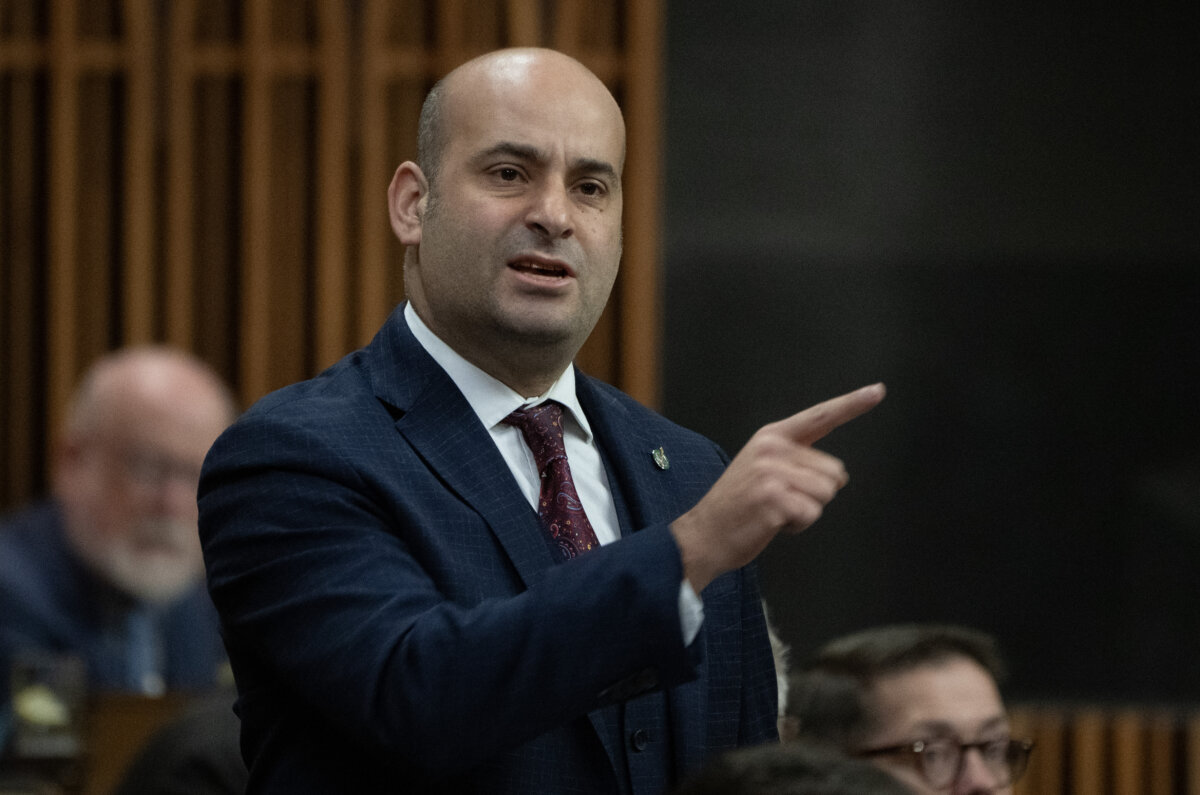

The Conservatives’ public safety critic pressed the minister of public safety to allow parliamentarians to review an agreement with Beijing on law enforcement cooperation and intelligence sharing, saying the issue requires further scrutiny.
The demand, made at a parliamentary committee meeting on March 24, was a follow-up from an initial letter Tory MP Frank Caputo wrote to Public Safety Minister Gary Anandasangaree in early February, requesting the agreement be shared with the public or be reviewed by MPs.
“Prime Minister Carney called China our greatest security threat during the last election. Yet, he signed a memorandum of understanding with respect to matters of intelligence,” Caputo said.
“Canadians have not seen it. I asked for it roughly a month and a half ago. Where is it?”
Anandasangaree responded that it is “imperative for Canada to ensure that we meet countries where they’re at, not where we want them to be,” and noted that he has addressed the issue raised by Caputo “on a number of occasions.”
Caputo repeatedly asked that parliamentarians be allowed to see the memorandum of understanding (MOU).
The public safety minister said he would ask RCMP Commissioner Michael Duheme, who was also at the committee meeting, to answer Caputo’s question, noting that the agreement involves the federal police force.
Caputo said, “If I’m not going to get an answer from you, the top person in this portfolio … and that’s no disrespect to the commissioner of the RCMP, if you don’t know the answer, where an MOU is or when we might get it, I’ve got an issue with that and I think Canadians will as well.”
Ottawa and Beijing signed the MOU on cooperation in combating crimes between the RCMP and China’s Ministry of Public Security during Prime Minister Mark Carney’s visit to China in January.
While other MOUs signed during the trip have been made public, the government has so far kept the agreement involving law enforcement and intelligence sharing confidential.
Caputo’s initial letter to Anandasangaree on Feb. 9 asked whether the MOU would be made public, and noted that agreements with Beijing, especially on matters related to public safety, should be subject to adequate oversight and parliamentary scrutiny.
“Allowing Parliamentarians to review the provisions outlined in the MOU is this government’s and your personal duty to Canadians just as it is central to my responsibility as the Shadow Minister for Public Safety,” Caputo wrote in the letter.
He vowed on Feb. 22 to keep asking the federal government to release the agreement until it does so.
The Prime Minister’s Office said in January when announcing the government’s new agreements with Beijing that Canada and China would pursue “pragmatic and constructive engagement in public safety and security.”
A spokesperson for the RCMP told The Epoch Times that the MOU is not a public document and it demonstrates a “renewed commitment to cooperation between our two agencies to address a number of shared concerns, notably criminal activities in the fentanyl trade.”
MOU Concerns
Conservative MP and democratic reform critic Michael Cooper voiced concern about the agreement during a parliamentary committee meeting on Feb. 6, saying China has engaged in transnational repression targeting Chinese diaspora communities in Canada, has “shown no respect for Canada’s sovereignty,” and has threatened the safety and security of Canadians.
Ottawa’s agreement with Beijing on police cooperation has been a source of concern for not only Conservatives, but also China experts and democracy activists.
China scholar and former diplomat Charles Burton told MPs at a committee meeting on Feb. 26 that the agreement between the RCMP and China’s Ministry of Public Security is one of the most worrying agreements Ottawa made with Beijing.
He said Canada gains “almost nothing” from the agreement, noting that sharing Canada’s “best practices” for law enforcement with China gives Beijing “the very information they need to understand the RCMP techniques and exploit our vulnerabilities in countering foreign subversion from China.”
Ten Hong Kong democracy activist groups have also expressed concern about the deal, saying the government’s lack of transparency about it has intensified fears among the Hong Kong diaspora.
“These concerns are rooted in lived experience,” the groups said in a Feb. 12 joint statement. “Hong Kongers living overseas have faced surveillance, harassment, intimidation, and pressure directed at themselves and their families by Chinese authorities.”
Former national RCMP director Garry Clement has also spoken out about the agreement, telling MPs earlier this month that the deal involves the same Chinese ministry that was involved in operating illegal police stations across Canada.
“Law enforcement in China is part of the PRC [People’s Republic of China] apparatus,” Clement said. “You can’t separate them from the government, and they do not operate under the rule of law. I experienced it firsthand.”
 Friends Read Free
Copy
Facebook
Tweet
Friends Read Free
Copy
Facebook
Tweet