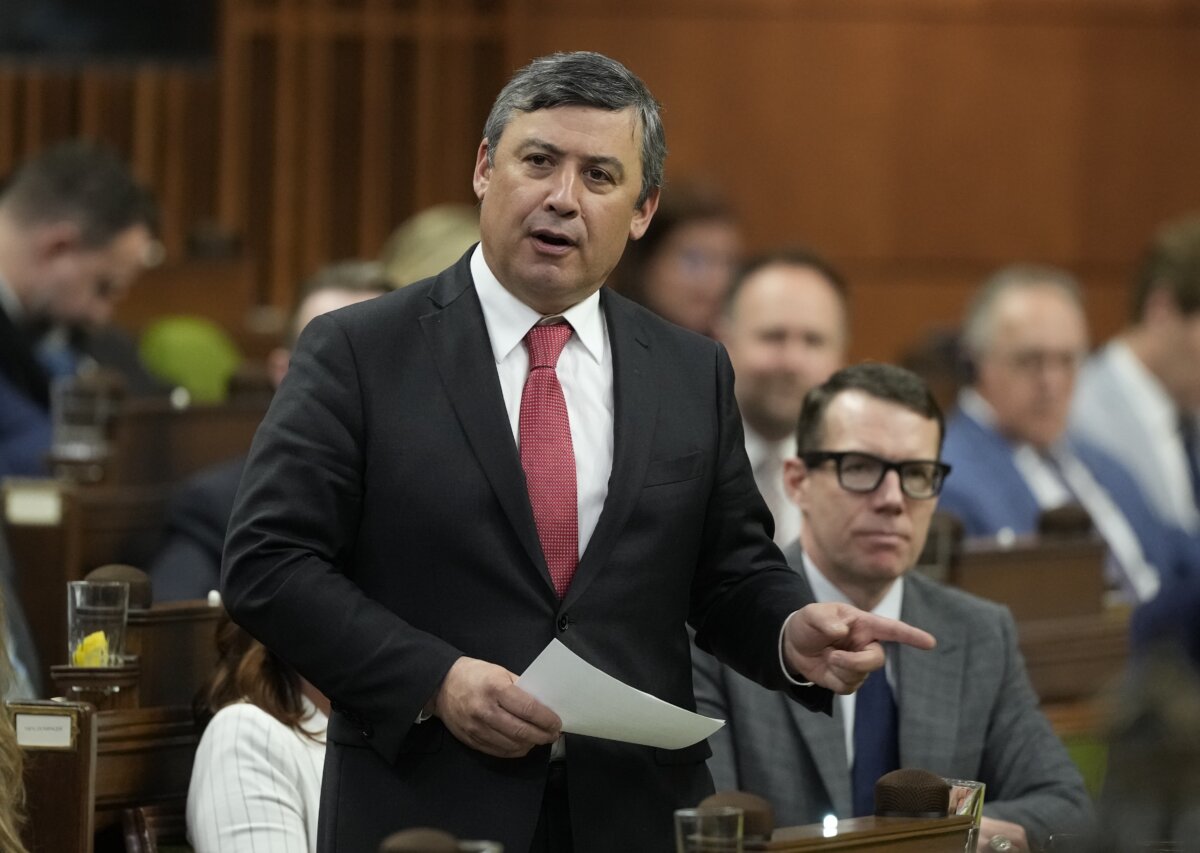

Conservative MP and foreign affairs critic Michael Chong met with Taiwanese President Lai Ching-te on May 20 to discuss Canada-Taiwan relations and the need for Canadian MPs to continue to visit Taiwan to foster bilateral relations.
According to a readout of the meeting, Chong and Lai also discussed Taiwan’s “importance as a democracy at the front lines of threats from an authoritarian state,” peace and security in the Indo-Pacific region, support for Taiwan’s “meaningful” participation in international fora, as well as trade and investment.
Lai commented on the meeting on social media, saying he was glad to meet with the Tory MP, who is also the vice-chair of the House of Commons foreign affairs and international development committee.
“We deeply value the House of Commons’ support for Taiwan’s international participation & look forward to even closer Taiwan-Canada ties,” Lai said in a May 20 post on X.
Chong also met with Taiwan’s Minister of Mainland Affairs Council, Chiu Chui-cheng. They discussed peace and security in the Taiwan Strait, relations between China and Taiwan, the opportunity for further Canada-Taiwan exchanges, and Taiwan’s right to engage with the global community, says a readout of the meeting.
Chong also met with Taiwanese Trade Representative Jen-Ni Yang and Foreign Affairs Minister Chen Ming-chi on May 18 and discussed Canada–Taiwan economic ties and diplomatic relations.
Chong’s meetings with Taiwanese officials come after the Chinese ambassador to Canada, Wang Di, warned Canada against sending parliamentarians to Taiwan.
Wang said in an interview with The Globe and Mail in late April that it would be “hurtful” to Canada-China ties if Canadian parliamentarians conduct “any official engagement” with Taiwan. He also said sending navy ships through the Taiwan Strait is “harassment, and even provocation.”
The Chinese Communist Party (CCP) views self-ruled Taiwan as a breakaway province, despite never having governed the island nation, and seeks to place it under Beijing’s rule. Meanwhile, Taiwan is pushing back against Beijing’s international pressure campaign to sideline the island.
Canadian navy ships have travelled through the Taiwan Strait roughly a dozen times in the last decade, often accompanying U.S. Navy vessels, which China has criticized. Taiwan has said it affirms the strait as international waters and supports freedom of navigation.
Countries that want diplomatic relations with Beijing can’t recognize Taiwan as a sovereign entity. Canada has a “One China policy” that does not recognize Taiwan as a state, but maintains economic and cultural ties.
Foreign Affairs Minister Anita Anand was asked by reporters on May 20 whether she supports Chong’s decision to visit Taiwan, and whether China should be dictating who Canadian politicians engage with, and where they visit.
Anand said Canada has a long history of parliamentary delegations visiting Taiwan and has strong people-to-people and commercial ties with Taiwan, but noted Canada’s One China policy.
“At the same time, our foreign policy does operate within the framework of the One China policy, which has been maintained by successive governments of Canada since 1970,” she added. “So there is a need, really, to understand both of those important threads.”
‘Assert Canadian Sovereignty’
Chong’s visit to Taiwan began on May 18 and is expected to wrap up on May 21. Ahead of the trip, he said his visit served two purposes: to “show solidarity with a democracy at the front lines of intimidation” by the CCP, and to “assert Canadian sovereignty” despite the Chinese ambassador’s warning.
“Canada is a sovereign and independent country,” Chong said in a May 17 statement. “We do not take direction from a foreign government about where Canadian MPs can travel internationally, and where Royal Canadian Navy warships can transit in international waters.”
After Chong’s arrival in Taiwan, the communist regime repeated its warning about Canadian engagement with Taiwan. A spokesperson for China’s embassy in Canada said it opposes any countries having formal diplomatic relations with Taiwan.
The Chinese ambassador’s remarks were criticized by MPs across party lines. Deputy Tory Leader Melissa Lantsman said Canada does not take instruction from foreign ambassadors and that Prime Minister Mark Carney “should make that clear.”
Liberal MP Judy Sgro, who is chair of the Canada-Taiwan Friendship Group in Parliament, said the relationship between Canada and Taiwan is “priceless” and protecting Canada’s diplomatic sovereignty “means standing by our partners and refusing to allow external pressure to dictate our international engagement.”
Reacting to the Chinese ambassador’s warning against Canadian parliamentarians engaging with Taiwan, Bloc Québécois Leader Yves-François Blanchet criticized Carney, saying he showed “imprudence” by getting closer to the Chinese regime, while “ignoring human rights considerations and the values of freedom and democracy.”
“This naivety is catching up with him: China believes it is entitled to intimidate Canada’s elected officials,” Blanchet said on social media on May 2.
Canada-Taiwan relations have received renewed attention in recent months as Prime Minister Mark Carney’s government has sought closer ties with Beijing.
Taiwan’s ambassador to Canada, Harry Tseng, said in February that Taiwan was left with the impression that Canada is seeking to improve its relations with China at the expense of its relationship with Taiwan by delaying the signing of a trade cooperation agreement.
Tseng told CBC’s Radio-Canada the agreement between Ottawa and Taipei has been ready to be finalized since April 2025.
Carney said in February that Canada has trade relations with Taiwan and isn’t “afraid” of having relations with the island nation, but is “focusing on strengthening our trade relations with China.”
Noé Chartier and Paul Rowan Brian contributed to this report.
 Friends Read Free
Copy
Facebook
Tweet
Friends Read Free
Copy
Facebook
Tweet