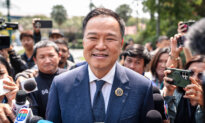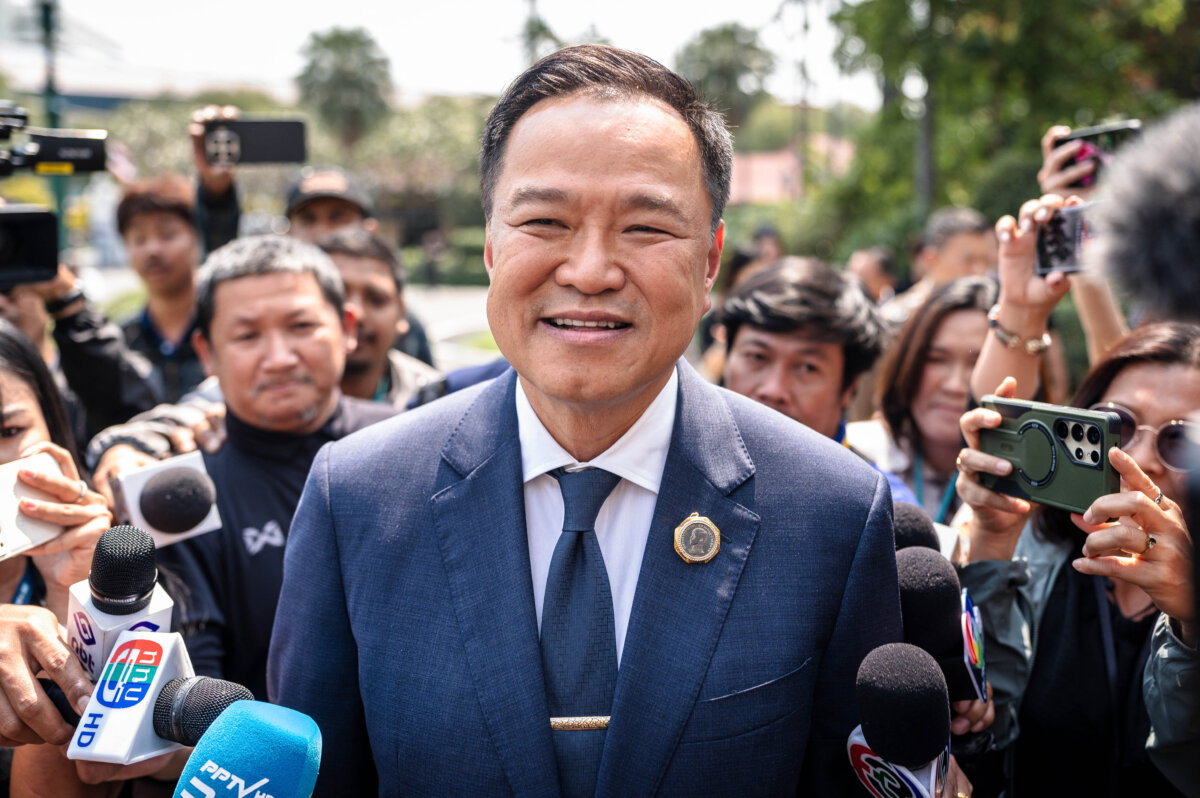
Thailand’s caretaker prime minister, Anutin Charnvirakul, recorded a strong performance in the country’s election on Feb. 8 and is on course to form a ruling coalition with his conservative Bhumjaithai Party.
According to unofficial results released by the state-run Election Commission, after 94 percent of polling stations had reported on Feb. 9, Bhumjaithai, which translates to Proud Thais Party, won about 193 seats in the 500-member House of Representatives.
The center-left People’s Party was second with 117 seats, and the Pheu Thai Party gained only 74.
Anutin, 59, called the election in December 2025 after less than 100 days in office and described the result as “a victory for all Thais.”
Anutin told reporters on Feb. 8 that he could not comment on the formation of a coalition and said each party would need to hold internal discussions on the way forward.
The People’s Party has ruled out joining a coalition led by Anutin, but its leader, Natthaphong Ruengpanyawut, said on Feb. 8 that it would not seek to form its own coalition government.
About 400 seats in the House are directly elected from constituencies, and 100 others are chosen from “party list” nominees, based on a separate proportional representation ballot.
Voter Turnout Down
Voter turnout, at about 65 percent, was much lower than in the 2023 election, in which Bhumjaithai came third.
Move Forward, a center-left party that won the most seats in the 2023 election, was later banned by Thailand’s Constitutional Court.
It had proposed reforming Thailand’s lèse-majesté law, which forbids insulting the country’s monarchy, but was accused of violating the constitution.
The leader of the center-left Pheu Thai Party, Paetongtarn Shinawatra, then became prime minister, but she was permanently removed on Aug. 29, 2025, when the Constitutional Court ruled that she violated ethics rules in a leaked phone call with former Cambodian leader Hun Sen.
Anutin became caretaker prime minister in September and was in charge in December when Thai troops exchanged fire with Cambodian soldiers across their disputed border.
Thailand and Cambodia have long disputed their shared border. Much of the tension stems from a map drawn in 1907, when Cambodia was under French colonial rule. Sitting on the border is the contested 11th-century Preah Vihear Temple complex, which both sides claim as part of their cultural heritage.
Sporadic clashes over the decades have caused casualties among both soldiers and civilians. In May 2025, a Cambodian soldier was killed in a border skirmish. Then in July, five days of intense fighting left dozens of troops and civilians dead and displaced thousands of residents on both sides of the frontier.
Anutin has previously said that if he were reelected, he would retain the incumbent ministers of finance, foreign affairs, and commerce in a new Cabinet.
At the Bhumjaithai Party’s final rally before the election, Finance Minister Ekniti Nitithanprapas, a former World Bank official, said, “I confirm, as the head of the economic team, that the Bhumjaithai Party will not engage in populism because when populism is implemented it leads to creating debts for future generations, leaving them burdened with liabilities.”
“Therefore, we must use money effectively within the framework of fiscal discipline,” Ekniti said, according to Thai news outlet The Nation.
Voters in the Feb. 8 election also supported a proposal to change the constitution, amending a charter established by the military after a 2014 coup, which critics say gives too much power to the senate, which is not directly elected by the people.
Correction: A previous version of this article misspelled the name of People’s Party leader Natthaphong Ruengpanyawut. The Epoch Times regrets the error.
 Friends Read Free
Copy
Facebook
Tweet
Friends Read Free
Copy
Facebook
Tweet