
Ottawa likely failed to secure a trade deal extension after Aug. 1 as Mexico did, because of its negotiation style and the retaliatory tariffs it placed on the United States, the U.S. ambassador to Canada says.
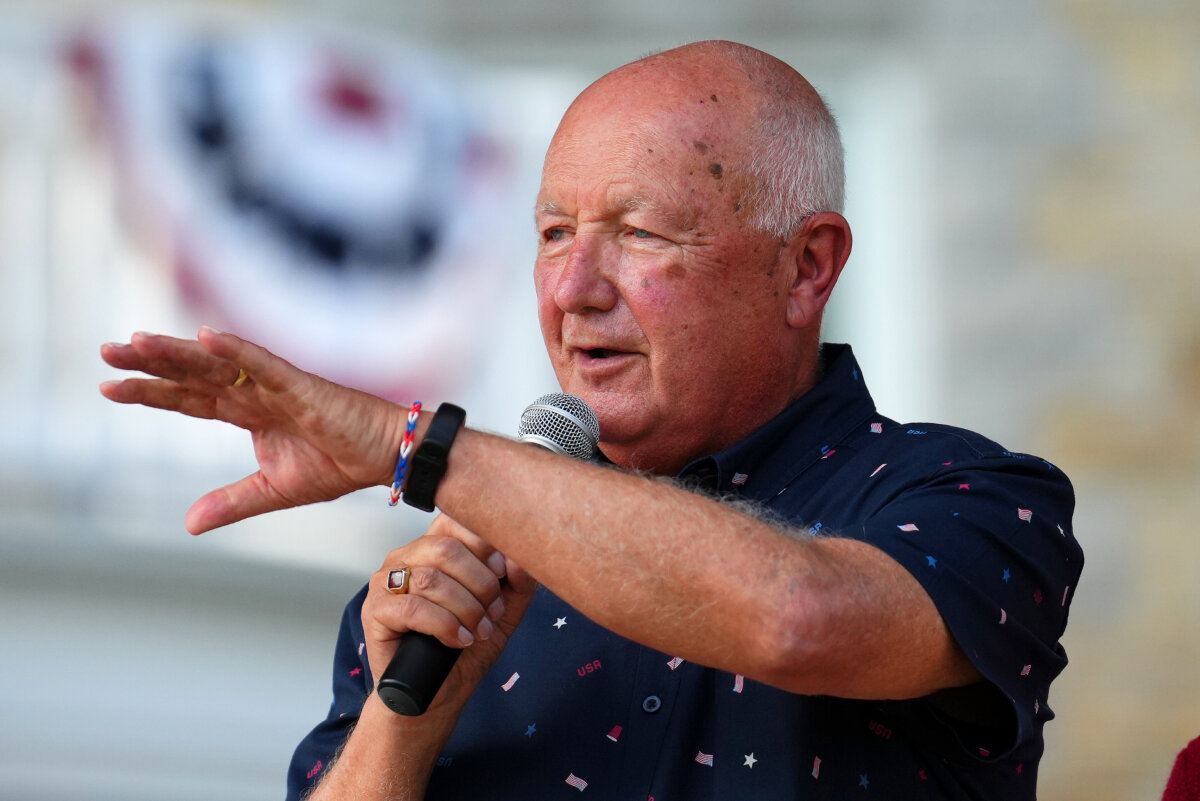
Pete Hoekstra made the comments in an Aug. 5 interview on CBC’s “Power & Politics,” where he was asked why Mexico was given an extension to continue negotiations on trade and tariffs while Canada was not.
“I think it’s because of the feeling in the room, or the energy in the room when the negotiators are talking to each other,” the U.S. Ambassador to Canada replied. “So the decision was made by our team… to give Mexico an extension [and] put the 35 percent tariff on Canada.”
Hoekstra added that due to the bulk of Canada-U.S. trade still being exempt from tariffs under the U.S.-Canada-Mexico Agreement (USMCA), “Canada really didn’t get hit very hard.”
He also said that Mexico not placing counter-tariffs on the United States contributed to the country getting a 90-day extension, whereas Canada’s retaliatory tariffs and negative comments from “certain” Canadian politicians about the United States likely contributed to Canada not getting a grace period.
“Those are decisions that Canadians have made, and as a sovereign country that’s how you have decided to engage and negotiate,” he said.
Mexico received a 90-day suspension of increased tariffs before the Aug. 1 deadline set by U.S. President Donald Trump. Trump said his understanding of Mexican President Claudia Sheinbaum is growing and he had a “very successful” call with her prior to his decision.
Mexico currently faces a 50 percent tariff on aluminum, copper, and steel as well as a 25 percent tariff on automobiles, but avoided having its blanket rate raised. The country’s 25 percent rate had been set to rise to 30 percent on Aug. 1, the deadline the U.S. put in place to strike deals with other countries.
Sheinbaum said July 31 on social media that the United States and Mexico will work “to build a long-term agreement through dialogue” during the 90-day reprieve.
Trump hiked tariffs on Canada from 25 percent to 35 percent at the beginning of the month, exempting goods under the USMCA, although sectoral tariffs of 50 percent still apply to Canadian aluminum, steel and copper, along with 25 percent on auto parts.
Canada put in place a 25 percent retaliatory tariff on U.S.-manufactured vehicles in April, which impacts all non-USMCA-compliant vehicles and car parts imported out of the United States. This was in addition to 25 percent tariffs put on $30 billion of U.S. imports in March, which Trump cited as a justification for increasing tariffs on Canadian products to 35 percent. He also said Canada has not done enough to stem the flow of fentanyl across the Canada-U.S. border.
Canada also has tariff rate quotas (TRQs) on various U.S. exports including eggs, dairy, and poultry, which are allowed as a carve-out to protect Canadian supply-managed sectors such as the dairy industry. This has been another point of contention for Trump who says Canada unfairly subsidizes its dairy industry, undercutting U.S. producers.
Hoekstra noted only Canada and China have chosen to implement retaliatory tariffs.
“So taking a look at the pattern of the agreements that we have today, I find it hard to believe that Canada with retaliatory tariffs—that those will stay in place,” Hoekstra said, but added that counter-tariffs aren’t the most serious issue preventing a trade deal between the two countries.
“There are a lot more serious issues than those retaliatory tariffs,” Hoekstra said. “We’ve got aluminum, steel, copper, auto parts and those types of things that are going to have a much larger impact moving forward than those retaliatory tariffs.”
Hoekstra was also asked if he understands why Canadians are angry over the trade and tariff disputes with the United States. He said that while Ottawa has been “very effective at selling the strategy of ‘elbows up,'” he added that “if Canadians want to make this more of a personal anti-American perspective that is their business.”
Regarding the future relationship with Canada, Hoekstra said both countries “thrive off each other” and “neither wants a weakened neighbour,” but added that tariffs are likely here to stay as part of new U.S. policy and “there will be tariffs for every single country.”
Canada’s exports to the U.S. went up by 3.1 percent this June despite tariffs, largely driven by greater energy exports compared to May, according to Statistics Canada. Despite the increase, the exports were still 12.5 percent lower than June of 2024.
Prime Minister Mark Carney has said he is “disappointed” by the U.S. decision to raise tariffs on Canada but added that his government is committed to the USMCA, which he described as the “world’s second-largest free trade agreement by trading volume.”
 Friends Read Free
Copy
Facebook
Tweet
Friends Read Free
Copy
Facebook
Tweet