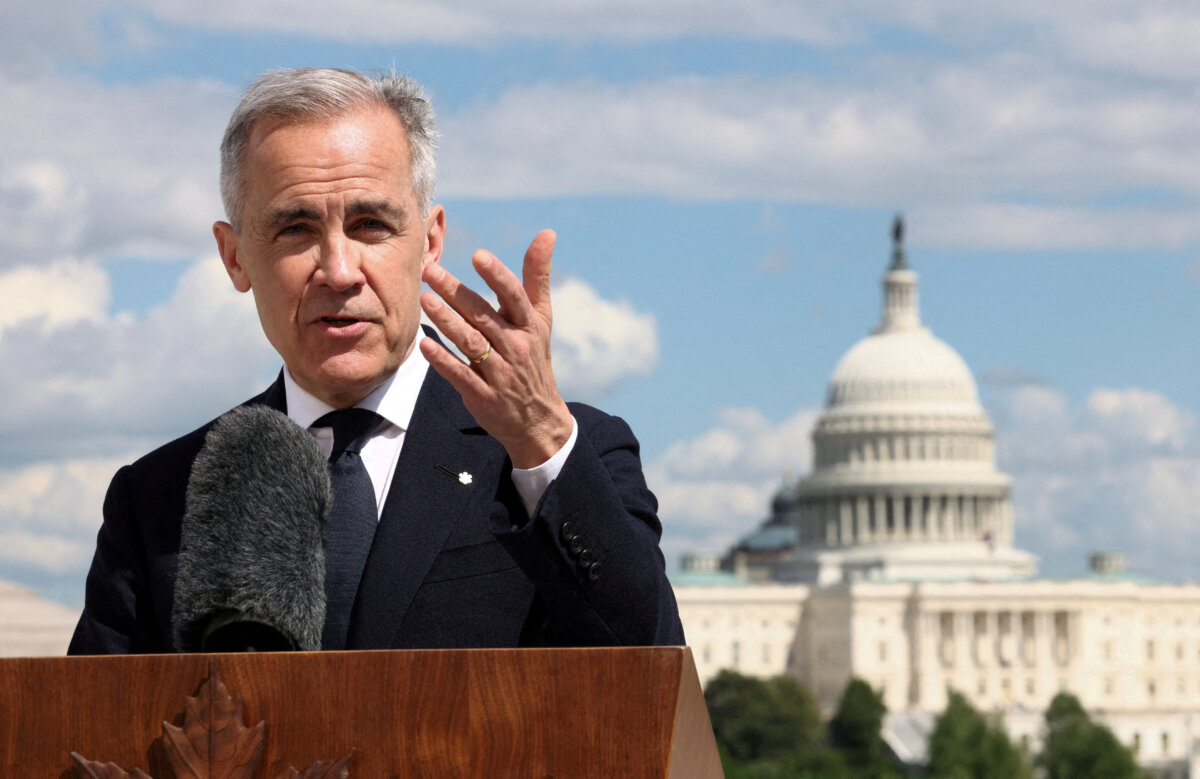

Prime Minister Mark Carney says he is “disappointed” by the U.S. decision to raise tariffs on Canada, but that Canada retains one of the lowest average tariff rates globally due to many products being exempt under the United States-Mexico-Canada Trade Agreement (USMCA).
“While the Canadian government is disappointed by this action, we remain committed to CUSMA [USMCA], which is the world’s second-largest free trade agreement by trading volume,” Carney said in a July 31 press release.
The United States raised tariffs on Canada from 25 percent to 35 percent beginning on Aug. 1, citing the issue of illicit drugs like fentanyl flowing over the border, and Ottawa having “failed to cooperate” to curb it. Washington also cited Canada’s retaliatory measures as justification for the increase.
Carney said in the statement that the “U.S. average tariff rate” on Canadian goods remains “one of the lowest for all its trading partners” due to the trade agreement signed during U.S. President Donald Trump’s first term. The Bank of Canada said this week that up to 95 percent of Canadian exports could qualify for exemptions under USMCA.
However, Carney said sectors like lumber, steel, aluminum, and automobiles are “heavily impacted” by tariffs. The United States has also levied 50 percent tariffs on steel and aluminum, 25 percent tariffs on automobiles and auto parts, and 10 percent tariffs on oil and potash.
“For such sectors, the Canadian government will act to protect Canadian jobs, invest in our industrial competitiveness, buy Canadian, and diversify our export markets,” Carney said.
The prime minister said when it comes to fentanyl, Canada accounts for just 1 percent of imports of the drug into the United States, and has been “working intensively to further reduce these volumes.” Carney highlighted that Ottawa has taken steps to improve border security and reduce illegal drug exports in recent months, such as investing $1.4 billion in border security.
“We will continue working with the United States to stop the scourge of fentanyl and save lives in both our countries,” he said.
Washington said in its July 31 tariff announcement that Mexican cartels are increasingly synthesizing fentanyl in Canada, that “super labs” are operating in western Canada, and fentanyl seizures at the northern border have “surpassed total seizures of the past three years combined.”
Carney said although Ottawa will continue to negotiate on trade with the United States, “the Canadian government is laser focused on what we can control: building Canada strong.” He cited recent initiatives such as major projects legislation and reducing interprovincial trade barriers, which he said could bring $500 billion in new investments into Canada.
The Senate recently passed Bill C-5, which allows projects to bypass provisions of certain laws, and aims to reduce the approval times for major projects to two years, while also reducing interprovincial trade barriers.
“We can give ourselves more than any foreign government can ever take away by building with Canadian workers and by using Canadian resources to benefit all Canadians,” Carney said.
 Friends Read Free
Copy
Facebook
Tweet
Friends Read Free
Copy
Facebook
Tweet