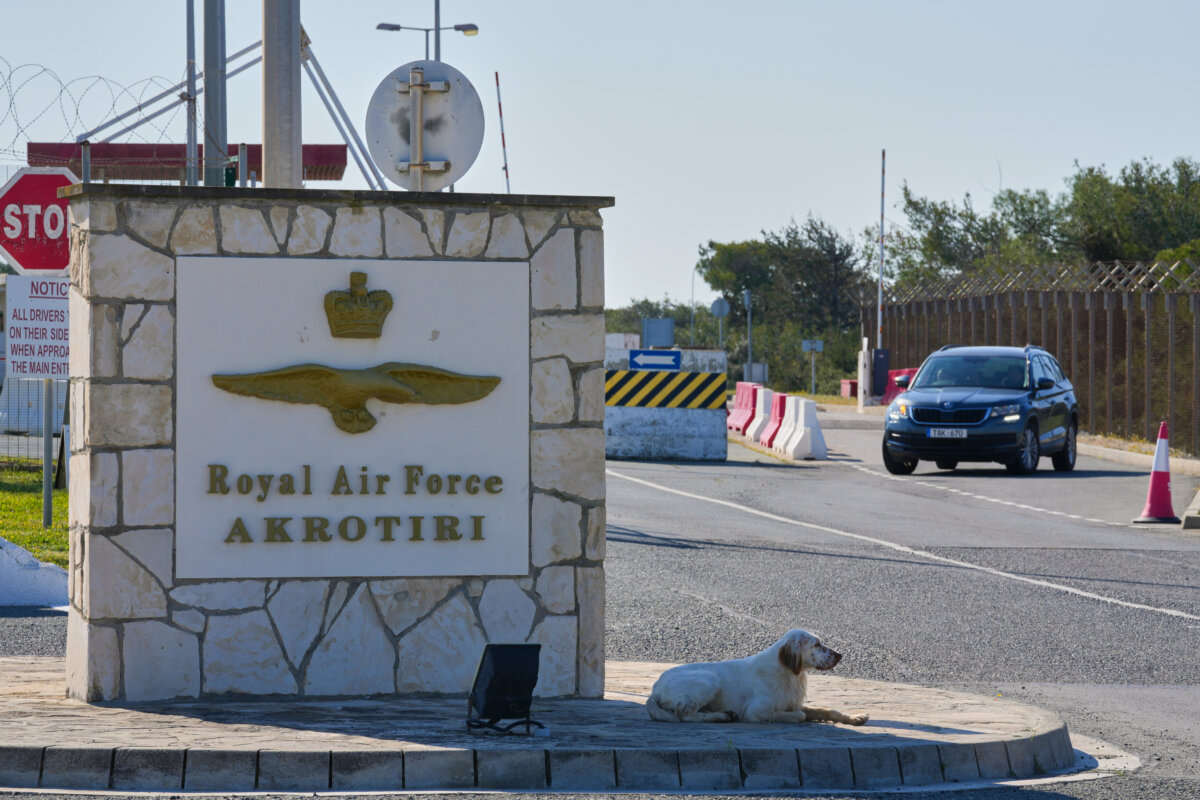

Cypriot High Commissioner to the UK Kyriacos Kouros said on March 4 that Cypriots are disappointed with the UK government’s response following a drone strike on a British military base on the island.
Speaking to the BBC, when asked whether Cyprus felt adequately protected by the UK, Kouros said, “Let’s say that the people are disappointed, the people are scared, the people could expect more.”
A drone struck the UK’s RAF Akrotiri base on the Mediterranean island on March 2 amid escalating tensions linked to the conflict involving Iran.
“The British people have to understand that the British bases in Cyprus cannot be seen separated from the whole of the island,” Kouros told Sky News on March 4. “There are Cypriots living in the British bases.”
On March 4, UK Secretary of State for Defense John Healey said in a March 5 post on X that the “longstanding friendship between the UK and the Republic of Cyprus is strong in the face of Iranian threats.”
He said that he had discussed with Cypriot Defense Minister Vasilis Palmas how the UK is further reinforcing air defenses to support shared security with Cyprus.
The UK’s Ministry of Defence stated in a March 4 post on X that the drone was “not launched from Iran.”
“Overnight, RAF Typhoon and F-35B jets continued defensive air operations across the Middle East with support from Voyager air-to-air refuelling in defence of British interests and allies,” the ministry stated.
“The Ministry of Defence can confirm that a Shahed-like drone which targeted RAF Akrotiri at midnight on 2nd March was not launched from Iran.”
It also stated, “Royal Navy Wildcat helicopters—armed with Martlet missiles capable of taking out aerial threats—will arrive in Cyprus in the coming days.”
UK Prime Minister Keir Starmer said on March 3 that he was deploying HMS Dragon, an air defense destroyer, to Cyprus.
Spain, Italy, and France are deploying military assets to Cyprus and the eastern Mediterranean as European countries move in, in an attempt to bolster security following Iranian drone attacks in the region.
On March 5, Italy said it is planning to send air defense aid to Gulf countries and naval assets to Cyprus after Iranian air strikes, Italian Prime Minister Giorgia Meloni’s government said on March 5.
In an address to the lower house of Parliament, Italian Defense Minister Guido Crosetto said Italy had also lifted its national air defenses to the highest level.
“When faced with a reckless reaction, we can expect anything and everything,” he said, referring to Iran’s retaliatory strikes this week.
He also said that Rome would send vessels to protect Cyprus along with some European allies.
Madrid has announced that it will send its most advanced frigate to the Mediterranean island.
In a March 5 statement, Spain’s Ministry of Defense announced that it would send the frigate Cristóbal Colón to Cyprus in the company of the French aircraft carrier Charles de Gaulle and other ships of the Greek navy.
It said it would head to the Mediterranean to reach the coast of Crete by March 10.
“With the deployment of the ‘Cristóbal Colón,’ Spain shows its commitment to the defense of the European Union and its eastern border,” it said.
On March 4, the U.S. State Department raised its travel advisory for Cyprus to Level 3 and authorized the departure of non-emergency government personnel and their families because of safety concerns.
Reuters contributed to this report.
 Friends Read Free
Copy
Facebook
Tweet
Friends Read Free
Copy
Facebook
Tweet