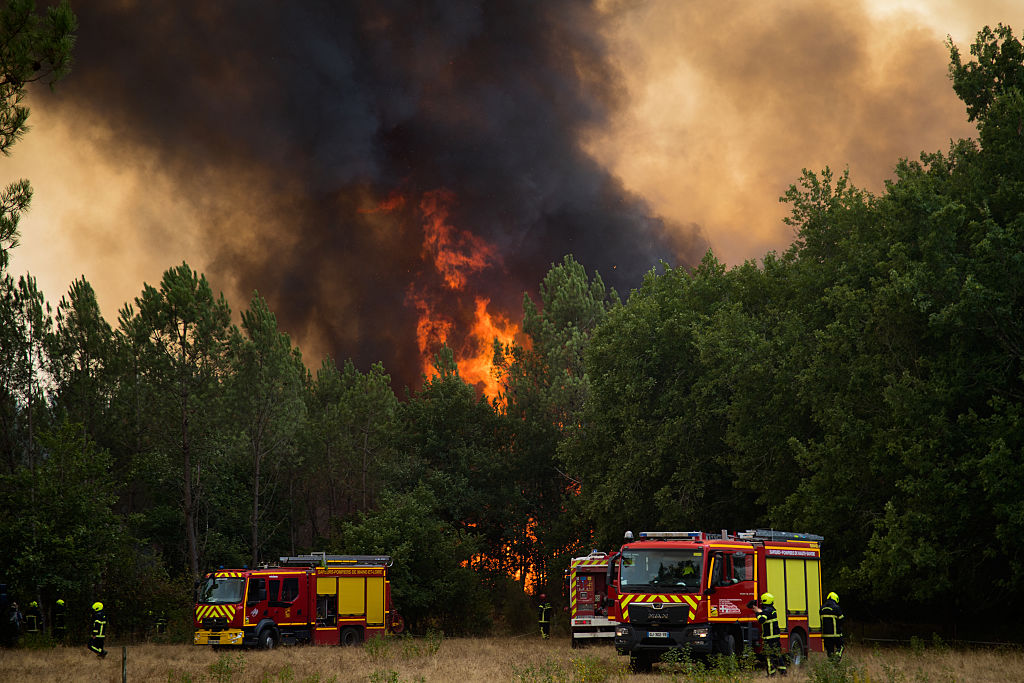

PARIS—France has just lived through its worst fire season in decades. More than 96,000 hectares (237,000 acres) have burned by Aug. 22.
The largest blaze in a generation swept through pine forests southwest of Bordeaux, while in the Mediterranean department of Var, east of Marseille, the Gros Bessillon fire burned for a month before firefighters brought it under control in mid-August.
Amid the devastation, one prevention measure has emerged at the center of a growing political debate: mandatory brush clearing.
The rules require owners of buildings located within 200 meters (650 feet) of woodland to clear vegetation within a 50-meter radius of any structure.
Authorities have championed the measure. According to state officials, lessons drawn from the 2021 Gonfaron fire in the Var showed that homes on properly cleared land emerged largely unscathed.
Yet even as the flames advanced this summer, those obligations were under attack in court.
What began as a technical fire-prevention rule has become a political battleground, with foresters and right-leaning lawmakers criticizing environmental groups for promoting regulations that hamper the prevention work intended to keep fires at bay.
Biodiversity Debate
The exasperation boiled over on Aug. 11.
Meeting with farmers whose land had been devastated by the Gros Bessillon fire, Var Prefect Simon Babre took aim at environmental groups that challenged his Sept. 26, 2025, decree governing mandatory brush clearing.
He asked them to withdraw the lawsuits, arguing that the clearing obligations were already insufficiently enforced.
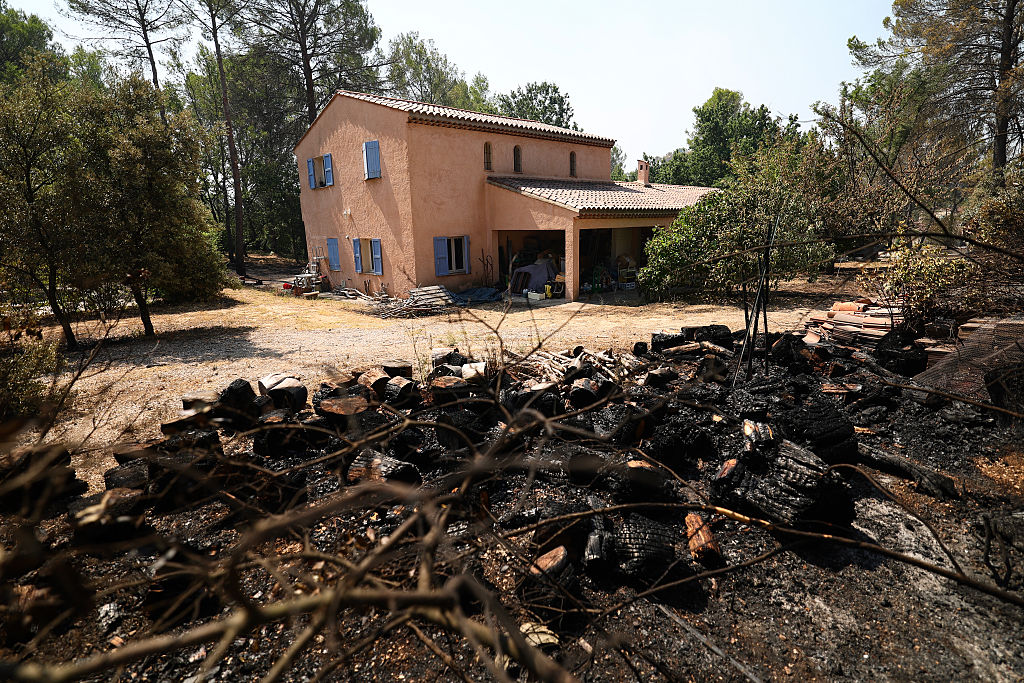 Burnt trees in front of a house spared by the wildfire in Montfort-sur-Argens, southeastern France, on Aug. 1, 2026. (Clement Mahoudeau/AFP via Getty Images)
The bird protection group says its position has been misrepresented.
“We do not contest the usefulness of the legal clearing obligations,” Anael Marchas, a legal officer with the group’s regional branch in the Var, told The Epoch Times.
“What poses a problem for us today is the way these operations are going to be carried out.”
The Var, he noted, is the only department in mainland France outside Corsica where the endangered Hermann’s tortoise still lives.
Heavy mechanical clearing during the breeding season can kill many tortoises on a given plot, he argued.
“There is a need to carry out these clearing operations because public safety is at stake,” he added.
“However, we should not pit wildfire risk management against biodiversity conservation, but rather consider how to reconcile the two without pursuing one at the expense of the other.”
‘Fires Destroy Biodiversity’
The Var prefecture, for its part, is unmoved.
In a comment to The Epoch Times, it said the contested decree emerged from more than a year of consultation involving stakeholders from the forestry and environmental sectors, and rejected any opposition between clearing and conservation.
“The decree seeks to take biodiversity considerations into account as fully as possible when implementing mandatory wildfire-prevention clearing requirements, while ensuring effective fire prevention,” it said.
The bird-protection group has sought to “limit mechanical brush clearing to the period from November to mid-February,” a proposal the prefecture called “unrealistic.”
It noted that the Var has some 3,200 kilometers (2,000 miles) of tracks requiring maintenance, far more than local contractors could clear within a three-and-a-half-month window.
The 2025 decree, it added, already prohibits full mechanical grinding on plots larger than 8,000 square meters between Feb. 15 and Sept. 30 to protect the Hermann’s tortoise.
The prefecture said no clearing operations have been delayed as a result of the litigation.
The lawsuit is only the local front of a broader legal campaign.
At the national level, the League for the Protection of Birds and two allied groups took their challenge all the way to the Council of State, France’s highest administrative court, seeking to overturn a March 29, 2024, ministerial decree that deemed clearing conducted in accordance with prefectural rules not to pose a “sufficiently characterized” risk to protected species.
The court rejected the request for annulment on Feb. 6, but its ruling nevertheless gave the groups a significant legal foothold: It held that this presumption does not eliminate the need for a species-protection waiver when such a risk does in fact exist.
The bird-protection group hailed the decision as confirmation that wildlife-protection rules “cannot be circumvented.”
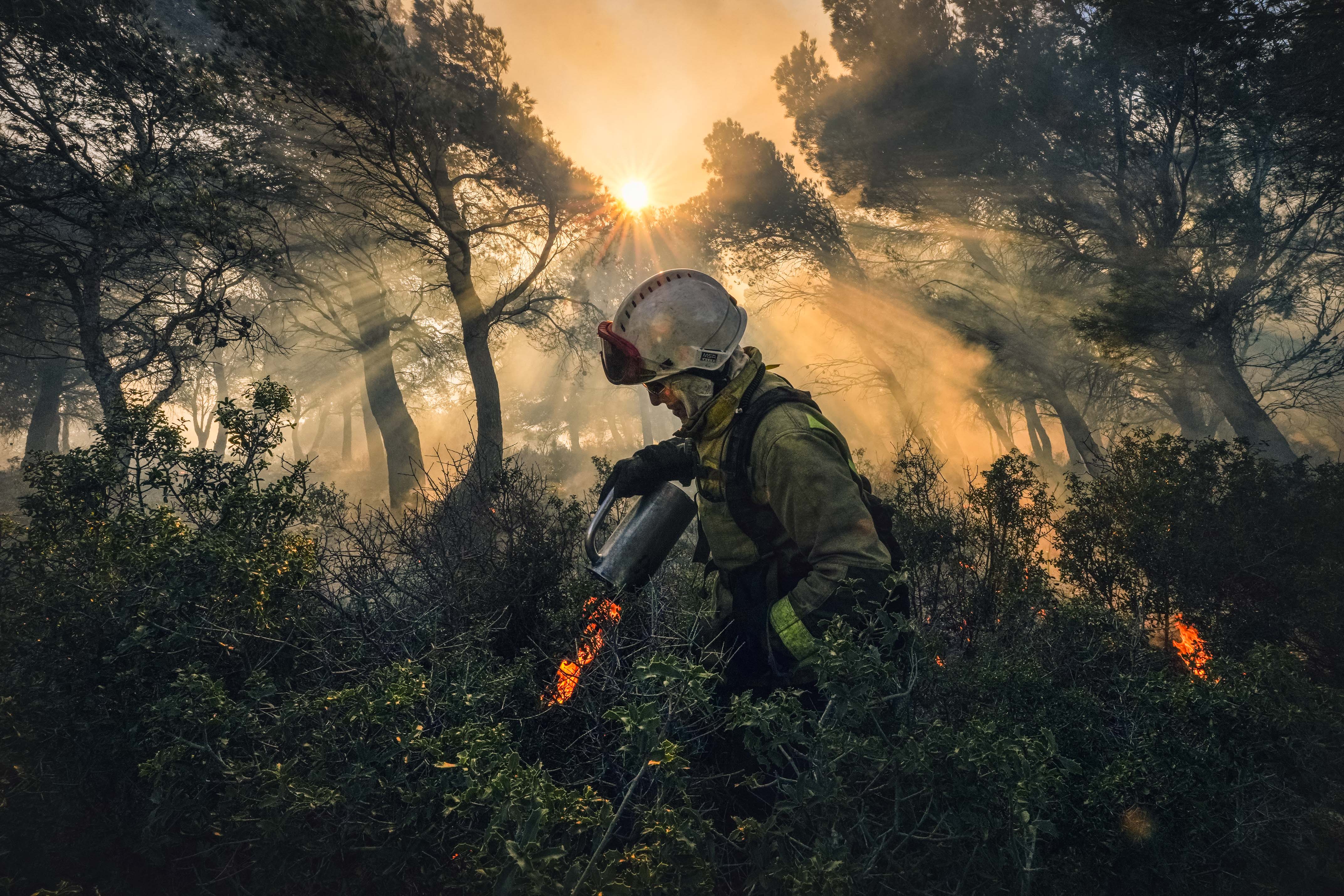 A firefighter lights a controlled burn in a forest in Bages in the Aude department of southwestern France, on Jan. 18, 2025. The burning operation aims to clear a portion of the forest of excess undergrowth and bushes before the summer heat returns to the area. (Idriss Bigou-Gilles/AFP via Getty Images)
‘Protecting People and Property Is Sacred’
Jean Bacci, the French senator who co-authored the 2023 law strengthening the country’s brush-clearing obligations, told The Epoch Times that many environmentalists “have little grasp of reality” and, as a result, end up “making contradictory demands,” calling for brush clearing while “refusing to accept even the minimal environmental disruption necessary to carry it out.”
“In life, you have to make choices,” Bacci said. “We therefore have to accept a minimum level of disruption in order to ensure the greatest possible protection.”
That view was echoed by Nicolas Douzain-Didier, delegate general of France’s National Wood Federation, a timber industry body, who said some environmental NGOs at times put the environment before people.
“We cannot water down measures designed to protect people and accept that our grandmother, our brother, or our cousin be exposed to a deadly risk: protecting people and property is sacred,” he told The Epoch Times.
He noted that France’s forests are home to many of the country’s protected terrestrial species and argued that the greatest threat to them is fire itself.
For Bacci, the main problem lies not so much with environmental NGOs or Green politicians, who, he said, can obstruct brush-clearing operations, but with what he described as “the ideology” prevailing within the administration responsible for environmental protection and the layers of complexity it imposes.
“The authorities have required us to have a dog handler walk ahead of mechanical equipment to spot tortoises that might be in its path,” he said.
“Financially, that is simply unfeasible. A dog handler costs 1,000 euros a day, and to do everything that needs to be done, you would need many of them. In the Var, you effectively have one and a half: one based in the department and another covering both the Var and the Vaucluse. It is unworkable.”
He cited another case in which maintenance work was held up to “avoid disturbing, and I stress disturbing, not killing, around a dozen tortoises with mechanical equipment.”
The area was later ravaged by the 2021 Gonfaron fire, which he said killed more than 100 of the animals.
Douzain-Didier, for his part, pointed to what he described as the “absurdity” of some of the situations landowners and forestry professionals face.
“You may have dangerous or dying trees along a roadside, and no one can tell you anymore what you are supposed to do,” he said.
“If a branch breaks off and kills a passing motorist, you are held responsible. But if you urgently remove those trees to make the road safe, you are told you are not allowed to because it is nesting season and a bat might have passed through the area.”
The Same Question Across Europe
The French controversy echoes across Europe, where this summer’s fires have revived the same question: what is standing in the way of prevention?
In the United Kingdom, gamekeepers and hill farmers have for generations carried out controlled winter burns of old heather and grasses to prevent combustible vegetation from building up on the moors.
The practice has come under criticism from environmentalists, who argue that it can damage peatlands that store carbon and provide habitat for insects and several bird species.
Last year, the Labour government’s environment department and Natural England, its conservation agency, banned the practice across more than 1.6 million acres to protect carbon-storing peat, a decision Richard Bailey, a veteran Peak District gamekeeper, told lawmakers in June is turning the uplands into a tinderbox: “It is only a matter of time before somebody gets killed.”
In Spain, where more than 262,000 hectares (647,000 acres) had burned by Aug. 20, claims that environmental legislation prevented landowners from clearing brush spread so widely on social media that the government issued an official rebuttal, insisting that neither national forestry law nor European rules prohibit such work.
Conservative politicians from the Popular Party and Vox have nevertheless argued that environmental overregulation and excessive bureaucracy are severely hampering effective wildfire prevention efforts.
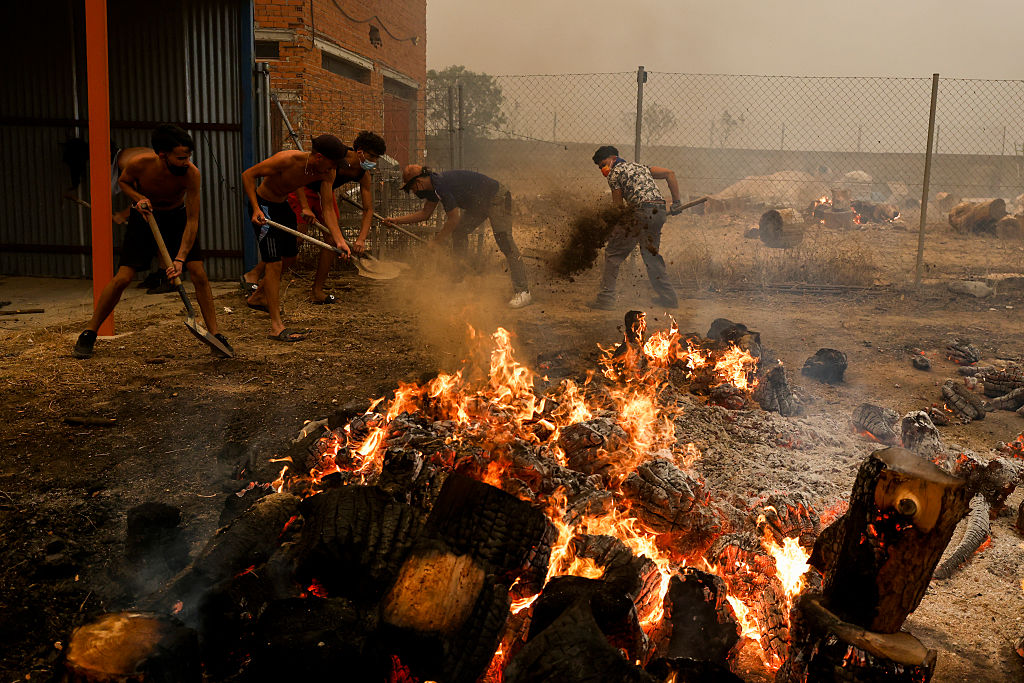 Students of David Gonzalez, who owns a martial arts gym for young people, try to extinguish a fire outside David’s house as wildfires surround the village in El Tiemblo, in Ávila province, Spain, on July 24, 2026. (Pablo Blazquez Dominguez/Getty Images)
The blaze forced crews to carve access routes through vegetation so dense that parts of the mountain were otherwise unreachable.
Asked about that issue by a local broadcaster on Aug.19, Abruzzo regional president Marco Marsilio responded with a barb: Had bulldozers arrived in peacetime to knock down thousands of trees to create such access routes, some “guardian angels of the trees” would have shown up to chain themselves to the first sapling.
Back in France, Bertrand Alliot, an environmental management engineer and former board member of the League for the Protection of Birds who now speaks for Action Écologie, an environmental organization opposed to political environmentalism and degrowth, expressed similar frustration.
“Many environmentalists embrace a laissez-faire approach to nature, believing it should be allowed to evolve without human intervention, and resort to activism or legal action in the name of species protection that can hinder the work of those on the ground,” he told The Epoch Times, stressing that “a protected species is not necessarily a species threatened with extinction.”
“Between environmentalist activism, rules piled upon rules, and the sheer scale of the clearing work needed in some forests,” he concluded, “the situation is becoming extremely difficult to manage.”
 Friends Read Free
Copy
Facebook
Tweet
Friends Read Free
Copy
Facebook
Tweet