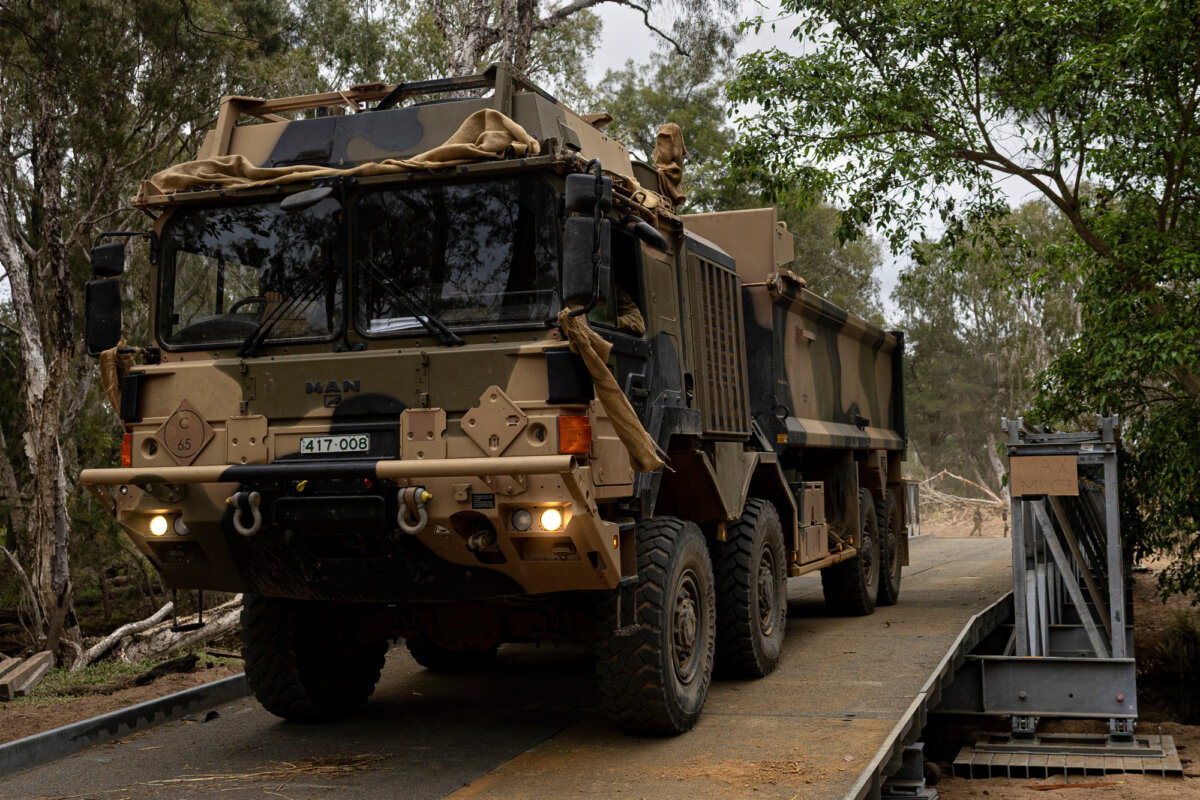

A senior Australian Strategic Policy Institute (ASPI) defence analyst says deploying military capabilities in northern Australia would send a strong deterrence to adversaries and boost national security.
Appearing before parliament’s Joint Standing Committee on Northern Australia on May 15, ASPI National Security Program Director John Coyne warned the federal government’s approach to northern Australia was too slow, too fragmented, and too reactive in the current environment.
Coyne said the current approach was not cohesive with individual projects developed in isolation rather than coordinated, leaving infrastructure and workforces out of step.
“If you look into our defence strategic review, much of our defence is trying to deter conflict,” he said.
“Nothing deters [conflict] more than showing other countries that we are serious about being ready for any potential development … and having frontline or defence maintenance capabilities in northern Australia does that job.”
Coyne also argued that while northern Australia sits at the centre of major global shifts—including intensifying strategic competition due to its proximity to a more aggressive Chinese Communist Party—the country’s existing development was not quick enough.
“We cannot continue to approach northern development through southern assumptions,” Coyne said.
“Opportunity alone does not create transformation.”
Instead, the defence analyst called for a new “operating system” for the north focused on speed, scale and integration.
Does the North Need the Iron Boomerang?
The push for large-scale, integrated development of northern Australia has been reflected in project concepts like the “Iron Boomerang,” a little-talked-about proposal aimed at creating a major industrial corridor that spans the width of the continent.
The project, the brainchild of businessman Shane Condon and has been floated for more than a decade, aims to build an ambitious over 3,000-kilometre freight line across northern Australia.
The “boomerang” concept comes from the idea that trains would run loads in both directions, carrying iron ore east, coal west, and benefiting steel plants at either end.
The project would, in turn, drive growth in manufacturing, jobs, and port development.
Financier Matthew Jeffries has referred to the project as one that “makes sense on many perspectives.”
Jeffries argues that the modern steelmaking is automated and that transporting raw materials overseas is inefficient and wasteful. Instead, Australia should process its own iron ore into steel domestically, especially in the northern regions where the raw materials can be found.
“Modern steel production is not particularly labour intensive and now heavily mechanised so is the perfect industry for northern Australia,” he said on LinkedIn.
“The raw commodities are particularly bulky incurring substantial transport costs compared to raw material costs, and the absence of viable backload shipments [from China] means that there are even environmental downsides with unnecessary Co2 production.
“As such it seems sensible to consider vertical integration to capitalise on our iron ore resources.”
 Friends Read Free
Copy
Facebook
Tweet
Friends Read Free
Copy
Facebook
Tweet