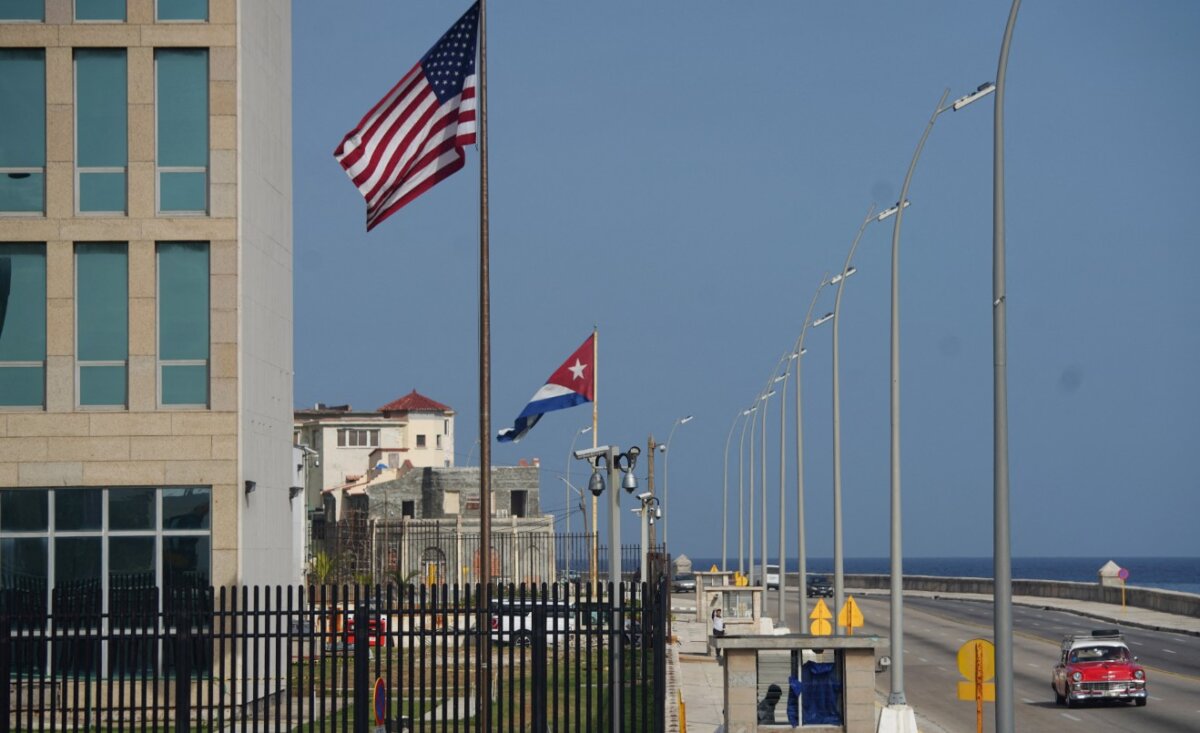
The U.S. Embassy in Cuba has warned of a rise in protests organized by the Cuban communist regime against Washington, noting that some U.S. citizens are being denied entry upon arrival in the country.
“U.S. citizens in Cuba or planning to travel to Cuba are advised that there have been incidents of U.S. citizens being denied entry upon arrival as well as a spike in regime-sponsored protest activity directed at the United States, including anti-U.S. rhetoric,” the embassy stated on its website.
In a separate statement, related to a regime-organized demonstration outside the building on Feb. 3, the embassy warned U.S. nationals: “Avoid the demonstration area and areas with high likelihood of protests. Avoid crowds. … Be aware of your surroundings.”
U.S. President Donald Trump in January urged Cuba to strike a deal with his administration after the United States captured former Venezuelan socialist leader Nicolás Maduro and pressured interim Venezuelan leader Delcy Rodríguez to redirect oil deliveries that had previously been sold to Cuba at discounted prices.
Last year, Venezuela was Cuba’s largest oil supplier, providing the Caribbean nation with 26,500 barrels per day, one-third of Cuba’s daily needs. Mexico came in second, with significantly fewer barrels per day at 5,000.
Fuel shortages in Cuba have pushed up prices for food and transportation, and prompted fuel shortages and hours of power outages.
In an executive order signed on Jan. 29, Trump said the Cuban regime posed an “unusual and extraordinary threat” to the United States, and said Havana “blatantly hosts dangerous adversaries” and supports “numerous hostile countries, transnational terrorist groups and malign actors.”
In 1959, a communist revolution led by Fidel Castro ousted U.S.-backed dictator Fulgencio Batista and replaced him with a totalitarian regime that was supported economically by the Soviet Union, and later by Venezuela.
There are an estimated 2.4 million people of Cuban origin in the United States, many of whom fled from the communist regime and settled in Florida.
Trump said on Feb. 2 that Mexico would stop sending oil to Cuba, escalating a U.S.-led pressure campaign aimed at cutting off the communist-controlled island’s remaining fuel supplies and pushing Havana toward negotiations.
“Mexico is going to cease sending them oil,” Trump told reporters in the Oval Office, without offering details on timing or enforcement.
During his first administration, Trump unveiled restrictions on Cuban imports, but he has gone much further this time, putting the regime under severe economic strain.
“Cuba will be failing pretty soon,” Trump told reporters in the Oval Office on Jan. 27. “Cuba is really a nation that’s very close to failing.”
Trump later imposed tariffs on goods from countries supplying oil to Cuba.
Unscheduled Power Outages
Cuba’s national electrical grid is increasingly unstable, and prolonged scheduled and unscheduled power outages are a daily occurrence across the country, according to the U.S. Embassy statement.
It warned American residents and visitors to “take precautions by conserving fuel, water, food and mobile phone charge, and be prepared for significant disruption.”
“We’re starting to talk with Cuba. They need help on a humanitarian basis,” Trump told reporters on Air Force One en route to Florida on Jan. 31. “A lot of people in our country were treated very badly by Cuba. … We’d like to be able to have them go back to a vote in their country, which they haven’t seen in their country for many, many decades.”
Cuba’s deputy foreign minister, Carlos Fernández de Cossio, said on Feb. 1 that Cuba and the United States are in communication and that the regime in Havana was “ready to have a serious, meaningful and responsible dialogue.”
“The U.S. … is attempting to force every country in the world not to provide fuel to Cuba. Can that be sustained in the long run?” Fernández said.
“Is every country in the world going to accept that the U.S. tell them to whom they can export their national products?”
Reuters contributed to this report.
Correction: A previous version of this article misspelled the name of Fulgencio Batista. The Epoch Times regrets the error.
 Friends Read Free
Copy
Facebook
Tweet
Friends Read Free
Copy
Facebook
Tweet