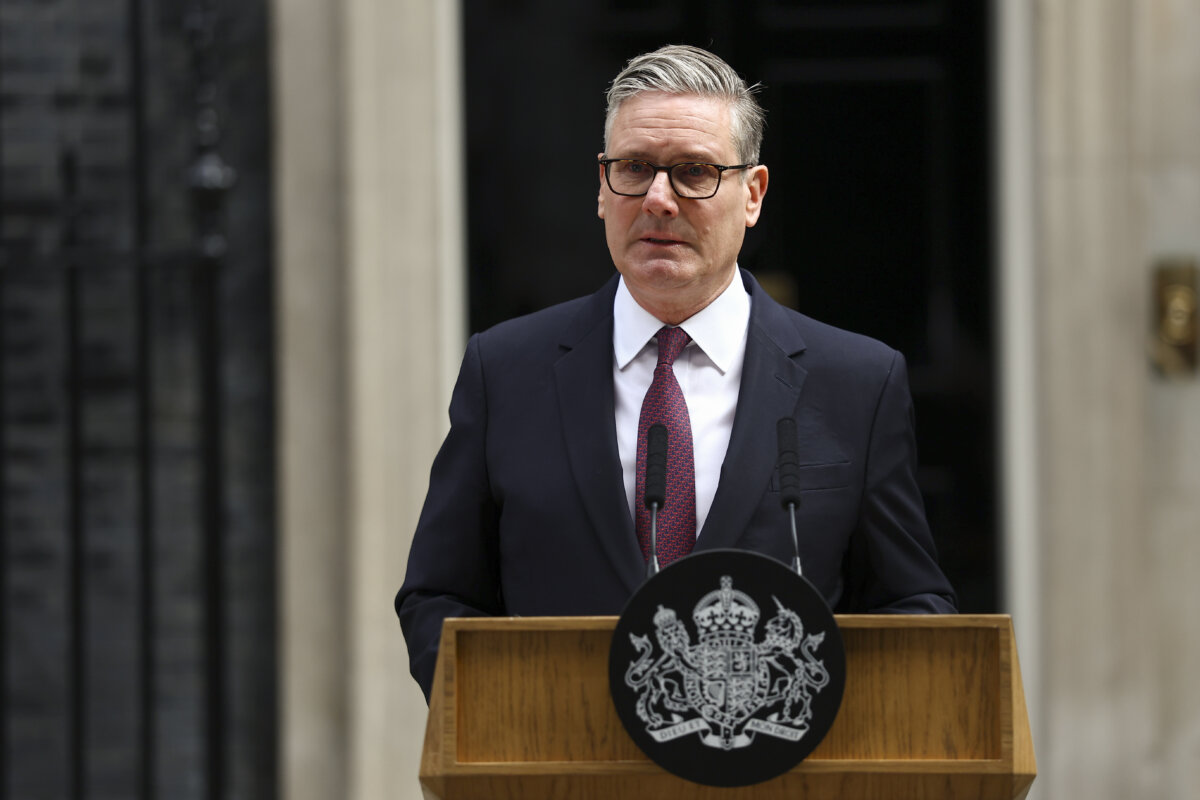

Leaders from across Europe have bid farewell to outgoing British Prime Minister Keir Starmer after he announced he would be stepping down.
Starmer made the announcement on June 22. His decision was a result of pressure from within his own Labour Party and of his declining popularity nationwide.
However, his reputation was held in higher regard across the continent, due to his more conciliatory tone toward the European Union, which has had a fractious relationship with Britain for the past 10 years following Brexit, a move Starmer actively campaigned against.
European Commission President Ursula von der Leyen said in a June 22 post on X that it “can take many leaders years to grow into the statesman [Starmer] became in just two years.”
“European and Ukrainian security is stronger because of you. Thank you, dear Keir,” she added.
The leader of the UK’s closest neighbor, Irish Prime Minister Micheal Martin, also thanked his outgoing British counterpart, saying he wanted “to acknowledge the significant role Keir played in resetting the Irish-British relationship as well as relations between the UK and the European Union during his time as prime minister,” in a statement released by his office on June 22.
The historically difficult relationship between the two countries had also been put under renewed strain due to Ireland’s membership of the EU while the UK chose to leave, creating tensions around the border between Northern Ireland, which is part of the UK, and the Republic.
French President Emmanuel Macron, who has forged a close relationship with Starmer due to their staunch support for Ukraine, also thanked the departing prime minister.
“I would like to thank Prime Minister Keir Starmer for his contribution to strengthening the Franco-British relationship, his commitment within the coalition of the willing for Ukraine, as well as to relaunching the relationship between the United Kingdom and the European Union,” he wrote in a June 22 post on X.
“The work accomplished together on defence, nuclear energy, space and innovation, particularly during our Franco-British summit last July, testifies to this commitment.”
Starmer’s support for Kyiv also drew praise from Ukrainian President Volodymyr Zelenskyy, who thanked Starmer “for always being in touch, always engaged, and always striving to do what is needed” and said their conversations had always been “filled with real substance”.
“Keir, you are always a welcome guest in Ukraine,” he said on X.
German Chancellor Freidreich Merz has not personally sent his regards to Starmer, but German government spokesperson Stefan Kornelius said Starmer had always been “a reliable and close partner on foreign policy issues, especially concerning Ukraine,” German outlet DW reported.
Across the Atlantic
The leaders of Canada and the United States struck notably different tones in their messages to the outgoing British prime minister.
Canadian Prime Minister Mark Carney, who has previously served as the governor of the Bank of England, said in a statement that it had been “a privilege to work alongside Sir Keir Starmer as he has led international efforts to support Ukraine through the Coalition of the Willing, strengthen NATO, improve Arctic cooperation, and deepen the historic partnership between Canada and the United Kingdom.”
U.S. President Donald Trump, several hours before Starmer himself announced he would be leaving office, revealed that the prime minister would be stepping down in a June 21 post on Truth Social.
“He failed badly on two very important subjects- IMMIGRATION AND ENERGY (OPEN NORTH SEA OIL!). I wish him well!” Trump added, summing up his view of Starmer’s time in the post.
Succession Race
During his resignation speech, Starmer said he would remain prime minister until a successor was chosen and pledged an orderly transfer of power, as the UK prepares for its seventh leader in a decade.
He said the Labour Party’s National Executive Committee will open nominations on July 9 and complete any leadership contest before Parliament’s summer recess, ensuring a new leader is in place before lawmakers return in September.
The resignation marks a dramatic fall for a leader who swept Labour to a landslide election victory less than two years ago, and it paves the way for the UK’s seventh leader since it voted to leave the European Union.
However, there may not be a leadership contest.
Focus has now shifted to Andy Burnham, the former mayor of Greater Manchester, whose return to Parliament in a byelection on June 18 precipitated Starmer’s exit.
Burnham confirmed on social media, following the prime minister’s announcement, that he will put himself forward as leader.
“Keir has given huge service to our country, and I want to thank him for his leadership and dedication during such a challenging period,” Burnham said.
“His decision marks the beginning of a transition, and it is important that this process is conducted in an orderly and responsible way. I will put myself forward as part of this process.”
If Labour lawmakers decide to unite behind Burnham, 56, a career politician who served in the governments of Tony Blair and Gordon Brown and in the shadow cabinets of Ed Miliband and Jeremy Corbyn, a leadership contest will not be necessary.
Labour rules state that 20 percent of the party’s MPs have to nominate a candidate for the candidate to be able to stand to be leader. If no other candidate can secure the backing of enough lawmakers, Burnham could effectively be coronated as prime minister. Polling shows he is the most popular Labour politician to succeed as leader among the party members.
Starmer’s former health secretary, Wes Streeting, was the most high-profile minister to resign in the days following disastrous local election results for Labour in May, saying he intended to fight in any leadership contest, but changed his mind after Burnham’s byelection victory, throwing his support behind the former mayor.
Thus far, Burnham is the only Labour MP who has said he will run for the leadership, though rumours are swirling around Westminster about others who may toss their hat into the ring.
Recently resigned armed forces minister Al Carns refused to rule himself out of the race in a June 22 interview with ITV, saying he was “not ready to make a decision on this in any way, shape, or form,” while the BBC reported that some Labour MPs are encouraging cabinet member Darren Jones to run, but he is unlikely to do so.
Nominations for the post do not formally open until July 9. Whoever succeeds Starmer will become the UK’s seventh prime minister in 10 years.
Rachel Roberts and Tom Ozimek contributed to this report.
 Friends Read Free
Copy
Facebook
Tweet
Friends Read Free
Copy
Facebook
Tweet