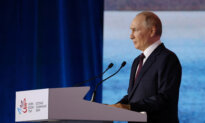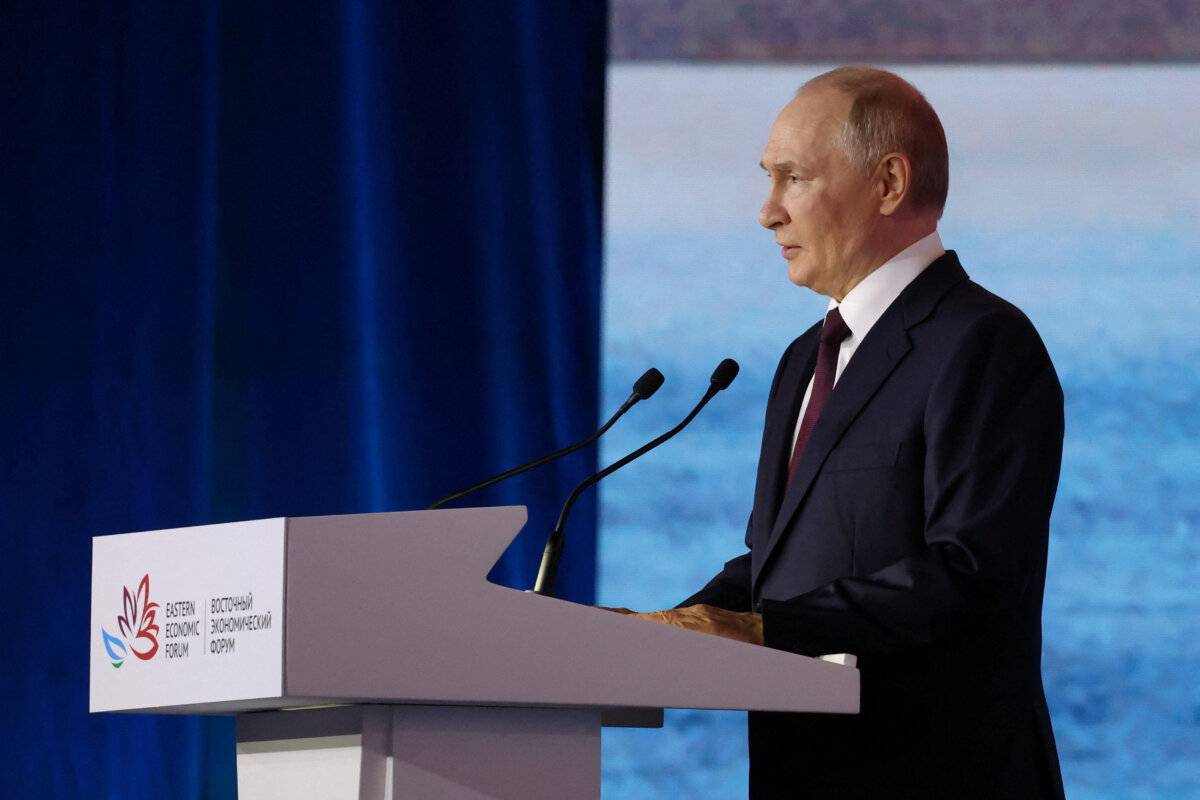
Russian President Vladimir Putin said on Sept. 5 that if foreign troops were deployed to Ukraine ahead of a final peace agreement, they would be considered “legitimate targets” to be attacked.
“If any troops appear there, especially now while fighting is ongoing, we assume that they will be legitimate targets for destruction,” Putin said during a panel discussion at the Eastern Economic Forum in Vladivostok, eastern Russia.
“And if decisions are reached that lead to peace, to long-term peace, then I simply do not see any sense in their presence on the territory of Ukraine, full stop.”
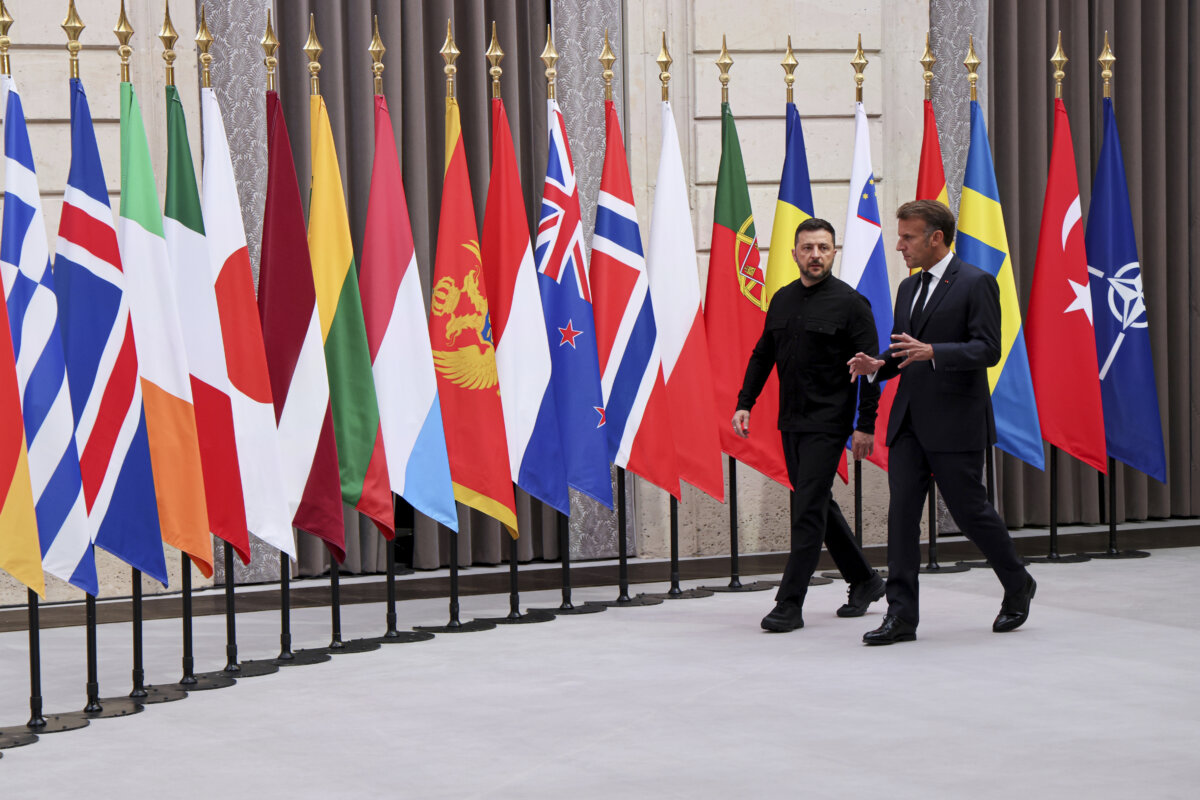
Putin’s comments come a day after European leaders met with Ukrainian President Volodymyr Zelenskyy at the Elysee Palace in Paris, and French President Emmanuel Macron said 26 countries had offered to provide security guarantees to Ukraine.
The meeting of the so-called “coalition of the willing” included the leaders of France, the UK, Germany, and several NATO member countries in Europe. Some attended in person, while other participants joined by video link.
U.S. envoy for peace talks Steve Witkoff also met the European leaders, then held a closed-door meeting with Zelenskyy.
‘Reassurance Force’
Macron said what he called a “reassurance force” would only be sent to Ukraine after the conflict ends.
Standing next to Zelenskyy at a press conference after the meeting, Macron said the force “does not have the will or the objective of waging war against Russia,” but will aim “to prevent any new major aggression and to involve the 26 states very clearly in the lasting security of Ukraine.”
Macron said the international force would include land, air, and naval forces.
Russia has been adamant that Kyiv should never join NATO and is hostile to the idea of forces from members of the alliance putting boots on the ground in Ukraine.
Zelenskyy said in a Sept. 5 post on X that it was important to move faster on security guarantees for Ukraine and “to be as productive as possible together with America, to strengthen our air defense.”
“We continue coordination for the sake of real diplomacy,” Zelenskyy said. “Putin pretends he does not need peace, does not need negotiations, but in fact global pressure can shape Russia’s interest in ending the war. I thank everyone helping.”
U.S. President Donald Trump, following events at this week’s Shanghai Cooperation Organization summit in Tianjin, wrote on Truth Social on Sept. 5: “Looks like we’ve lost India and Russia to deepest, darkest, China. May they have a long and prosperous future together!”
During a meeting at the White House on Aug. 18, Trump said the United States would help provide security guarantees to Ukraine after the war to prevent future aggression.
During that meeting, Trump told seven European leaders, including European Commission President Ursula von der Leyen, that a breakthrough occurred at the Alaska summit when Russian President Vladimir Putin agreed to accept security guarantees for Ukraine.
He said he hoped that Europe would shoulder a large portion of the responsibility, with the United States playing a supportive role.
Russian Foreign Minister Sergei Lavrov said on Aug. 20 that attempts to resolve security issues relating to Ukraine without including Moscow were a “road to nowhere.”
Warning From German Chancellor
German Chancellor Friedrich Merz said on Aug. 31 that peace could not be negotiated “at the price of Ukraine’s capitulation.”
In an interview with German public broadcaster ZDF, Merz said, “You could end the war tomorrow if Ukraine surrendered and lost its independence.”
Trump and Putin met in Alaska on Aug. 15. Trump later took to his Truth Social platform to call for Putin and Zelenskyy to hold a bilateral meeting, after which all three of them would hold a trilateral meeting to resolve the ongoing Russia–Ukraine conflict.
During an Aug. 29 interview, Trump said: “A [trilateral meeting] would happen. A [bilateral], I don’t know about, but a [trilateral] will happen. But, you know, sometimes people aren’t ready for it.”
Emel Akan, Ryan Morgan, The Associated Press, and Reuters contributed to this report.
 Friends Read Free
Copy
Facebook
Tweet
Friends Read Free
Copy
Facebook
Tweet