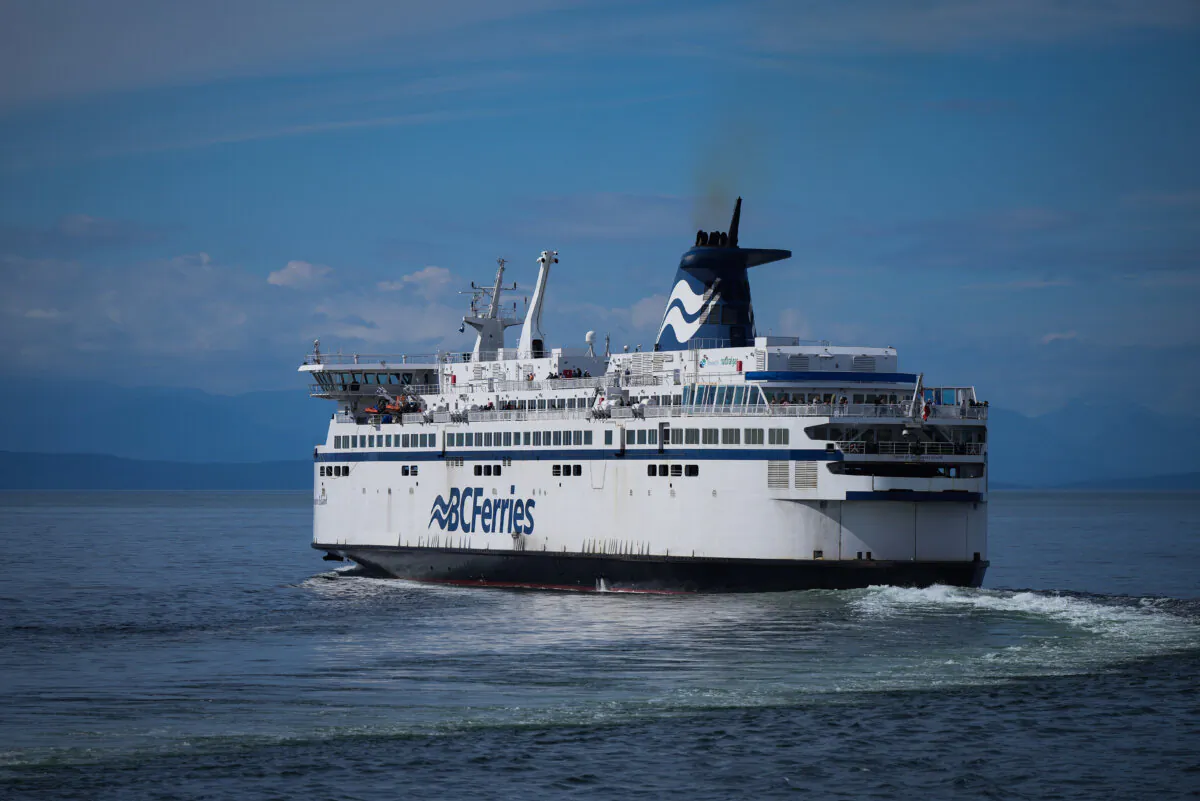

The Canada Infrastructure Bank is providing a $1 billion loan to BC Ferries to purchase four new vessels from a Chinese state-owned shipyard, a move that has sparked concern among federal and provincial politicians alike.
The Canada Infrastructure Bank (CIB), a federal Crown corporation, made the announcement on June 26, saying the below-market-rate financing provided to BC Ferries will help reduce future fare increases and support the modernization of the ferry operator’s fleet.
The update comes after federal Transport Minister Chrystia Freeland asked her British Columbia counterpart Mike Farnworth in a letter last week to “verify and confirm with utmost certainty that no federal funding will be diverted to support the acquisition of these new ferries.”
Freeland criticized the deal with the Chinese company, pointing to tariff tensions, national security risks, and the need to prioritize Canadian firms. She highlighted the financial support Ottawa has provided to the ferry operator, including roughly $37.8 million Transport Canada will give the province to support BC Ferries. She also mentioned a previous $75 million loan from the CIB, but made no mention of any future loans from the bank.
The newly announced $1 billion loan to BC Ferries was approved by the CIB’s board in early March, according to the bank.
The loan is the bank’s second investment in modernizing the ferry operator’s fleet, and it will be allocated in two portions, with $690 million going toward the vessels and $310 million toward electrification infrastructure, said the bank. The previous $75 million was announced in May 2024 for four net-zero emission ferries.
“Without CIB financing, the costs of the new ferries and electrification infrastructure would need to be borne more fully by BC Ferries’ customers and every year of delayed purchase risks more service disruptions, reduced travel options and fewer employment gains,” said the bank in its press release, which did not mention that the four new vessels would be built by a foreign company.
BC Ferries announced its decision to hire China Merchants Industry Weihai Shipyards (CMI Weihai) on June 10, saying it followed a “rigorous global procurement process” that evaluated proponents on bid strength, technical capabilities, safety and quality standards, experience, costs, and delivery timelines.
Opposition Conservative Leader Pierre Poilievre took to social media to question the CIB’s loan.
“The Liberal government’s Infrastructure Bank just handed $1B of your tax dollars to a Chinese state-owned company,” he wrote in a June 16 post. “No jobs for Canadians. No benefit to our economy. Just more borrowed money leaving the country.”
The office of the federal transport minister redirected The Epoch Times’ request for comment to the office of the minister of housing and infrastructure, saying the CIB is part of its portfolio. The office of the minister of housing and infrastructure’s office did not respond by publication time.
The CIB told The Epoch Times in a statement it believes the two investments in BC Ferries will deliver positive outcomes for the people and businesses of the Vancouver region, which it says include expanded capacity on busy routes, a “cleaner and more reliable” travel experience, and reduced fare pressure.
However, the bank noted it does not play a role in procurement decisions.
“Our mandate as a federal crown corporation is to help project proponents to accelerate the infrastructure Canada needs, and to do so while leveraging private capital,” reads the statement. “We do not play a role in the competitive tendering process and procurement decisions employed by our partners.”
BC Ferries did not directly respond to questions on whether it was reconsidering its deal with the Chinese shipyard but said financing tools like the CIB loan allow the ferry operator to invest in new, reliable vessels amid financial strains.
“Even after multiple consecutive years of record-setting demand, BC Ferries is facing serious financial pressures as our costs outpace revenue and our infrastructure ages,” BC Ferries president Nicolas Jimenez said in a statement. “We’re doing everything we can to reduce costs and meet our customers’ expectations around affordability.”
The B.C. ministry of transportation declined to comment, telling The Epoch Times it has no role in the funding arrangement between BC Ferries and the CIB.
Concerns
BC Ferries’ decision to award the contract to a Chinese state-owned shipyard has drawn calls for its cancellation, with critics citing the threats posed by the Chinese communist regime as well as the need to keep investment in Canada.
B.C. Opposition Conservative Leader John Rustad has called the vessel deal a national security issue.
“China’s money laundering, China’s fentanyl, & China’s election interference have all hurt BC & Canada,” he said in a social media post on June 11. “This is a national security issue–moreover, BC cannot give China billions of BC tax [dollars] that should be going to OUR BC workers.”
Canadian intelligence officials last year said Beijing has previously used China-based corporations to further the regime’s strategic goals.
“We do see corporate actors out of [China] using all means and various techniques at their disposal to try to further the objectives of the Communist Party of China,” officials said in May 2024.
Expressing similar concerns, Freeland asked Farnworth in her June 16 letter to outline the measures BC Ferries will implement to mitigate security threats from China.
“There have also been ongoing concerns regarding threats to security, including cybersecurity, from China,” she wrote. “I would like your assurance that BC Ferries conducted a robust risk assessment, and I expect them to engage with the relevant provincial and federal security agencies and departments to mitigate any security risk.”
Freeland also said she was “surprised” BC Ferries was not required to include an “appropriate level” of Canadian content in the procurement while the federal government is focused on supporting Canadian industries.
Parliamentary secretary for the transport minister Liberal MP Mike Kelloway said on June 13 that BC Ferries’ contract falls under provincial procurement standards, and that if that type of decision was in the federal government’s hands, they would prioritize Canadian companies.
Tory MP Dan Albas has also questioned the economic impact of the BC Ferries deal, saying on June 16 that large procurement contracts should be used to “support Canadian jobs, Canadian steel, especially during this time where our steel and aluminum industries are hit so hard,” referring to U.S. tariffs on Canadian steel and aluminum.
Meanwhile, B.C. Premier David Eby said last week the selection of the Chinese shipyard was not his “preferred outcome” but that he will not ask BC Ferries to reopen the procurement process due to the time and financial costs involved.
“I agree it is not ideal that the ferry award went to China, but reopening would mean a delay in delivering ferries for British Columbians who are desperate for them,” he said in Victoria on June 17, adding that his government will work to ensure that “the next round of ferries is built right here at home.”
Eby also pointed out that no Canadian shipyard submitted a bid for the contract. Rustad argued the outcome might have been different if the provincial government had encouraged Canadian companies to participate.
On the federal front, New Democrat MP and infrastructure critic Jenny Kwan has said Ottawa could play a role in helping Canadian companies become more competitive so they can bid for large procurement contracts.
 Friends Read Free
Copy
Facebook
Tweet
Friends Read Free
Copy
Facebook
Tweet