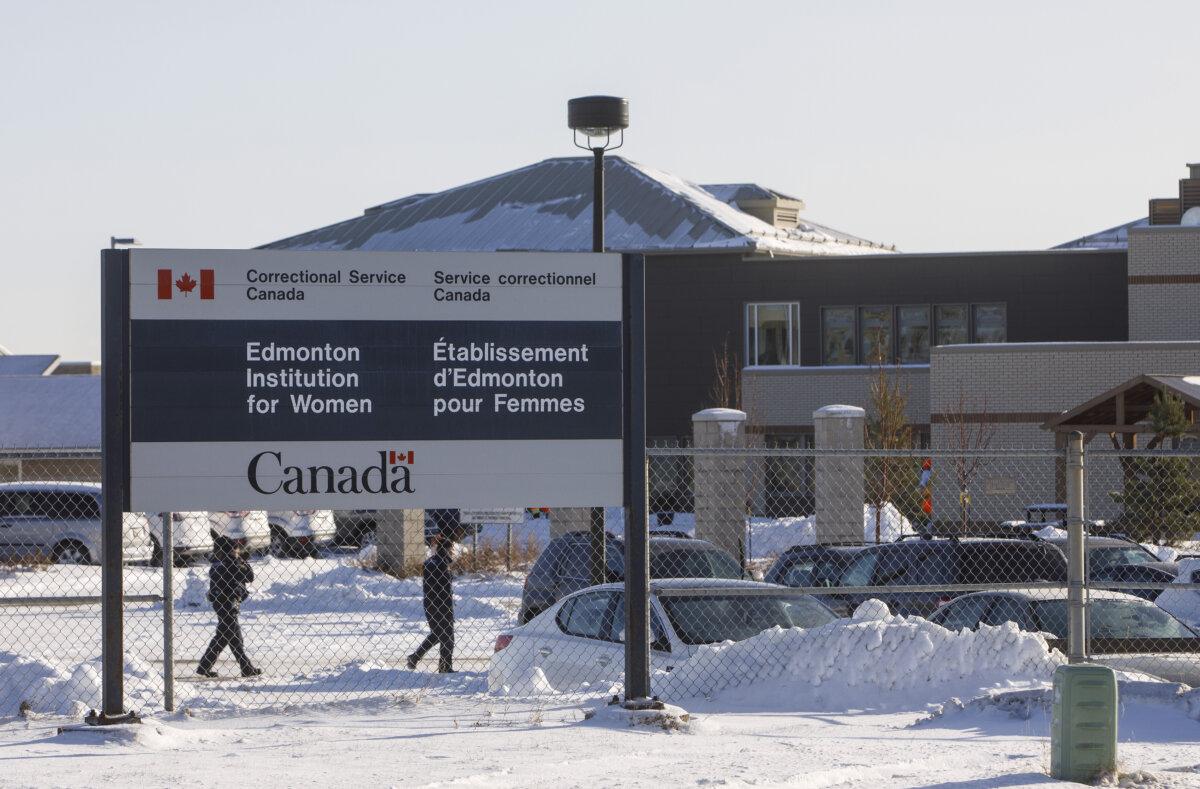

Ottawa is defending its policy of allowing transgender-identifying biological males to be housed in women’s prisons, while acknowledging that some of these inmates have faced sexual assault charges in women’s facilities.
The government outlined its position in a statement of defence filed Aug. 31 as part of a lawsuit brought by the Canadian Women’s Sex-Based Rights (CAWSBAR) organization.
“Canada’s accommodation of the needs of gender diverse inmates does not infringe the rights guaranteed to cisgender women inmates,” the Attorney General of Canada wrote in the statement of defence, adding that “the Plaintiff’s allegations of harm relating to the placement and transfer of gender diverse offenders into women’s institutions are vague” and “lack specificity.”
Lawsuit
CAWSBAR launched the lawsuit in April 2025 with representation by lawyers funded by the Justice Centre for Constitutional Freedoms, alleging that permitting transgender-identifying male inmates to be placed into women’s prisons exposes female prisoners to physical and psychological harm and violates their Charter rights.
The organization subsequently sought and obtained public-interest standing on May 14 of this year after the federal court denied the government’s attempt to strike down the lawsuit.
CAWSBAR said it was bringing the case on behalf of female inmates because female prisoners directly affected by the policy might be hesitant to pursue their own cases due to fear of negative consequences from the institution they are in as well as on parole decisions.
“The Claim alleges that the practice of placing and transferring trans-identified male inmates into federal correctional facilities traditionally reserved for women has caused incarcerated women a series of serious harms,” reads CAWSBAR’s Dec. 5, 2025, Notice of Motion.
The lawsuit challenges the constitutionality of the Correctional Service Canada’s (CSC) Commissioner’s Directive 100: Gender Diverse Offenders, which lays out regulations for how CSC accommodates gender identity in federal prisons.
The directive allows inmates to request placement in a men’s or women’s prison based on their gender identity, subject to a safety and security assessment.
“If overriding health or safety concerns are identified and cannot be effectively mitigated, the placement request may be denied. In such cases, alternative measures are implemented to support the person’s gender-related needs where they reside,” CSC spokesperson Esther Mailhot wrote in a Dec. 9 email to The Epoch Times.
In the lawsuit, CAWSBAR says that the directive breaches sections 7, 12, and 15 of the Canadian Charter of Rights and Freedoms relating to protection of life, liberty, and security of the person; protection from cruel and unusual treatment or punishment; and rights of equality.
It also refers to section 28, which safeguards equal Charter rights for males and females.
‘Ameliorative Policy’
In its statement of defence, the federal government rejects CAWSBAR’s argument, saying that Directive 100, which was introduced in 2022, is an “ameliorative policy” and adding that “most gender diverse offenders serve their sentence in an institution that aligns with their sex.”
Specifically, Ottawa said that identifying as transgender or gender diverse does not determine whether an inmate will be transferred to a women’s institution and that these decisions are made on a case-by-case basis after assessing risks by Canada’s deputy commissioner of women.
Despite stating that its policy is secure and has all necessary safeguards, Ottawa acknowledges a number of alleged sexual assaults committed by transgender-identifying men at women’s institutions.
One case includes a “gender diverse inmate” identified as S/M who was moved to Grand Valley Institution for Women in Kitchener, Ont., and was charged with sexual assault and criminal harassment in 2020 following a complaint filed by a female inmate.
Another “gender diverse” inmate identified as KF/R was also charged with two counts of sexual assault on a female inmate at the same institution in October 2024.
Further cases detailed in the statement of defence include an allegation against a “gender diverse” inmate identified as M/H who was accused of sexual assault at the Grand Valley Institution in 2018. However, police ultimately investigated and did not charge the individual.
The statement also outlines the case of a female inmate who told CSC she had been sexually assaulted by a “gender diverse” inmate at the Okimaw Ohci Healing Lodge in Maple Creek, Sask., in 2019. The female inmate did not provide details regarding the alleged assault, and the investigation did not lead to charges.
In total, the defence notes 59 incidents caused by 19 “gender diverse” inmates impacting 45 female inmates are alleged by CAWSBAR in its lawsuit. However, Ottawa wrote that it had insufficient information to write responses for 45 of the alleged 59 harmful incidents.
Despite these incidents, Ottawa wrote that it “wholly denies that any alleged harm to inmates housed in women’s institutions flowed from the implementation of CD 100.”
The government further writes that the safeguards contained in Directive 100 and broader CSC policies provide security to women in institutions, including allowing for “gender diverse” inmates who are transferred to a women’s institution to be taken back to an institution that aligns with their biological sex on an urgent emergency basis when necessary.
In its statement of defence, Ottawa further states that even if there has been a Charter violation as a result of the directive, it would be a reasonable limit required by a free and democratic society and would be justified by the safety precautions taken by the CSC and the wider goal of accommodating “gender diverse” inmates.
Constitutional lawyer Chris Fleury, whose organization is representing CAWSBAR, said the proof of his clients’ claims are in the defence statement itself.
“The government’s own Defence shows that female inmates have made serious complaints about what has happened to them in women’s prisons, including complaints that resulted in sexual-assault charges,” Fleury said.
“Female inmates are being exposed to real risks and real harm. This case is about protecting their safety, dignity, and constitutional rights.”
Ottawa is requesting the court to dismiss CAWSBAR’s claim with costs.
 Friends Read Free
Copy
Facebook
Tweet
Friends Read Free
Copy
Facebook
Tweet