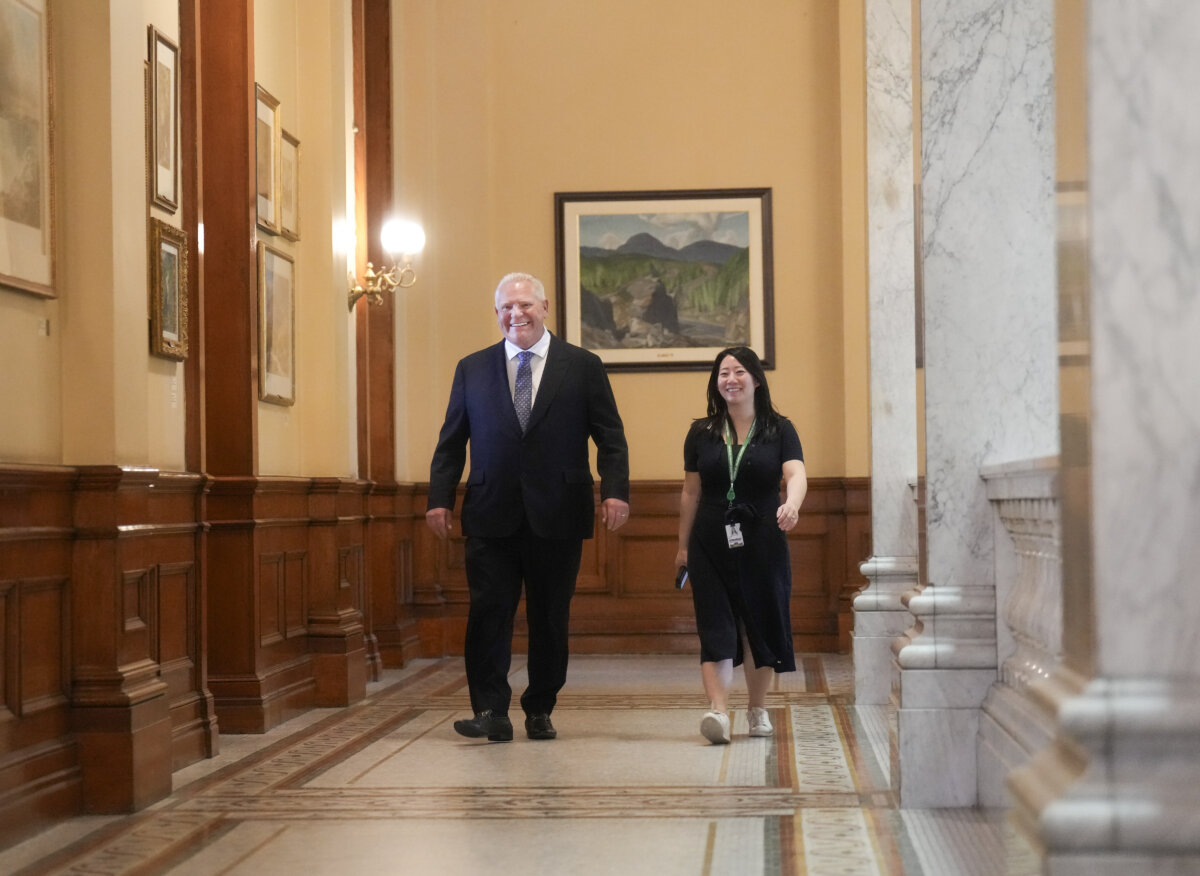

Ontario Premier Doug Ford concluded a two-day trip to Washington, D.C., on June 9, where he promoted renewing North America’s free-trade pact under a “Building Fortress North America” framework that he says would strengthen the continent’s prosperity and security.
Ford’s proposal calls for closer cooperation on critical minerals, manufacturing, energy, defence, and Arctic security while reducing North America’s reliance on China for strategic industries such as electric vehicles, semiconductors, batteries, and artificial intelligence, his office said in a release.
The proposal comes as Canada, the United States, and Mexico prepare for a review of the Canada-United States-Mexico Agreement (CUSMA), while U.S. tariffs remain in place on Canadian steel, aluminum, and automobiles.
Ford met with members of Congress and aerospace and automotive industry representatives to rally support for renewing CUSMA, which he described as a “once-in-a-generation” opportunity for Canada, the U.S. and Mexico to boost economic growth.
“We’re seeing inflation happening on goods, on food, on fuel,” Ford said on June 9 from Washington, D.C. “If we get this deal done, everything is going to flow a lot quicker. There’s going to be more jobs, more opportunities for everyone.”
Details were not disclosed on who Ford met with specifically, apart from U.S. Ambassador to Canada Mark Wiseman, with whom he posted a photo. Ford had been scheduled to meet with American billionaire Ross Perot Jr., on June 8, who serves as chair of the U.S. Chamber of Commerce. However, the meeting was cancelled for scheduling reasons according to the chamber, which did not provide further details.
Ford said he’s been well received by those he met in Washington and emphasized positive ties with the United States.
“My message to everyone: We love Americans. We love the U.S., and I know Americans love Canadians. Let’s get a deal done,” he said. “Let’s create more jobs, more opportunities, more investment for both sides of the border.”
Ford’s proposal is outlined in a 32-page Ontario government document entitled “Building Fortress North America: Ontario’s North American Growth Plan,” which was released ahead of the premier’s trip.
The plan backs renewal of CUSMA with minor changes, and calls for strengthening supply chains for critical minerals, manufacturing, and energy, as well as boosting North American defence cooperation.
It also proposes expanding development of Ontario’s Ring of Fire mining region, more closely integrating the Canadian and U.S. energy systems, working more closely on defence and Arctic security, and tightening screening of Chinese investments in strategic sectors.
The plan calls for reducing reliance on China in key sectors, including critical minerals, electric vehicles, batteries, semiconductors, artificial intelligence (AI), advanced manufacturing and defence technologies.
Ford said renewing CUSMA is also crucial in order to attract investment.
“Everyone is holding on to their investments until they see this deal get done,” he said.
CUSMA
CUSMA was signed in 2018 to replace the North American Free Trade Agreement (NAFTA) and entered into force on July 1, 2020. The agreement preserves tariff-free trade for most qualifying goods among Canada, the United States and Mexico, while establishing updated rules in areas including automotive manufacturing, agriculture, and digital trade.
The agreement includes a joint review every six years, during which Canada, the United States and Mexico decide whether to extend it for another 16-year term, withdraw from the pact, or keep it in force without renewing it for a full term.
Prime Minister Mark Carney has said roughly 85 percent of Canada’s goods enter the United States tariff-free under the agreement.
Canada-U.S. Trade Minister Dominic LeBlanc and Canada’s top trade negotiator, Janice Charette, met with the U.S. Trade Representative Jamieson Greer earlier this month. Ottawa has called for keeping the agreement largely unchanged.
Greer has criticized Canada’s supply-managed dairy sector, digital policies and aspects of the North American auto industry, and has suggested these and other issues will be part of the negotiations. He has also pointed to broader trade disputes between the two countries, including over tariffs and market access.
“I think on some of these issues it’s going to be a challenging negotiation, but in some sectors of the economy it has been fine and it will be fine,” Greer said on May 26.
Industry Minister Mélanie Joly said she supports the purpose of Ford’s trip to Washington and said he is aligned with Ottawa’s position on opposing U.S. tariffs.
“I have a super good relationship with Premier Ford. I think that we’re standing shoulder to shoulder to counter the impacts of the tariffs,” Joly said June 9.
Tariffs
The Trump administration’s tariffs on Canadian steel, aluminum, automobiles, copper, and certain furniture products remain in place, despite Ottawa pushing to have them removed.
The Ontario government said over $1.2 trillion in goods and services flowed between the United States and Canada last year, amounting to more than $3.3 billion per day.
American exports to Canada have gone up by over 36 percent since CUSMA went into effect in 2020, and U.S. trade with Canada supports approximately 1.8 million American jobs, Ford’s office said.
Last year, Ford’s government drew the ire of U.S. President Donald Trump when the Ontario government launched a television ad on American networks that criticized tariffs.
Trump responded by announcing that he was immediately terminating all trade talks with Canada, arguing that the advertisement was an attempt to influence an upcoming U.S. Supreme Court case involving his tariffs.
 Friends Read Free
Copy
Facebook
Tweet
Friends Read Free
Copy
Facebook
Tweet