
U.S. President Donald Trump says he is considering not renewing the North American free trade agreement, arguing the United States would be better off without goods produced in Canada and Mexico.
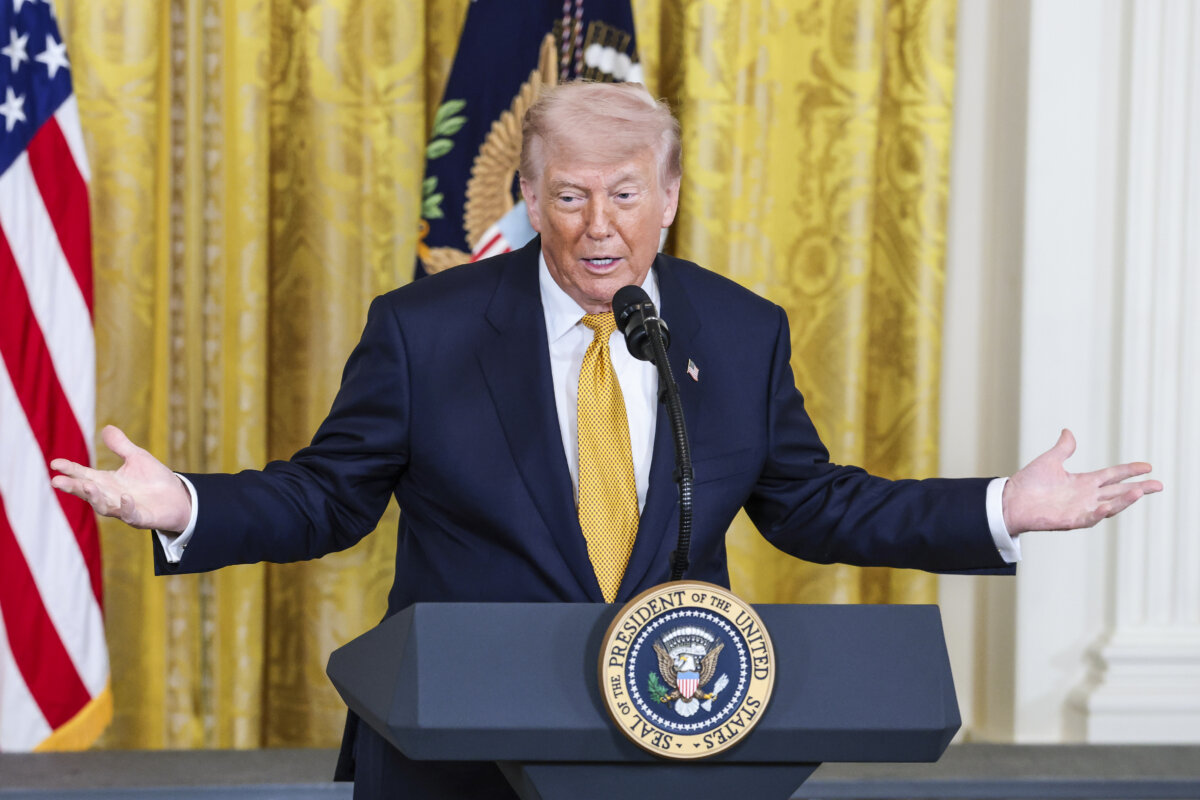
Trump made the remarks in the Oval Office on June 10 when reporters asked how confident he was that the Canada-United States-Mexico Agreement (CUSMA) would be renewed, and what additional commitments he expects from Canada.
“I’m not looking to renew it,” Trump said, before criticizing CUSMA’s predecessor NAFTA as the “worst trade deal I’ve ever seen.”
Trump replaced NAFTA with CUSMA in his first term, but in later years soured on the negotiated trade agreement, accusing Canada and Mexico of taking advantage of the United States.
Trump said the one thing he likes about CUSMA is its provision allowing for a review after six years, whereas NAFTA had no set renewal or expiry date.
A review of CUSMA is slated for July 1, when the three countries will have to decide whether to extend the deal. Failing to do so would lead to annual reviews. Any country could also decide to pull out.
“I don’t know that I’m going to renew it, because to be honest with you, the United States does much better,” Trump said. “We don’t need anything that Canada has, we don’t need anything that Mexico has, but they need everything that we have, and they have to treat us better.”
The president deplored having trade deficits with Canada and Mexico and repeated what he said previously about the United States not needing cars, lumber, or energy produced by its neighbours.
“We’re talking to them, we’ll see if we do something,” Trump said without elaborating, in an apparent reference to Canada and Mexico.
Canada had a US$46.4 billion surplus in goods trade with the United States in 2025, according to the United States Trade Representative (USTR), and Mexico had a US$196.9 billion surplus.
The USTR notes the North American economies have deep supply chain integration in sectors such as automobiles and energy.
This integration was shaken when Trump imposed universal tariffs on strategic sectors such as autos and metals at the beginning of his second term.
Mexico and the United States have engaged in formal talks ahead of the CUSMA review, with a first round taking place in late May. Two other rounds are slated for June and July.
Similar formal talks with Canada have not taken place nor been announced.
Canada-U.S. Trade Minister Dominic LeBlanc sent a letter to USTR Jamieson Greer and their Mexican counterpart last week advising that Canada seeks to extend CUSMA for 16 years. LeBlanc received letters from the Mexican and U.S. sides but did not want to reveal their content.
After LeBlanc sent his letter he visited Washington on June 2 to meet with Greer. He downplayed the absence of formal talks following the meeting, and said that work to untie various trade issues is currently taking place.
A day following LeBlanc’s trip, Ottawa announced it was directing Canada’s broadcasting regulator the CRTC to review its decision to triple the tax on online streamers, which would impact U.S. giants such as Netflix and Amazon. The U.S. ambassador to Canada had criticized the CRTC decision and called on Canada to scrap the legislation underpinning it, the Online Streaming Act.
Greer raised another trade issue on June 9, when he said that retaliatory tariffs imposed by Canada are problematic for negotiations. Canada removed most counter-tariffs on the United States last September to facilitate trade talks but kept retaliatory duties on sectoral sectors like steel, aluminum, and autos in place.
Prime Minister Mark Carney said last week his government is focused on reaching an agreement on the issue. “We’re trying to find a new partnership with the United States in the strategic sectors,” he said.
Carney said the United States has about 30 “technical” trade issues it is seeking to resolve with Canada and roughly 60 with Mexico.
 Friends Read Free
Copy
Facebook
Tweet
Friends Read Free
Copy
Facebook
Tweet