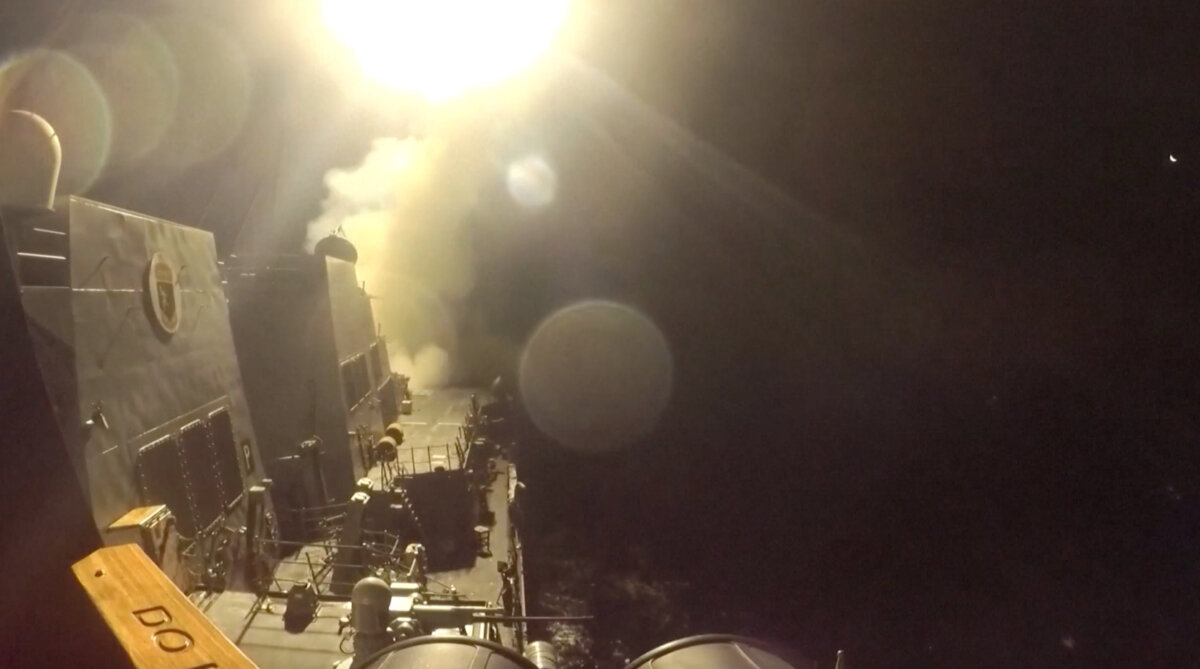

The United States on June 10 began launching new strikes on Iran after the U.S. adversary brought down a U.S. helicopter in yet another violation of the ceasefire, U.S. Central Command (CENTCOM) announced on Wednesday.
“U.S. Central Command forces began launching additional self-defense strikes today at 5:15 p.m. ET against multiple targets in Iran at the Commander in Chief’s direction,” CENTCOM said in a statement on X. “The strikes are in response to Iran’s unwarranted and continued aggression.”
President Donald Trump told Fox News on Wednesday evening that the strikes so far have included the use of 49 Tomahawk missiles inside Iran.
In addition, Trump said U.S. fighter jets are operating over the skies of Iran, taking out radar and air defense systems in the country’s southwestern region, which lies close to the Persian Gulf.
In response, Iran’s top joint military command announced that Iran would again close the Strait of Hormuz on Thursday, including ending oil tanker and commercial ship traffic in the critical shipping corridor. Iran said that it will shoot at any vessel attempting to pass the strait.
Trump indicated that behind the scenes, however, Iran’s leaders had taken a different tone and had asked him to end the bombing of the nation.
The president told Fox News that U.S. strikes would be winding down shortly, but he warned Iran that it needed to quickly agree to a deal with the United States.
CENTCOM said on X Wednesday that the Strait of Hormuz was still open.
“Commercial ships are continuing to transit in and out of the Strait of Hormuz tonight,” CENTCOM said.
It also pushed back on claims by Iranian state media that a U.S. warship had been hit in the Strait of Hormuz.
“No U.S. warships have been struck,” it said.
CENTCOM confirmed in a post on X at 9:04 p.m. ET that the latest round of strikes was now complete.
“CENTCOM forces launched strikes on Iranian military surveillance capabilities, communication systems, and air defense sites across Iran. U.S. Marine Corps, Air Force, and Navy assets fired precision munitions on Iranian targets that posed a threat to U.S. forces and international commercial ships transiting regional waters,” it stated. “U.S. forces remain vigilant, lethal, and ready.”
The strikes had been expected after Trump said earlier the same day that the United States would launch additional attacks on Iran, escalating his rhetoric after Tehran downed a U.S. Army Apache helicopter and as he accused Iranian negotiators of slow-walking the peace talks.
“We’re going to be attacking them and attacking them very hard,” Trump told reporters in the Oval Office. “We hit them hard yesterday, and we’re going to hit them hard again today.”
The president said the planned strikes were a response to Iran’s downing of the helicopter near the Strait of Hormuz, and he expressed frustration that Tehran had failed to finalize an agreement that he said would permanently block Iran from obtaining a nuclear weapon.
“We were really close to a deal, but they keep tapping us along, they keep playing us for suckers,” Trump said. “They should sign their deal. It’s a good deal.”
Secretary of War Pete Hegseth said ahead of the strikes, “President Trump said we will be hitting Iran hard, and we will be, because Iran has a chance to make a great deal—to codify what they said they were willing to do, and they haven’t been willing to do it.
“You can see when someone is trying to tap, tap, tap on a deal,” he added. “Instead, they’re going to have tap, tap, tap bombs dropping on key facilities in Iran from the United States of America! And that’s not because we want to restart anything. It’s because the War Department is prepared to set the terms to ensure that we get the kind of deal President Trump expects.”
The remarks marked a sharp shift from Trump’s comments a day earlier, when he said the United States and Iran were in the “final throes” of negotiations and suggested that a breakthrough could be reached within days.
Earlier on June 10, Trump signaled growing frustration with the pace of negotiations, warning in a Truth Social post that the regime had “taken too long” to reach an agreement and would now “have to pay the price.” He also described Iran’s military as being in disarray and accused Tehran of being “all talk and no action” in the negotiations.
Speaking to reporters in New York in the early morning hours of June 9, Trump said his strong preference was for a negotiated resolution of the conflict, rather than more bloodshed.
“If we do the bombing, you know a lot of people are going to be killed. Who wants to do that? I don’t,” Trump said on June 9.
“We’ll have a signed document that’s actually stronger than doing the bombing.”
Trump said that the Strait of Hormuz would, under the terms of the potential agreement, be opened “immediately upon signing.” Tehran has been restricting freedom of navigation in the strait in retaliation for the joint U.S.-Israeli military campaign.
Yet what ensued was an escalation of tensions in the Gulf: Iran downed a U.S. Apache attack helicopter on June 9, prompting the United States to launch retaliatory strikes. Tehran subsequently launched attacks against Bahrain, Kuwait, and Jordan on June 10, and Iran’s military said it had targeted 21 sites hosting U.S. air and naval assets.
Following the downing of the Apache—and the successful rescue of its two pilots—Trump said the United States would have to respond.
In turn, Iranian Foreign Minister Abbas Araghchi said in a social media post that Tehran “will leave no attack or threat unanswered” and warned foreign forces to withdraw from the region if they want to be safe.
Besides expressing frustration with what he said was Iranian foot-dragging over the negotiations, Trump on June 10 also touted the effectiveness of a U.S.-led blockade targeting Iran’s economy.
“The Fake News Media refuses to report how effective the U.S. Naval blockade is,” Trump wrote in a June 10 post on Truth Social. “Iran is doing zero business, not paying their military, or any of their bills, and quickly becoming a failed nation!”
Blockade Pressure, Iranian Response
Trump has on several occasions credited the blockade, rather than military action, with bringing Iran to the negotiating table.
Speaking to reporters on June 9, he said that economic pressure had proven more effective than a sustained bombing campaign, saying the restrictions were severely straining Iran’s economy and limiting its ability to sustain military operations.
The United States expanded the scope of its maritime restrictions in April, targeting vessels linked to Iran that were carrying goods deemed supportive of Tehran’s military or war-sustaining economy, including industrial materials, electronics, and other dual-use items.
Trump on June 10 doubled down on that assessment, stating that the blockade had largely cut off Iran from international commerce.
“Nothing gets through unless we want it to. It is a steel wall!” he wrote on Truth Social.
Trump also said that “lots of oil is getting out.”
Iranian officials have pushed back against Trump’s characterization of both the negotiations and the effectiveness of U.S. pressure.
Speaking at a ceremony in Tehran on June 10, Iranian President Masoud Pezeshkian said Iran’s adversaries had failed to achieve their objectives through military force and were now attempting to weaken the country by fostering internal divisions.
“They could not reach their goals through other means, and today they hope to achieve their intentions by creating division and discord inside the country,” Pezeshkian said, according to the state-run IRNA news agency.
He acknowledged that sanctions and economic restrictions had imposed hardships on the country but said that Iran would not yield to military threats or economic pressure.
“We are under sanctions, our paths have been blocked, and we are facing a difficult test,” Pezeshkian said. “War is not in the interest of the country, but if they want to violate our dignity, land, and territory, we will not submit.”
 Friends Read Free
Copy
Facebook
Tweet
Friends Read Free
Copy
Facebook
Tweet