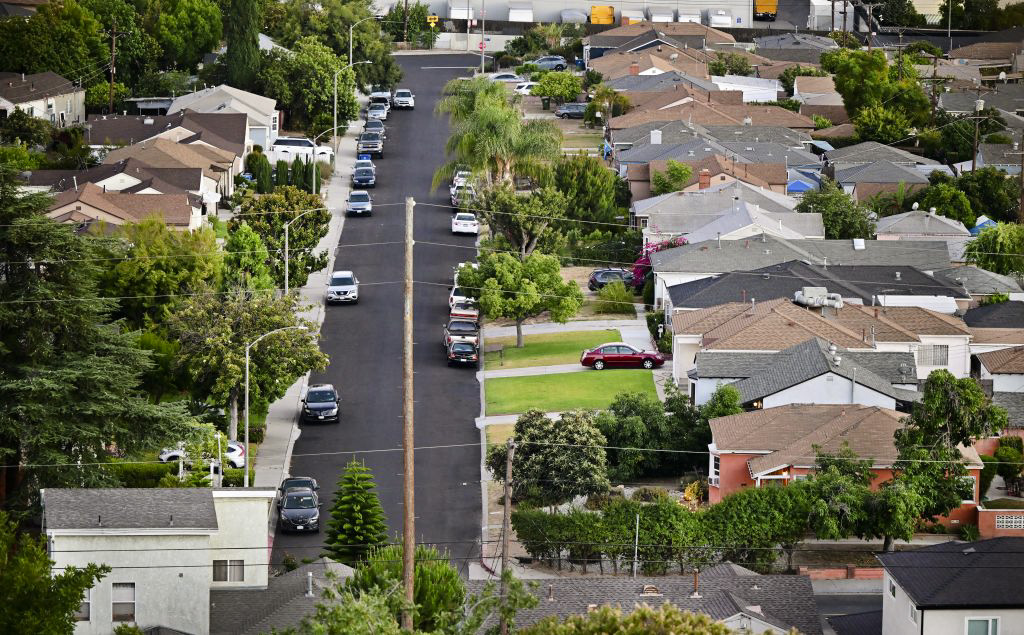

Decades of price gains have left tens of millions of U.S. homeowners in high-cost markets facing potential capital gains taxes reaching hundreds of thousands of dollars on the sale of their primary homes. And the risk is spreading to wider markets, especially fast-growing ones, a new report says.
Real estate professionals and analysts say this may be putting many homeowners on hold, adding to the nationwide housing shortage and worsening affordability pressures in recent years. They point to a nearly 30-year-old capital gains tax exemption law as one contributing factor.
Federal lawmakers are pushing a bipartisan bill to expand the tax exclusion and some are hopeful it will pass this year.
‘An Important Point’
Under the Taxpayer Relief Act passed in 1997, individuals receive a $250,000 tax-free exemption on capital gains from the sale of a primary residence, while married couples receive a $500,000 exemption.
At the same time, the U.S. housing market has seen substantial price growth, with median home prices rising from $129,000 in 1997 to $417,700 at the end of April, more than tripling, according to the National Association of Realtors (NAR). Some high-cost markets now exceed $1 million.
A May 18 analysis by the organization found that about 13.1 million U.S. homeowners—roughly 15 percent of owner-occupied households—hold unrealized capital gains exceeding the current exclusion limit.
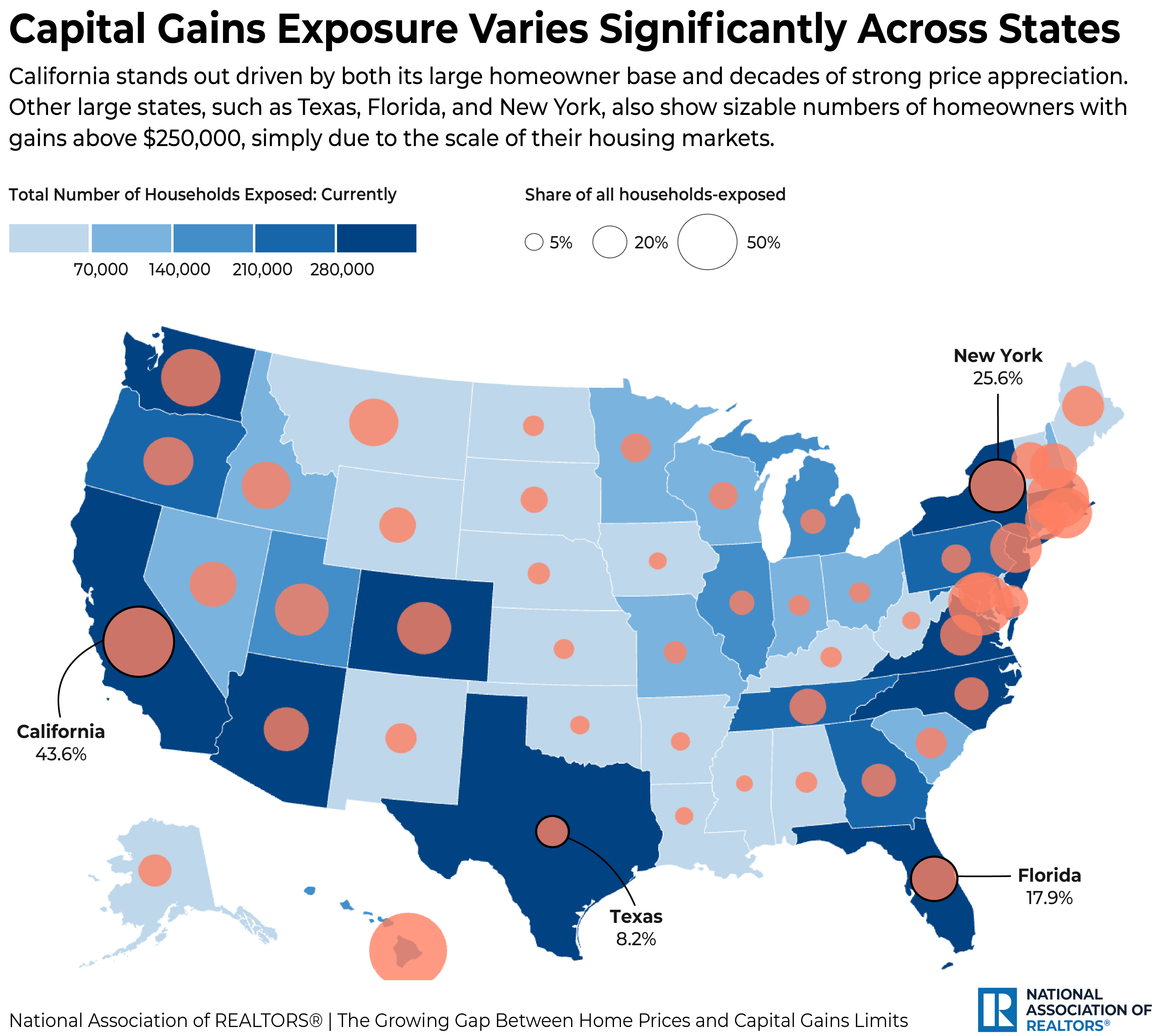
At the state level, about 51.3 percent of homeowners in Hawaii have unrealized capital gains above $250,000, followed by California (43.6 percent), the District of Columbia (36.2 percent), Massachusetts (33.1 percent), and Washington (29.9 percent), the report says. A majority of owner-occupied households in some cities in these high-cost states—including San Jose, San Diego, and urban Honolulu—have exceeded the exclusion threshold, with San Jose at 63 percent.
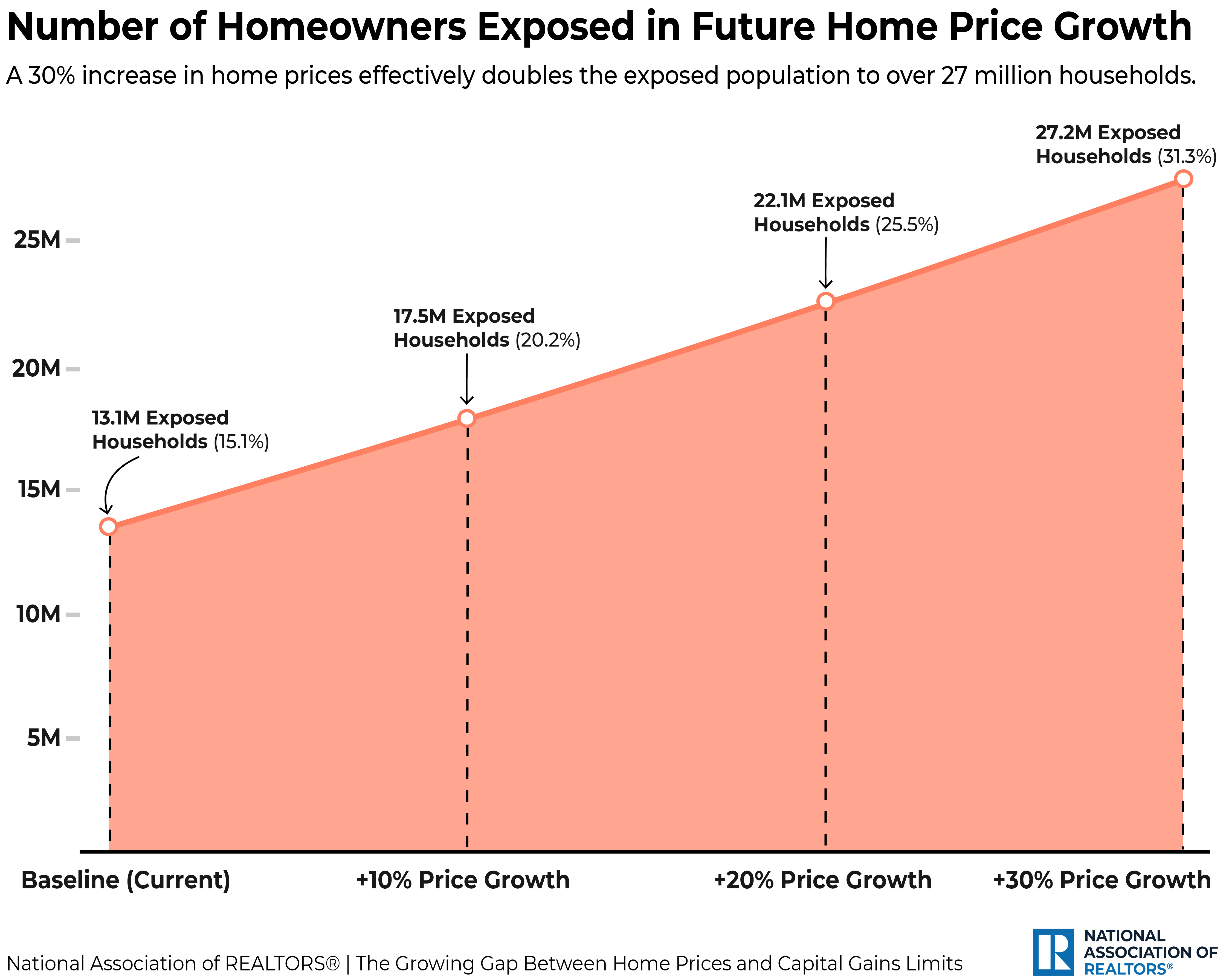
Notably, the report says, states that experienced fast price appreciation in the past 10 years, especially those that have a large number of households who bought their homes just before the housing price boom of the 2000s and the years after 2012, are showing some of the most rapid increases in the share of homeowners approaching the thresholds. These states include Idaho, Utah, Arizona, and Nevada.
The report spotlights Boise, Idaho, and Nashville, Tennessee, as two metropolitan areas where many homeowners purchased their properties before the recent surge in home prices. The share of households with unrealized capital gains exceeding the thresholds in the two cities is 21.5 percent and 17.9 percent, respectively.
“This highlights an important point: capital gains exposure is not just about where prices are highest today, but also about when homeowners purchased their homes,” the report states.
According to NAR, median home prices in five metropolitan areas exceeded $1 million in the first quarter, with the San Jose-Sunnyvale-Santa Clara region topping the list at $2.03 million. Boise and Nashville had median prices of $484,000 and $405,100, respectively.
‘A Much Broader Issue’
The report points out that, adjusted for inflation, the purchasing power of the exclusions has been halved since the Taxpayer Relief Act was passed. That means the $250,000 exclusion is equivalent to about $124,650 in 1997, while the $500,000 exclusion is equivalent to approximately $249,290.
“The biggest misconception is that this involves only luxury homes, but in fact these are just average homes that people bought years ago and have now appreciated so much over time,” NAR economist Nadia Evangelou told The Epoch Times. “It’s definitely a much broader issue than many realize.”
Because capital gains are incurred at the point of sale, Evangelou said homeowners who fear triggering a huge tax liability may simply choose to “wait it out.”
“There’s no way I would give away almost 30 percent of the money I could make on this sale,” Anne Russell, a broker with Rodeo Realty and a Los Angeles homeowner, told The Epoch Times.
Russell has been living in her 3,000-square-foot, five-bedroom home for nearly 40 years. She bought it for $350,000 in 1988 and made many renovations and a major expansion. Currently, she estimates the home’s market value to be about $2.8 million.
Now that her children are grown and have moved out, Russell hopes to sell her property, but says she is “trapped” by the nearly 30-year-old federal capital gains tax law, which would take nearly 15 percent of her profits. The state of California, meanwhile, would impose another 13.30 percent tax.
“Even with deducting all of the major improvements I’ve made to this house over the years, I’d still owe hundreds of thousands in capital gains taxes. This will not move Californians or anyone else in this situation out of their homes,” Russell said.
“This outdated capital gains law has resulted in an artificially-created housing shortage,” Ken DeLeon, founder of DeLeon Realty in Palo Alto, previously told The Epoch Times.
“A lot of older people who have lived in their homes for 30 years or more want to sell, but the value of those homes has tripled or quadrupled now. Some of these sellers could now be facing capital gains taxes of over $1 million.”
Effects on the Housing Market
With about 85 percent of sales involving existing homes, Evangelou said the fastest way to improve inventory is through turnover in existing stock. However, the current capital gains tax laws are stalling that process, she said.
Jonathan Miller, a real estate analyst and director of markets for StreetMatrix in New York City, told The Epoch Times that the financial burden of capital gains taxes is probably one of the biggest incentives against listing a home for sale.
“We’re losing inventory, and that is far more impactful for rising prices of those existing homes that are on the market,” he said. “The more supply we have, the more likely prices will start to stabilize.”
Miller noted that in the Northeast, bidding wars are still very common due to limited supply, with about one in four homes selling above asking price. “That’s not normal,” he said.
Kimberly Schmidt, team lead at Kimberly Schmidt & Associates with Compass in San Diego, said that the outdated limits on the capital gains exemption are seriously affecting the housing supply throughout Southern California.
She told The Epoch Times that San Diego is one of the most constrained and expensive markets in the country, and it’s in pressing need of more inventory.
“With a median countywide single-family home sales price of $1.1 million, and an even higher median price for the coastal areas, sellers could be hit with huge gains taxes,” Schmidt said. “So they usually end up just keeping the house, and that means fewer homes for sale.”
Miller said new construction will have minimal impact on inventory, as new homes account for only about 10 percent of total inventory in most U.S. markets.
Federal Relief Bill
Federal lawmakers from both parties have introduced legislation to address the issue.
First introduced in 2022 by Reps. Jimmy Panetta (D-Calif.) and Mike Kelly (R-Pa.), the More Homes on the Market Act would amend the tax law by increasing the home sales capital gains tax exclusion to $500,000 for individuals and $1 million for married couples.
Panetta remains hopeful that Congress will approve the bill this year.
“One of the ways we are working to pass this bill is to attach it to any next potential tax package,” he told The Epoch Times. “Affordable housing is the number one issue for my constituents, and I will continue to work for federal solutions to increase housing supply and lower housing costs.”
Panetta called the current home sale gains exclusions “outdated” in a statement, noting that the nearly 30-year-old tax thresholds “stifle our real estate market and contribute to a lack of housing supply.”
Kelly added in the statement that people who have made improvements and investments in their homes over the years are being “unfairly punished with massive tax burdens.”
The bill has since gained 121 bipartisan cosponsors, including 22 from California.
New York Republican Congressman Mike Lawler is confident that the More Homes on the Market Act will pass this year.
A major supporter of the bill, Lawler told The Epoch Times that updating the current tax laws will make it easier for long-term homeowners to sell, helping more homes enter the market.
“It’s a simple, common-sense way to ease the housing shortage, give young families a fair shot at buying a home, and allow seniors to keep more of their hard-earned money for retirement and long-term care,” he said.
Panetta said he would continue working with colleagues on both sides of the aisle to pass the legislation, which has also gained support from 40 groups throughout the country, including the National Taxpayers Union, Southwest Public Policy Center, Consumer Choice Center, and American Association of Senior Citizens.
A similar bill, the Capital Gains Inflation Relief Act, was introduced in the Senate in February 2025 by Sen. Ted Cruz. It was referred to the Committee on Finance, where it currently remains.
 Friends Read Free
Copy
Facebook
Tweet
Friends Read Free
Copy
Facebook
Tweet