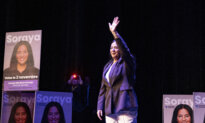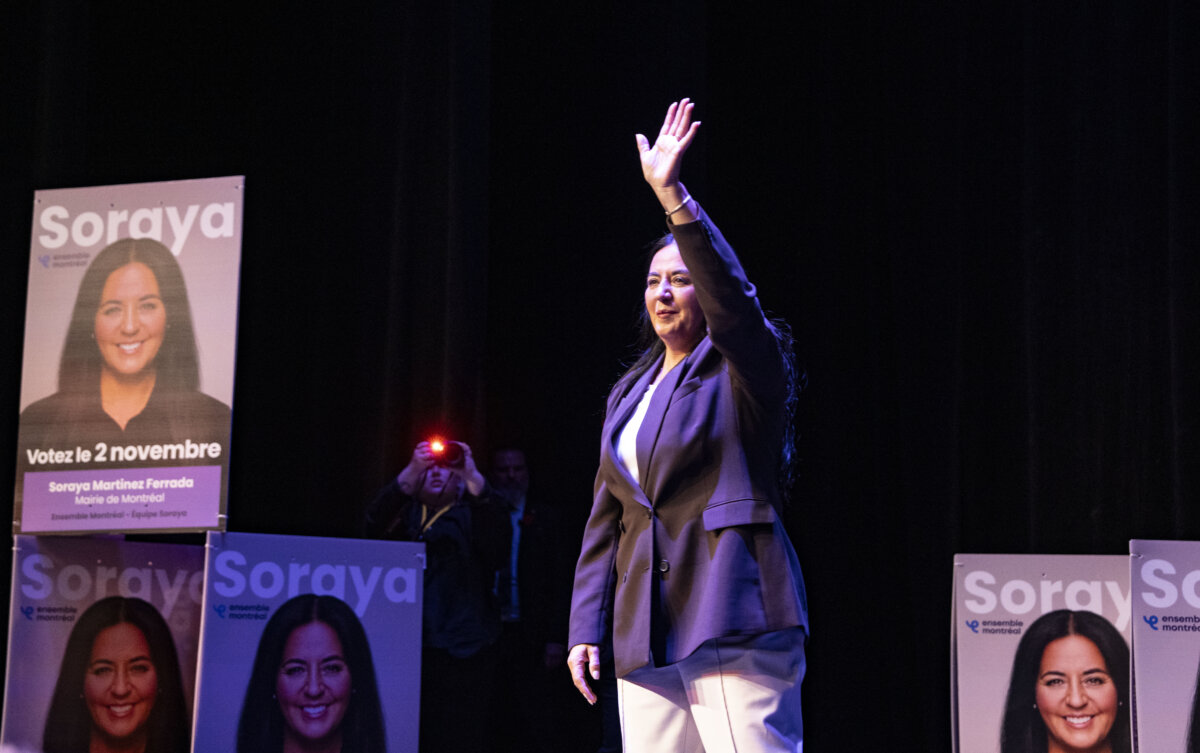

Montrealers have chosen former Liberal Tourism Minister Soraya Martinez Ferrada as their new mayor in a vote that toppled the city’s more left-leaning government after eight years in power.
Martinez Ferrada, a former Chilean refugee and leader of the Ensemble Montréal, is replacing outgoing Mayor Valérie Plante, who announced last year she would not pursue a third term at the helm of Projet Montréal.
Ferrada defeated Plante’s successor as leader of Projet Montréa, Luc Rabouin, by more than 30,000 votes in the Nov. 2 election. Rabouin has since announced his plans to resign as leader of the progressive party.
Martinez Ferrada won 43 percent of the vote while Rabouin took 35 percent.
Action Montréal Leader Gilbert Thibodeau placed a distant third with 10 percent of the vote followed by Transition Montreal’s Craig Sauvé with 8.5 percent, and Future Montreal’s Jean-François Kacou with 2 percent. Three independent candidates also tossed their hats into the ring for the mayoral seat but garnered less than 1 percent of the vote each.
Martinez Ferrada told supporters during her victory speech late on Nov. 2 that Montreal has shattered a new “glass ceiling” by choosing her to lead the city. Plante, who came to power in 2017, was the first female mayor of Montreal and Martinez Ferrada becomes the first Latino to occupy this position.
“We are here tonight because thousands of Montrealers believe in a better city, a city that truly belongs to everyone,” she said. “And this momentum for change arose in every neighbourhood of the city.”
Martinez Ferrada came to Canada as a child refugee from Chile in 1980, when her family escaped the military regime of Augusto Pinochet.
She served as a Montreal city councillor from 2005 to 2009, and transitioned to federal politics in 2019. She was appointed to the cabinet of former Prime Minister Justin Trudeau in 2023 where she served as tourism minister and the minister responsible for the Economic Development Agency of Canada for the Regions of Quebec.
Martinez Ferrada resigned in February to pursue the leadership of Ensemble Montréal. She has pledged to address the issue of homelessness, a central theme of the campaign, with a commitment to triple the city’s budget in addressing the issue and to dismantle the encampments that have arisen throughout the island in the next four years.
Martinez Ferrada has also vowed to eliminate 1,000 city jobs, boost the frequency of the subway system, and complete an audit of the city’s bike paths, a crucial component of Plante’s legacy that has led to discontent among some drivers and business owners. She has suggested that some bike lanes may be taken out.
Voter turnout was down from the previous two municipal elections with just 404,104 of 1,135,883 eligible voters casting a ballot on Nov. 2 to sit at just 35.6 percent. That is down nearly 2 percent since 2021 when 38 percent of voters participated and down nearly 7 percent since 42 percent of voters cast a ballot in 2017.
Quebec Elections
Municipal elections were held across the province on Nov. 2 as more than one million voters headed to the polls.
Incumbent Mayor Bruno Marchand successfully secured re-election in Quebec City, defeating seven challengers for the top office with a vote share exceeding 49 percent. Marchand was first elected mayor in 2021.
Another incumbent to secure a decisive victory is Laval Mayor Stéphane Boyer, who was re-elected with nearly 59 percent of the vote. Laval is Montreal’s largest suburb and the province’s third-largest city
Another former federal Liberal minister, Marie-Claude Bibeau, was elected mayor of Sherbrooke, in Quebec’s Eastern Townships region. She won with 46 percent of the vote.
Slightly more than half of municipal candidates in the province were elected unopposed this year. More than 4,500 individuals, including 564 mayors, have secured their positions through acclamation.
The Canadian Press contributed to this report.
 Friends Read Free
Copy
Facebook
Tweet
Friends Read Free
Copy
Facebook
Tweet