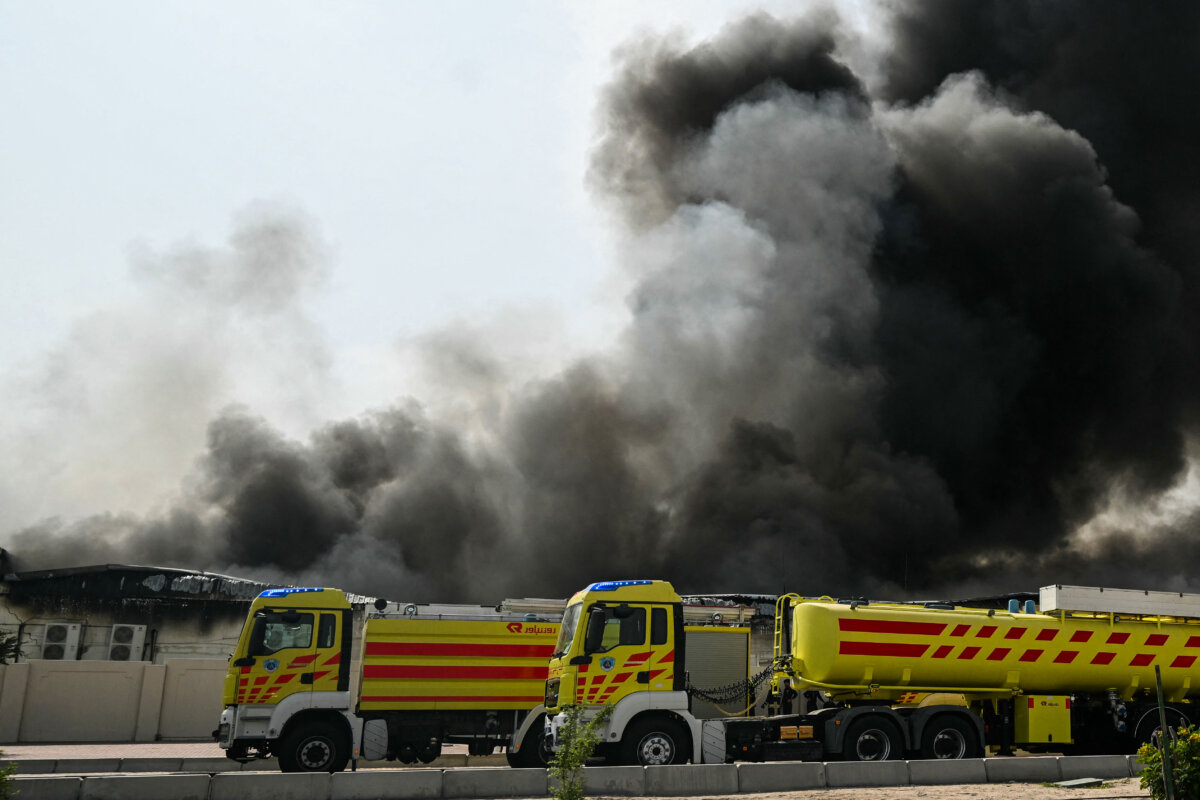

French Finance Minister Roland Lescure said on March 24 that between 30 and 40 percent of Gulf refining capacity has been damaged or destroyed, leaving a shortfall of around 11 million barrels per day on global oil markets.
Speaking before France’s National Assembly, Lescure said the disruption followed attacks on energy infrastructure across the region and warned that restoring capacity could take years.
“Today, 30 to 40 percent of the Gulf’s refining capacity is affected,” the minister said.
He said there has been a 60 percent increase in oil prices and a 70 percent increase in gas prices, linked to the sudden contraction of supplies, in comments published on France’s parliamentary channel La Chaîne Parlementaire on March 24.
However, Lescure ruled out the risk of shortages, at least “in the short term”, indicating that “only 20 percent” of France’s crude oil consumption depends on the Middle East.
“I have been speaking to the Qatari Minister of Energy specifically, and 17 percent of its gas production capacity is destroyed today following the attacks on these facilities, which will take years, we’re talking about at least three years, to restore,” Lescure said in comments he made on the same day, reported by France 24.
“Obviously, those that are shut down will take less time, but we’re talking about several months to restart. And so we are facing an oil market today in which there is a shortage of 11 million barrels every day, and that’s despite the efforts of Saudi Arabia to reopen a pipeline that allows oil exports to the Red Sea.”
Since the United States and Israel launched their Feb. 28 strikes on Iran, shipping traffic through the Strait of Hormuz, one of the world’s most important energy corridors, has slowed to a near standstill.
QatarEnergy’s CEO, Saad al-Kaabi, said on March 19 that Iranian attacks have knocked out 17 percent of Qatar’s LNG export capacity, causing an estimated $20 billion in annual revenue losses and threatening supplies to Europe and Asia.
Lescure said on Thursday that France would announce targeted measures in the coming days to address rising energy prices driven by the conflict.
“In the next few days, we will be able to announce new measures,” he said in an interview with RTL.
“We have already taken steps for those [affected], we are looking at what we call high-mileage drivers, but we will do so again in a targeted manner.”
He added that he had called a meeting of G7 finance ministers, energy ministers, and central bankers on Monday to coordinate a response to the crisis.
Brent crude climbed to $110 per barrel, according to Oil News on March 27. WTI Crude increased to $96.74.
German Defence Minister Boris Pistorius described the conflict as an economic “catastrophe” while speaking during a visit to Australia on Thursday.
“To make it crystal clear, this war is a catastrophe for the world’s economies. The impact is absolutely evident already now, after a little bit more than two weeks,” he said.
“If it comes to a point where we have a cease-fire, we will discuss every kind of operation to secure the peace.”
He also said that Germany did not want to be drawn further into the conflict.
“Nobody asked us before. It’s not our war, and therefore we don’t want to get sucked into that war, to make it crystal clear,” he added.
The economic impact is being reflected in growth forecasts.
The Organisation for Economic Co-operation and Development (OECD) on Thursday downgraded its outlook for the United Kingdom, citing higher energy prices linked to the conflict.
The Paris-based organization cut its 2026 growth forecast for the UK by half a percentage point to 0.7 percent. This compares with a 0.4 percentage point downgrade for the euro area, while the United States saw a 0.3 percentage point upgrade.
“Planned fiscal tightening and higher energy prices are anticipated to keep growth subdued in the United Kingdom, though the impact will be attenuated by lower policy rates next year,” the OECD said in its interim forecast update.
Reuters contributed to this report.
 Friends Read Free
Copy
Facebook
Tweet
Friends Read Free
Copy
Facebook
Tweet