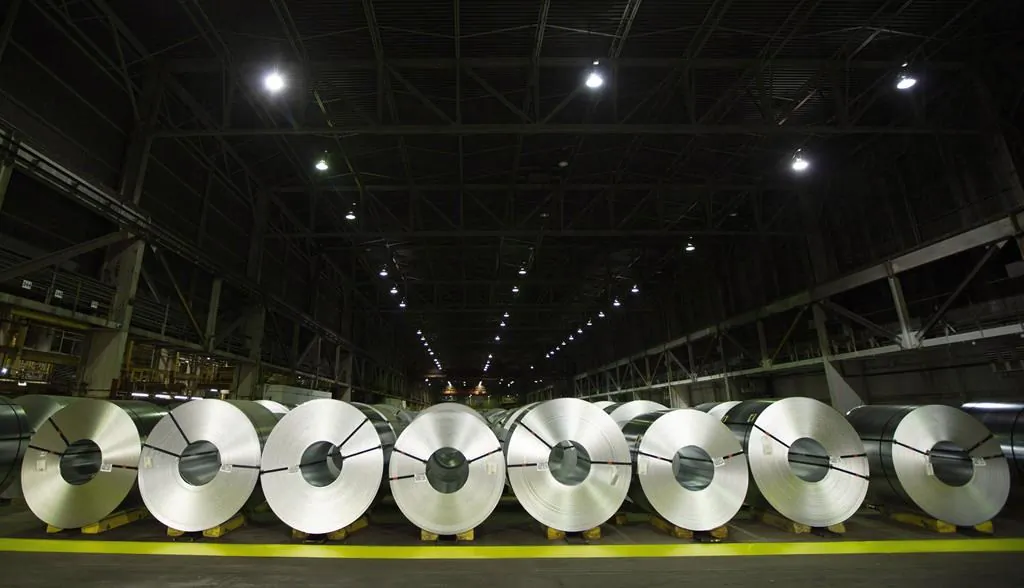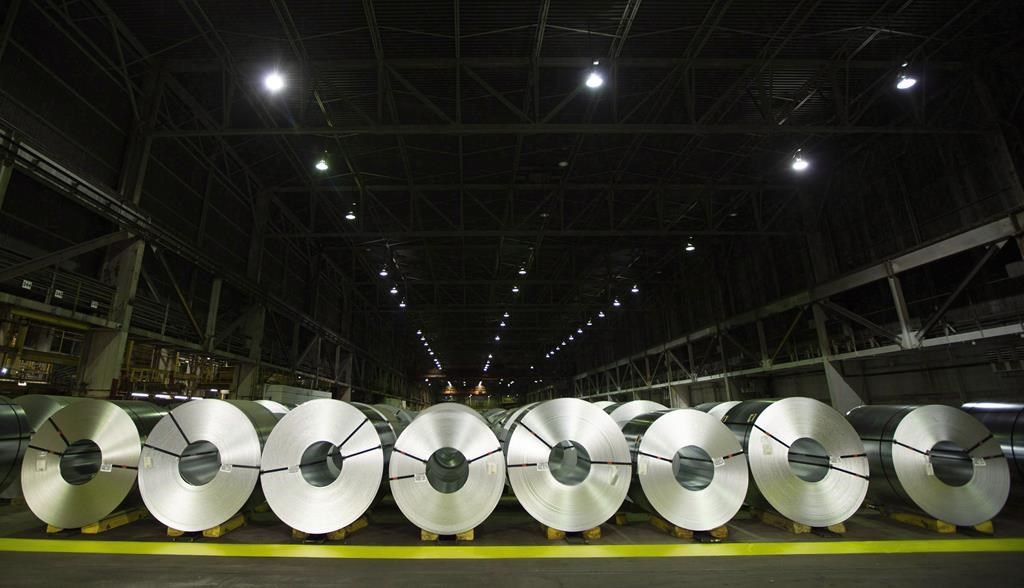

Stelco Holdings Inc. says it will indefinitely idle finishing operations at its steel plant in Hamilton, Ont., due to “market uncertainty,” a move that could affect as many as 500 employees.
The company said on Sept. 28 that it will concentrate production at its Lake Erie Works plant in Nanticoke, Ont. The company added that it will offer jobs at its Lake Erie plant to a “significant” number of affected Hamilton employees.
“In the face of continued market uncertainty and prolonged injury to Stelco’s business resulting largely from steel imports into Canada, we have been forced to make this very difficult decision that will impact as many as 500 Stelco employees,” a company spokesperson said in a statement.
Stelco said the decision will “ensure the survival” of the company as it faces continued pressure from U.S. tariffs and declining demand for its products.
The company said it will idle its cold-rolled and coated operations at Hamilton Works, with the wind-down expected to begin Oct. 9.
It said the move will change its product mix but will not affect total steel production. Stelco also said it will continue to monitor trade measures and domestic market conditions, and will evaluate its operations if conditions improve.
Ron Wells, president of United Steelworkers Local 1005, told media that the union expects about 350 production employees to lose their jobs.
Ohio-based Cleveland-Cliffs acquired Hamilton-based Stelco in a $3.4 billion deal in November 2024.
In a statement to The Epoch Times, a spokesperson for Industry Minister Mélanie Joly said the federal government sympathized with the workers and their families. Her office added that Ottawa has been attempting to work with the company to find ways for it to continue operations, but that the company has rejected the government’s proposals.
“For some time, our government has made clear to the company that we are ready and willing to provide financial support to sustain operations and protect jobs. Its decision to reject these practical proposals and continue with layoffs is extremely disappointing,” Joly’s office said.
“With the union and the Government of Ontario, we are focused on getting workers back on the job and defending Ontario’s steel industry from unjustified tariffs.”
Conservative Leader Pierre Poilievre said the layoffs represent “another devastating blow for Canadian workers, their families, and our steel industry,” following major job losses at Algoma Steel and ArcelorMittal.
“We must unleash Canadian businesses with the fastest permits, lowest taxes, and freest economy so they can hire, make, grow, invent, and build right here at home,” Poilievre said. “Conservatives will continue to fight every day to save Canadian jobs and deliver an affordable, safe, and independent country.”
Steel Tariffs
Stelco’s move comes as U.S. tariffs continue to affect Canada’s steel industry. Washington currently has sectoral tariffs on a number of Canadian products, including steel, aluminum, copper, and autos, ranging as high as 50 percent.
On Sept. 28, Trump also announced plans for the biggest steel plant in U.S. history, outlining that Mesabi Metallics would construct a US$15 billion facility in Iowa. The plant will produce 10 million tons of steel per year once fully operational.
Mesabi’s development marks the first so-called mega-steel plant built in the United States in more than 60 years. The Bethlehem Steel Burns Harbor Works in Indiana was built near Lake Michigan between 1962 and 1964.
Mesabi recently invested US$2.5 billion in an iron ore production plant in Nashwauk, Minnesota, which will provide material for steel production at its new Iowa operation.
Travis Gillmore and The Canadian Press contributed to this report.
 Friends Read Free
Copy
Facebook
Tweet
Friends Read Free
Copy
Facebook
Tweet