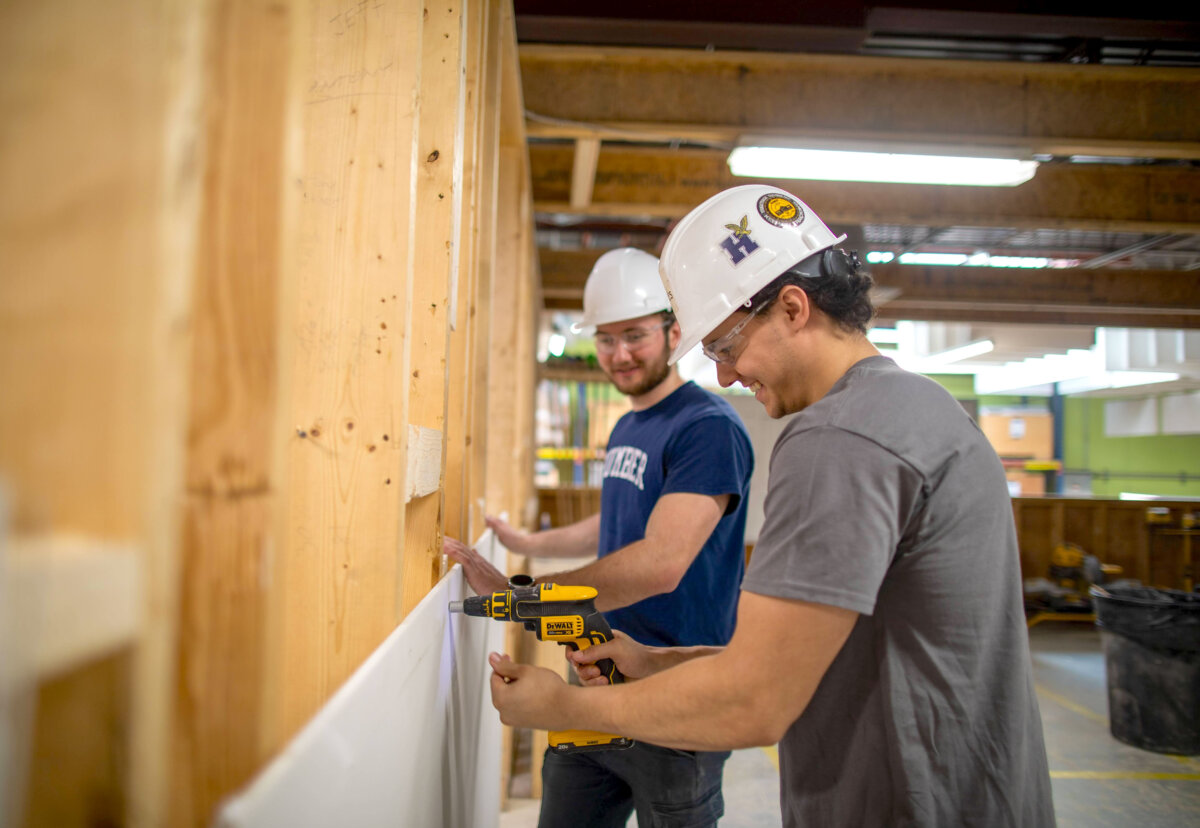

James Passafiume always knew he wanted to pursue a career in construction, but after high school he was confronted with the dilemma of choosing between an office management position or a more hands-on role at the worksite.
He chose the latter option, attending Humber Polytechnic’s Building Construction Technician program in Toronto, where he learned the practical aspects of managing job sites.
“The only real comparison I was weighing was the office side of construction—project management—but I realized I wanted to be more hands-on. I wanted to be active, on tools, not sitting behind a desk,” Passafiume, 23, told The Epoch Times.
Passafiume’s career path and quick success in finding a job after graduation mirrors a broader trend in the Canadian economy as college diploma and certificate holders outpace those with bachelor’s degrees and higher in the job market.
He said about half of his friend circle is in the trades, while the other half who have entered white collar professions are having “a little bit” of trouble finding good jobs.
Passafiume graduated in December and has already found a job in his field, which he said is going well.
He said many of his friends are particularly interested in getting into heating, ventilation, and air conditioning work (HVAC), while others have considerable enthusiasm for pursuing careers as electricians, millwrights, plumbers, and carpenters.
Trades Trending
The unemployment rate for 20 to 29-year-olds holding a college diploma was 6.4 percent in September, but 8.1 percent for those in the same age group holding a bachelor’s degree or higher, according to Statistics Canada.
Michael Auchincloss, associate dean of Humber’s Faculty of Applied Science and Technology, says the growth in interest in the trades has been enormous at the college over the past few years.
“Our HVAC labs run from 8 in the morning to 10 at night, six days a week,” Auchincloss said in an interview with The Epoch Times. “Plumbing, carpentry, electrical—it’s the same story across the board.”
Auchincloss said that although young people are becoming more interested in the trades, it’s often the case that their parents are encouraging them to give the trades a second look after seeing the obstacles faced by university graduates.

“There’s been a real mindset shift,” he said. “People are realizing the trades are not what they were stereotyped to be, and that they offer real, long-term opportunity.”
It’s not just his students, either. Auchincloss’s eldest son, Samson, obtained a bachelor’s degree in history with a minor in English from the University of Toronto but ended up having trouble finding work in his field immediately after graduation, so he began doing construction and painting on the weekends to make ends meet.
“Growing up, he did a lot of building with me, construction with me, because I’m an electrician by trade, and know a lot about all the trades, so he was able to open up an actual business to do renovations at that time,” Auchincloss said.
Samson now also works as a student adviser at a post-secondary institution, but continues to do construction work in his time off.
‘Become a Plumber’
The growing interest in the skilled trades is something Aunchincloss also attributes partly to the enduring viability of such work amid the rise in artificial intelligence (AI), machine learning, and automation.
“AI will never replace the hands-on work that needs to be done,” he said. “The skilled trades will never be replaced, not until you get that Jetsons robot—whatever it was back in the day—to start putting things together.”
The Future Skills Centre concluded last year that 57.4 percent of Canada’s workforce was in jobs that were highly exposed to AI, including administrative positions, customer service reps, accountants, editors, and designers.
The trades and skilled blue-collar jobs, by contrast, are seen by an increasing number of experts The Epoch Times spoke with as a field that’s increasingly in demand by Canada’s job market and particularly resilient to technological shocks.
Boxi Yang, a senior research associate with the Education and Skills team at the Conference Board of Canada, and Mark Patterson, executive director of Magnet at Toronto Metropolitan University, both say demand for work in the trades is surging and won’t be cut short anytime soon by the rise of AI and machine learning.
“We’re definitely facing a lot of undersupply of health-care workers and STEM workers and trades, yes, definitely trades in construction, electricians, and so forth,” Yang said in an interview. “So those are the fields that, under today’s circumstances, are definitely in huge hiring demand.”
Even Geoffrey Hinton, the 2024 Nobel Laureate in Physics known as the “Godfather of AI,” has been clear in his advice to young people entering the job market, telling a father to advise his son to “become a plumber, not an AI expert.”

Trades in the Age of AI
AI is already impacting Canada’s economy, but the impact on manual labour is improving processes more so than eliminating jobs, according to Auchincloss.
The Magnet initiative at Toronto Metropolitan University focuses on workforce development in the age of AI and digital technology, and Patterson says AI can be an assistance to enhance the trades as long as they adapt to work side by side.
“AI and machine learning will transform manual labour, but not through a single wave of job loss. Over the next decade we’ll see augmentation as tools become smarter and more embedded in everyday tasks,” he told The Epoch Times.
“By 20 to 30 years, robotics and automation will take on more routine physical work. The bigger issue for Canada is whether workers and employers build the capacity to adapt.”
Patterson said trades like electricians, carpenters, and plumbers will be especially resilient to job loss from AI because they work in fields that require human judgment.
“Skilled trades that involve complex physical environments, variable conditions, and human judgment remain highly resilient,” he said.
However, he noted that “even the most durable trades are being reshaped by AI powered tools, robotics, digital diagnostics, and new materials” and that “tradespeople will increasingly need digital fluency and adaptive capacity alongside hands-on expertise.”
Patterson said there’s been a growth in AI literacy along with a rising interest in the trades.
“We’re seeing growth in two areas: AI literacy across all programs, and rising interest in the trades. Students recognize that every job is becoming a hybrid of technical tools and human centred skills,” he said.
“Canada needs both strong skilled trades and more people with deep technical and domain expertise in every sector.”
At Humber, Auchincloss said they’re already integrating AI and robotics into several of their trades diplomas, including by teaching students how to program and utilize robotic welders.
“AI is just another tool in the toolbox,” he said. “It will never replace the hands-on work that needs to be done.”
Passifiume agreed, noting that job sites are rarely operated entirely by the book and require human judgment and unique responses when things don’t go as planned.
“It’s very rare when you’re on a job site where it’s kind of 100 percent pitch perfect,” he said.

Humber Polytechnic’s Carrier Drive Campus in Toronto on May 10, 2023. (Courtesy of Humber Polytechnic)
Auchincloss also noted that digital tools are reshaping construction, giving the example of how drones equipped with LiDAR (Light Detection and Ranging) can rapidly survey job sites that would formerly have taken long periods of time and large crews to complete.
Yang echoed this, writing in an October report she co-authored with Labour Market Information Council senior economist Pete Nelson that the trades are much more insulated from job elimination due to technological advances.
“Many certificate or diploma holders are entering occupations that are more insulated from automation and economic volatility—such as those in the skilled trades and health care. These sectors are proving resilient, offering hands-on work that is difficult to outsource or mechanize,” they wrote.
“The degree premium may still apply in the long run, but in the short term, young graduates are encountering bottlenecks while their college-trained peers find more open doors.”
Career Evolution
For a generation coming of age alongside AI, the trades and technology are both likely to become increasingly integrated. But the rise of skilled trades is likely to continue to outpace white collar jobs in the near future as AI replaces many entry-level white collar jobs, according to Yang.
For Passafiume, working in the trades isn’t just about a steady paycheque and resilience in the face of technological change, it’s also about the many opportunities for growth.
“Once you get into it, you get more hungry,” he said. “There is tons of work out there, and there’s going to be more.”
 Friends Read Free
Copy
Facebook
Tweet
Friends Read Free
Copy
Facebook
Tweet