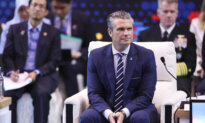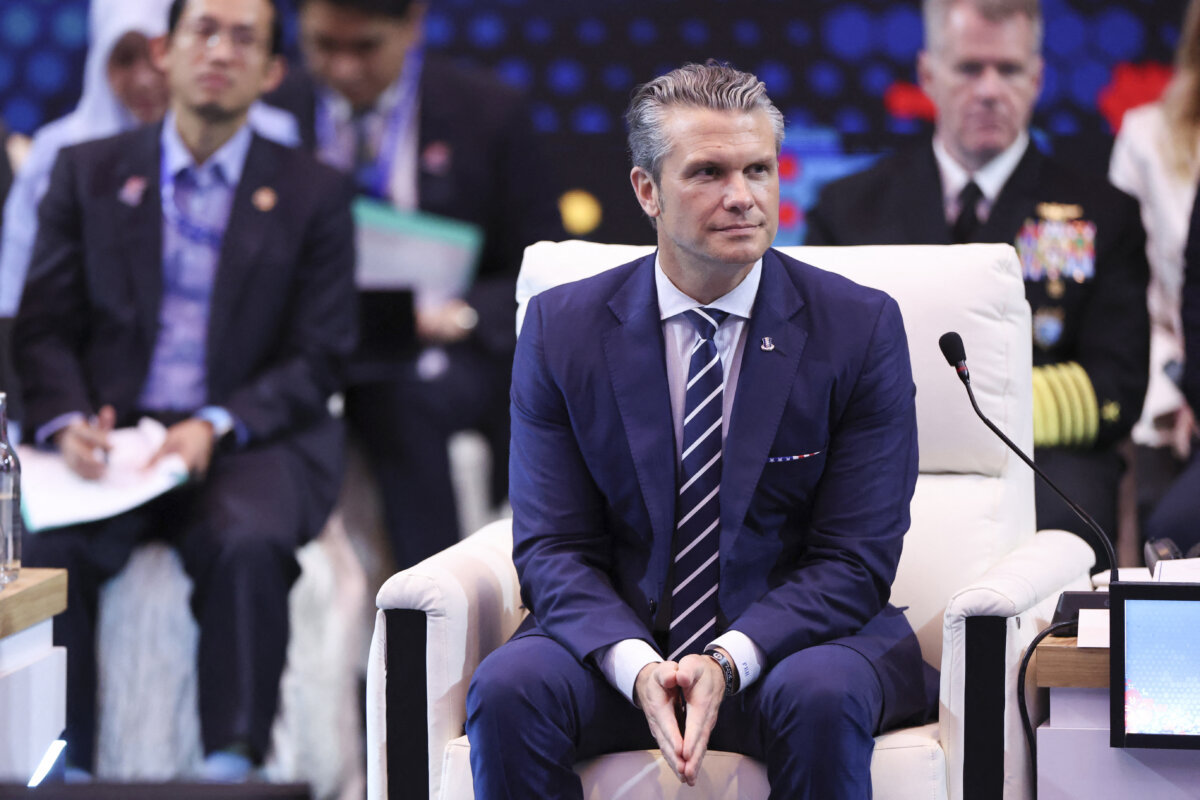

U.S. War Secretary Pete Hegseth criticized China’s increasingly “destabilizing” actions in the South China Sea in remarks on Nov. 1, calling on Southeast Asian countries to work closely with the United States to face Beijing’s aggression.
Hegseth made the remarks while meeting with his counterparts from the Association of Southeast Asian Nations (ASEAN) on his second day in Kuala Lumpur, Malaysia. He said China’s provocative actions, including using its vessels to ram other ships and firing water cannons, threaten the sovereignty of its neighbors and undermined regional stability.
He said he welcomed hearing perspectives on the threats that all nations face “from China’s aggression and course of actions in the South China Sea and elsewhere.”
“China’s sweeping territorial and maritime claims in the South China Sea fly in the face of their commitments to resolve disputes peacefully,” he said. “We seek peace. We do not seek conflict. But we must ensure that China is not seeking to dominate you or anybody else.”
The South China Sea is one of Asia’s most contested regions. China continues to ignore the 2016 ruling by the Permanent Court of Arbitration in The Hague, Netherlands, which rejected Beijing’s claims to almost the entire region, while ASEAN members—the Philippines, Vietnam, Malaysia, and Brunei—also lay claims to parts of the waters. The Philippines has borne the brunt of China’s maritime aggression in the South China Sea in recent years.
The Philippines has repeatedly called for a stronger regional response. In 2024, Philippine Defense Secretary Gilberto Teodoro Jr. said ASEAN “cannot continue to ignore what China is doing in the South China Sea” if the group wants to remain “relevant and credible.”
Hegseth criticized China’s decision to set up a “natural reserve” at Scarborough Shoal, seized from Manila in 2012 and located within the Philippines’s 200-mile exclusive economic zone. He told his counterparts that it was “yet another attempt to coerce new territorial and maritime claims” at their expense.
The United States and ASEAN should partner to build a “shared maritime domain awareness” network, Hegseth said.
“We need to develop our joint capabilities to respond, and this includes being able to monitor maritime conduct and develop the tools that allow us to respond quickly … ensuring that whoever is on the receiving end of aggression and provocation is then, therefore, by definition, not alone,” Hegseth said.
“No one can innovate and scale like the United States of America, and we’re eager to share those capabilities with allies and partners.”
The Pentagon chief urged ASEAN to expedite the finalization of a long-delayed Code of Conduct with China aimed at governing behavior in the South China Sea.
Hegseth said he looked forward to the second U.S.–ASEAN maritime exercise in December, aimed at boosting regional coordination and safeguarding freedom of navigation. The first exercise was held in 2019.
A day before Hegseth’s remarks, Australia, New Zealand, the Philippines, and the United States concluded a two-day “multilateral maritime cooperative activity” in the South China Sea. According to a statement from the U.S. Indo-Pacific Command, U.S. Navy Arleigh Burke-class guided-missile destroyer USS Fitzgerald and a P-8A Poseidon maritime patrol and reconnaissance aircraft took part in the exercise.
The Armed Forces of the Philippines stated that it was the 12th such joint exercise with the three other nations, reflecting their commitment to a rules-based international order in the Indo-Pacific, the Philippine News Agency reported on Nov. 1.
On Oct. 31, Hegseth held an in-person meeting with Chinese Defense Minister Adm. Dong Jun on the sidelines of the ASEAN meeting, where the Pentagon chief voiced U.S. concerns about China’s activities in the South China Sea, around Taiwan, and toward U.S. allies and partners in the region.
Hegseth said he spoke with Jun late on Nov. 1 and that the two agreed to establish direct communication between their militaries to “deconflict and deescalate any problems that arise,” according to a post on X. He noted that there will be “more meetings” to work out the details of the agreement.
Reuters and The Associated Press contributed to this report.
 Friends Read Free
Copy
Facebook
Tweet
Friends Read Free
Copy
Facebook
Tweet