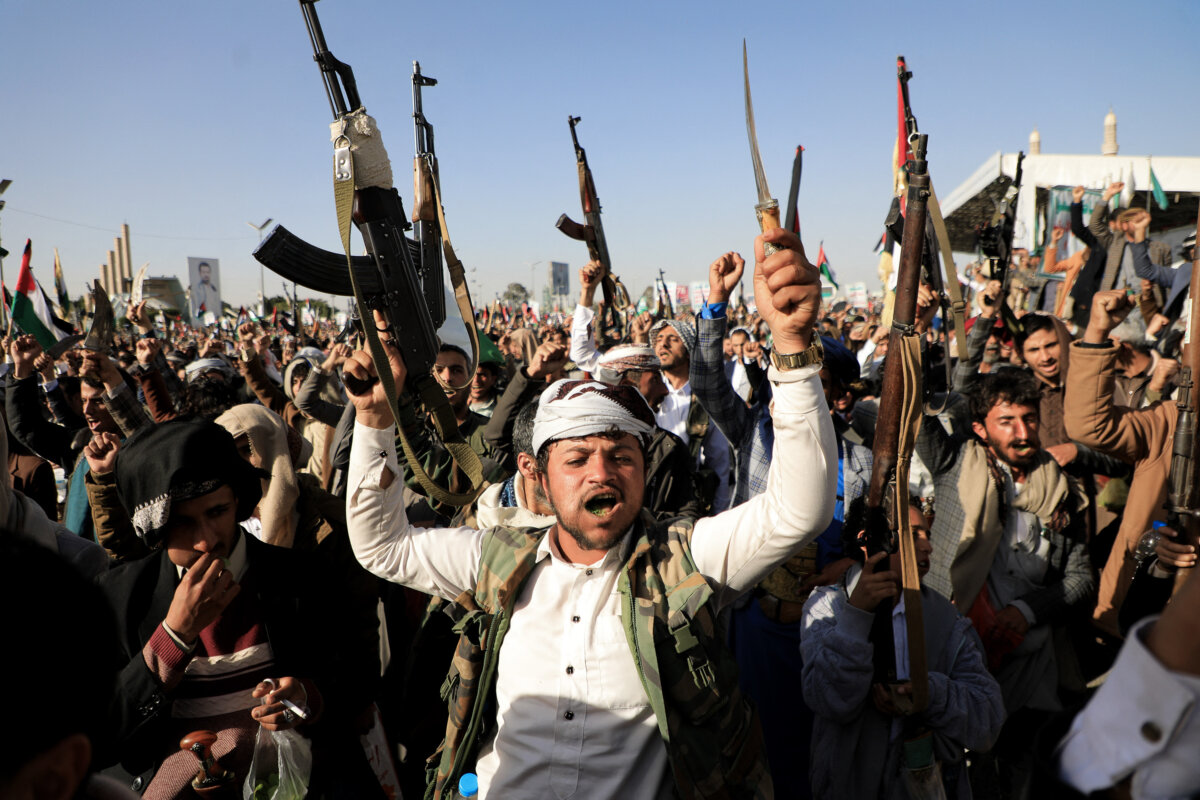


Yemen’s Houthis notched battlefield gains along the country’s Red Sea coastline on Sept. 9 and Sept. 10, amid intensifying fighting with the forces of Yemen’s internationally recognized government.
In a statement shared with The Associated Press, Ahmed Baasha—commander of the Yemeni government-aligned National Resistance Forces—confirmed Houthi forces had taken over the Red Sea port city of Mokha.
Hazam al-Assad, a member of the Houthis’ political bureau, also confirmed the capture of Mokha to The Associated Press.
The takeover of Mokha marked the Houthis’ biggest territorial gain since a 2022 ceasefire between the Iran-aligned terrorist group and the Yemeni government.
The port city is located approximately 50 miles from the Bab al-Mandeb Strait, which is a key waterway connecting the Red Sea and the Gulf of Aden.
About 12 percent of the world’s goods are shipped through the strait.
In a letter to the United Nations Security Council, Yemeni Foreign Minister Afrah Al-Zouba also described Houthi advances near western Taiz and southern Hodeidah, the Yemeni state-run SABA News Agency reported.
Al-Zouba called for an emergency U.N. Security Council meeting to discuss the increased threat Houthi forces could pose to shipping in the neighboring Red Sea and Bab al-Mandeb Strait, following these territorial gains.
The Houthis, which are designated as a foreign terrorist organization by the United States, seized control over the Yemeni capital city of Sanaa in late 2014 and have since consolidated power over an area of northwest Yemen representing about 80 percent of the country’s population.
They have continued to clash with the forces of the Yemeni government, which have support from the Kingdom of Saudi Arabia.
Fighting within Yemen had reached a stalemate and subsided following the 2022 ceasefire but has flared up again in recent weeks.
In July, the Houthis began attacking ships linked to Saudi Arabia and threatened to further blockade Saudi shipping through the Bab al-Mandeb Strait and Red Sea.
Shipping in the Bab al-Mandeb Strait has dropped by roughly 60 percent since the Houthis started attacking ships passing through the waterway in 2023.
During a meeting with European ambassadors on Wednesday, Yemeni President Rashad Muhammad al-Alimi warned that the Bab al-Mandeb Strait must not become like the Strait of Hormuz, SABA News Agency reported.
Al-Alimi also warned that Yemen could not become a platform for the Iranian regime to engage in additional geopolitical blackmail.
Shipping through the Strait of Hormuz has slowed in recent weeks as Iran has attacked multiple commercial vessels in the waterway.
On Sunday, Iranian security official Mohsen Rezaei indicated Tehran was planning to announce a new restricted zone in the Gulf of Oman.
In addition to the territorial gains in Yemen, the Houthis also carried out ballistic missile and drone attacks on the Saudi Arabian cities of Abha, Khamis Mushait, and Jazan on Sept. 9.
The attacks came after the terrorist group struck an airbase in Khamis Mushait and targeted oil infrastructure, injuring 73 people in Saudi Arabia’s southern border region on Sept. 8.
The Houthis previously declared a naval blockade against Saudi Arabia in the Bab al-Mandab Strait on July 20.
The Iran-aligned group later claimed strikes against two Saudi Arabian oil tankers in the Red Sea on July 23.
Secretary of State Marco Rubio suggested on Tuesday that Iran was behind some of the Houthi terrorist group’s recent actions.
“The Houthis, in many ways, are agents and proxies of the Iranians,” he told reporters. “I think behind some of this is clearly the Iranian hand.”
 Friends Read Free
Copy
Facebook
Tweet
Friends Read Free
Copy
Facebook
Tweet