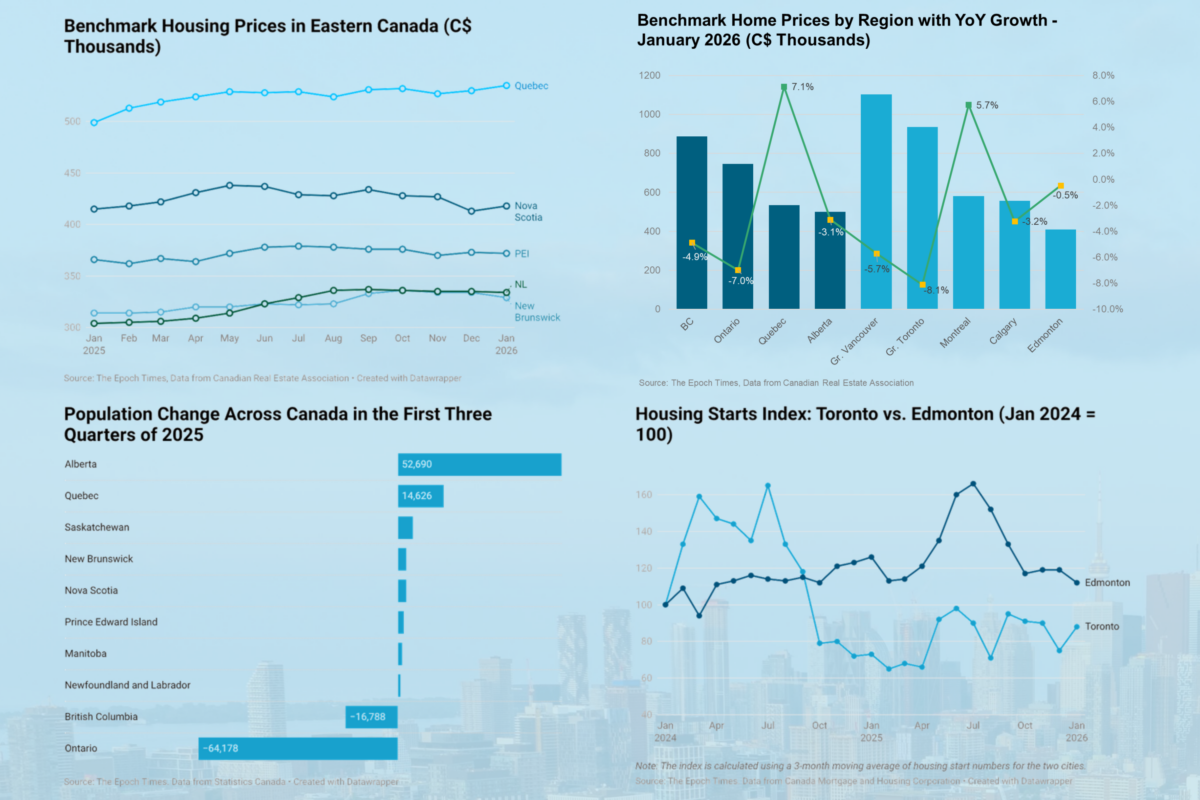

Canada’s housing market is experiencing a regional split, with housing activity cooling in some provinces while prices continue to rise in others.
Ontario, British Columbia, and Alberta are seeing benchmark home prices fall on an annual basis, while prices in Saskatchewan, Quebec, and the maritime provinces are still running hot, with continued annual gains, according to a monthly housing activity report from WOWA, a personal finance encyclopedia.
The trend is also reflected in the Canada Mortgage and Housing Corporation’s Housing Market Outlook 2026, which said regional housing markets “vary significantly.” It said construction and home sales in Ontario and B.C. will remain “weaker than their 10-year averages” while the Prairies and Quebec will remain above their historical averages.
The report said overall national home demand is subdued, but home sales are expected to pick up temporarily in 2026, led by Ontario and B.C. The report said those provinces have had “some of the weakest sales in decades,” so their rebound will mostly be due to pent-up demand from recent weakness rather than a sustained recovery.
Home sales in the Prairies and Quebec are likely to stay above historical averages throughout the year, but moderate in the second half, the report said.
Experts told The Epoch Times that the split between provinces reflects differing market conditions: some cities had overheated markets that were more susceptible to corrections when the overall market cooled, while other cities—particularly in the Maritime provinces—remain attractive to buyers due to lower home prices.
Geographical constraints on building new housing in some cities in Quebec, Prince Edward Island, and New Brunswick have also played a role in keeping housing prices elevated.
High prices are also limiting how many Canadians can participate in the market overall, contributing to cooling trends, says Eric Miller, president of Rideau Potomac Strategy Group. He said there are “just not that many Canadians with an ability to buy at these prices,” especially in expensive cities like Toronto and Vancouver.
“There’s only so many people out there who can afford that, even if they’re doing a 30-year mortgage, long-term kind of play. B.C. and Ontario—they’re the first ones to see major cooling,” he said.
David Amborski, a professor at Toronto Metropolitan University’s School of Urban and Regional Planning, said the housing markets in Toronto and Vancouver were overvalued relative to other cities, so they underwent “more of an adjustment” in prices when the federal government announced a reduction in immigration levels in October 2024.
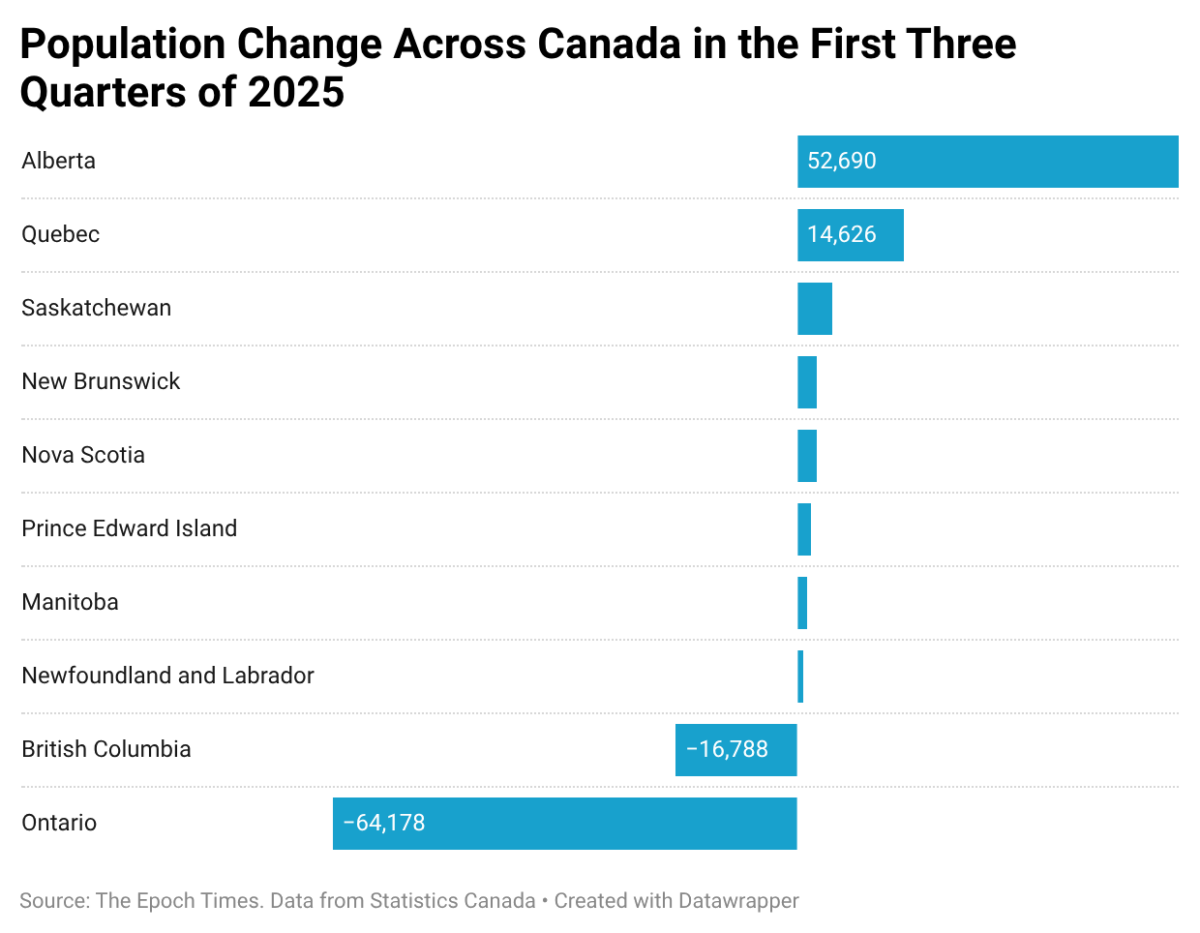
Canada’s population rose by more than 3 million from 2020 to 2025, increasing pressure on housing across the country. The Liberal government began lowering its target immigration levels in 2024.
In the first three quarters of 2025, Ontario and B.C. were the only provinces with population decreases due to immigration outflows. The population of Ontario fell by 64,178 people, while B.C.’s population dropped by 16,788. Populations continued to rise in the other provinces.
Cooling in Ontario, BC, Alberta
The WOWA report said that benchmark housing prices across Canada fell by 4.9 percent year over year. Unlike average housing prices, benchmark prices gauge the value of a “typical” home by adjusting for the type, size, and features of homes.
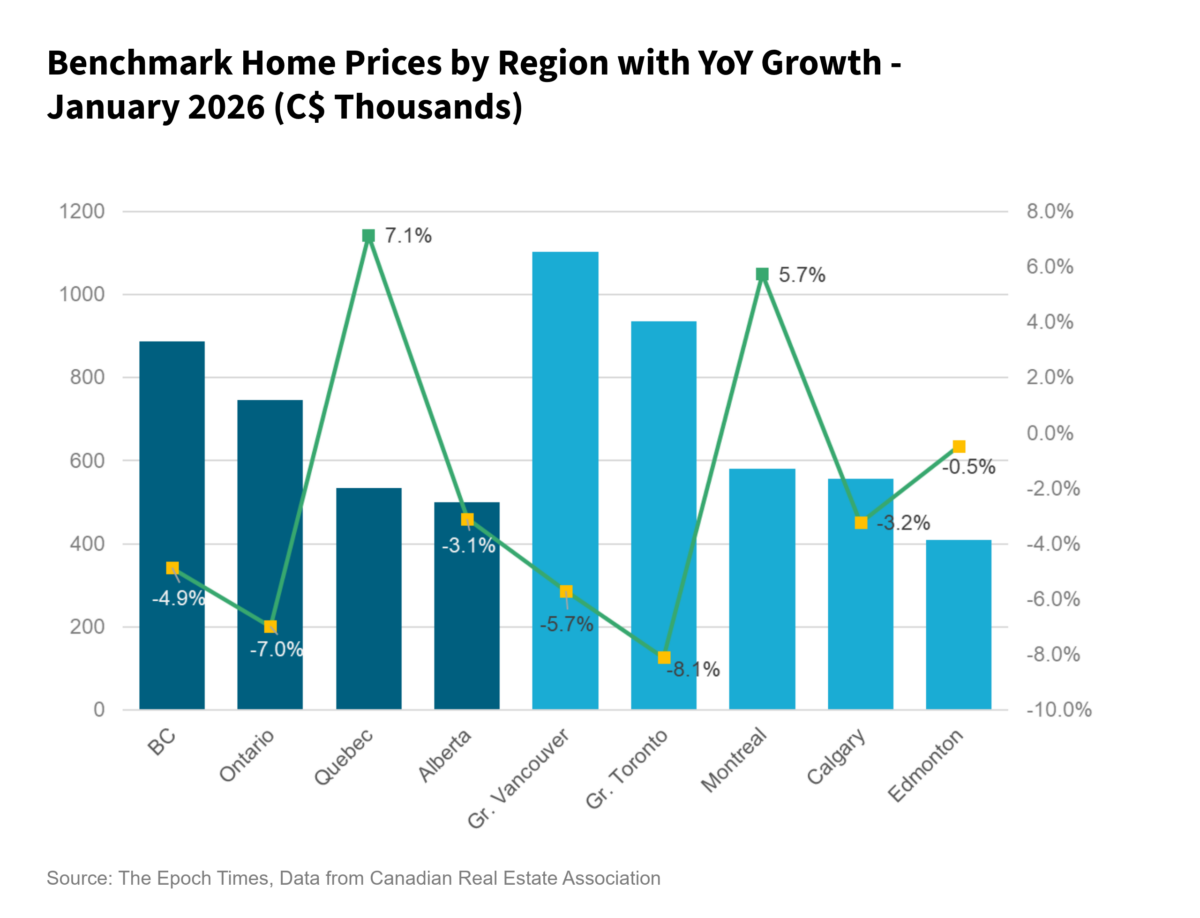
The two provinces with the highest average benchmark home prices—Ontario and B.C.—also recorded the largest annual price declines. Ontario saw the steepest drop, with the benchmark price falling 7 percent from a year earlier to an average of $745,800.
In B.C., which saw the second-largest decline, prices dropped 4.9 percent on an annualized basis. However, B.C. still has the highest benchmark housing price of any province, at $886,200.
Alberta’s benchmark housing price fell by 3.1 percent from a year earlier, with the average price in January 2026 at $499,300.
Amborski attributed reduced housing activity in Ontario and B.C. to larger price corrections in Toronto and Vancouver, which have the highest housing prices in Canada.
In January 2026, the benchmark price for a home was $1,101,900 in Greater Vancouver and $935,200 in the Greater Toronto Area (GTA). Year-over-year benchmark prices fell 5.7 percent in Vancouver and 8.1 percent in the GTA.
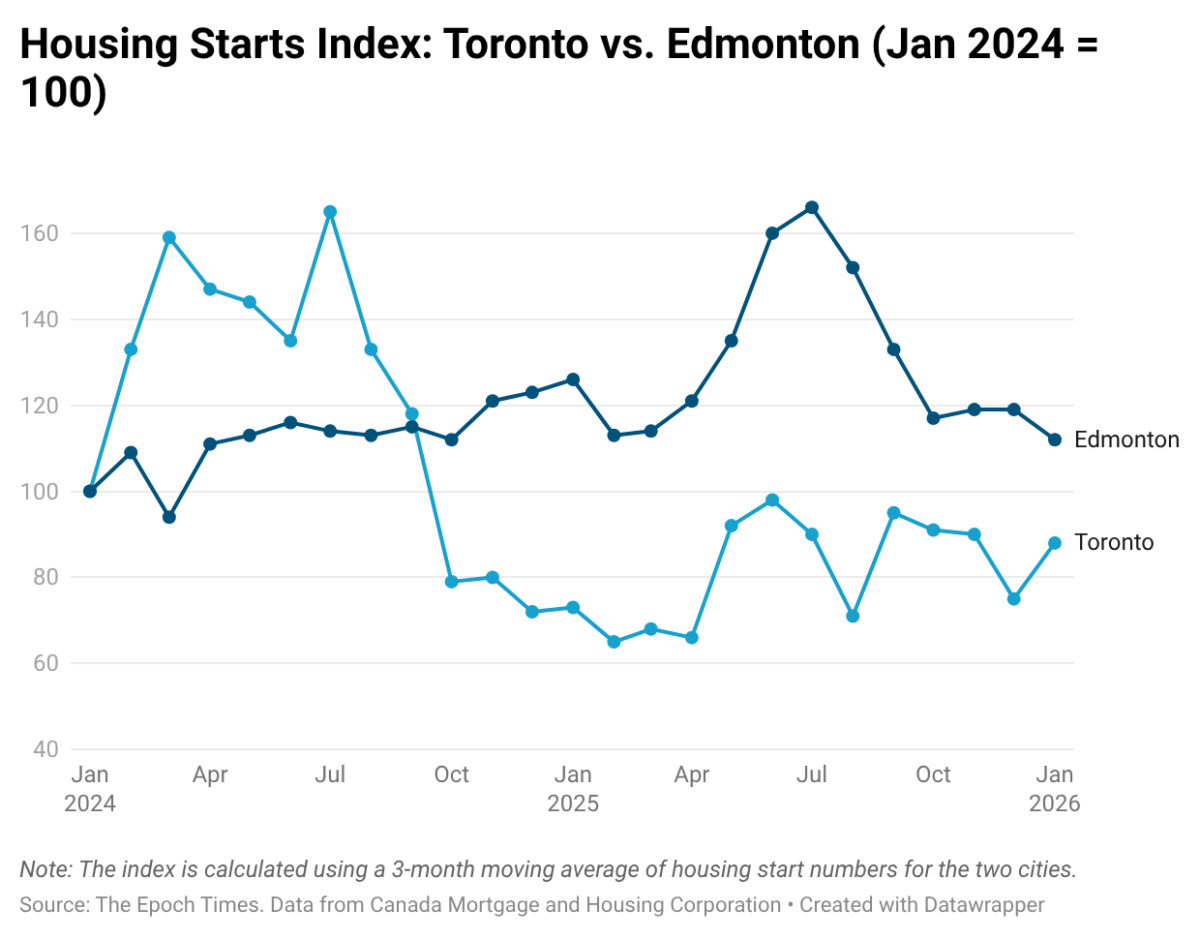
Amborski said that while Toronto and Vancouver have typically had a shortage of housing that would keep prices elevated, Edmonton has not had the same problem. He said the city is the “poster child for supply” when it comes to housing, which has led to cooling housing activity.
The CMHC’s Fall 2025 Housing Supply Report found “robust growth in housing starts” in Edmonton in the first half of 2025. It said the city’s “relative affordability kept developers feeling optimistic” despite the economic uncertainty that has led to fewer housing starts in other cities across Canada.
For Calgary, the CMHC report also said “positive builder sentiment” has kept housing starts high, but weaker sales so far in 2026 have increased the number of houses available for sale.
Eastern Provinces Remain Hot
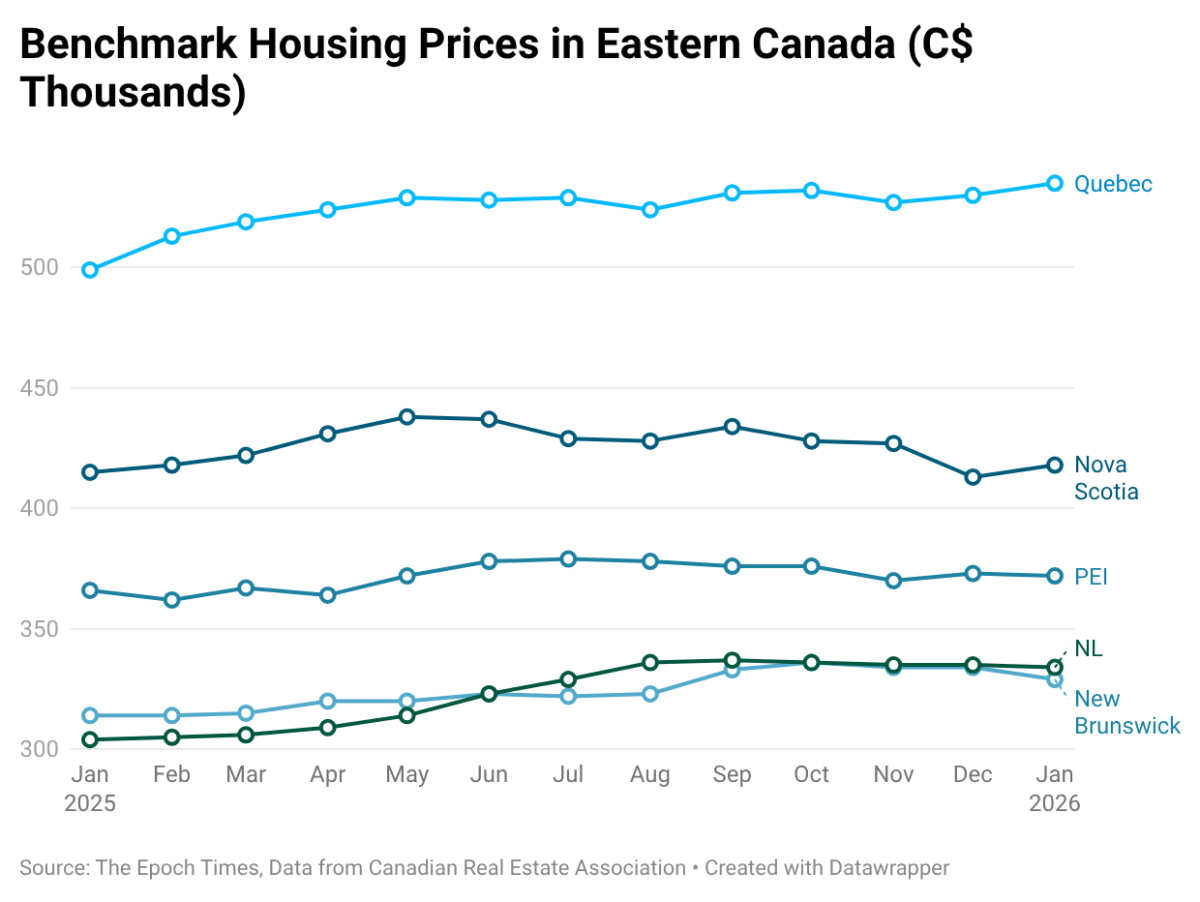
The WOWA report indicated that benchmark housing prices rose in all provinces other than Ontario, B.C., and Alberta on a year-over-year basis. Newfoundland and Labrador, which has some of the lowest housing prices in Canada, led the gains, with prices increasing by 9.7 percent to $334,000.
Benchmark housing prices in Quebec rose 7.1 percent year over year to $535,000. They rose 5.6 percent in Saskatchewan to $359,500, 4.8 percent in New Brunswick to $329,400, 1.7 percent in Prince Edward Island to $371,700, and 0.6 percent in Nova Scotia to $417,700. WOWA benchmark pricing did not include Manitoba.
Rideau Potomac’s Miller also said geographical constraints in eastern provinces have played a role in reducing the available housing supply and pushing prices upwards. He said this is especially true in Halifax. Nova Scotia’s largest city sits on a peninsula surrounded by water, which restricts how much new housing can be built.
“There’s also been a huge amount of speculation in the Halifax market … outside buyers who are acquiring properties, not for the purposes of living in them, but as an investment,” Miller said.
He said the Island of Montreal in Quebec has had this same issue, as there are “geographic limits on building in the central part of the city,” which has tended to push prices upwards.
 Friends Read Free
Copy
Facebook
Tweet
Friends Read Free
Copy
Facebook
Tweet