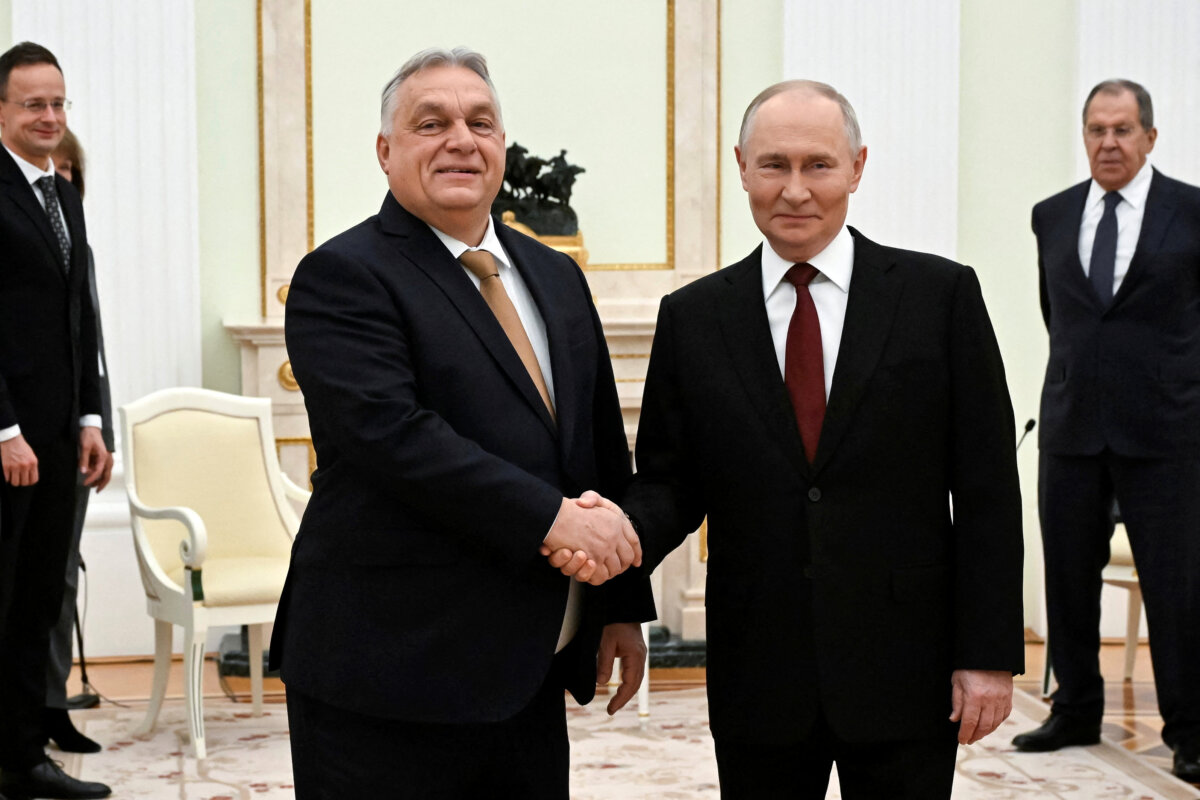
Hungarian Prime Minister Viktor Orban met with Russian President Vladimir Putin in Moscow on Nov. 28 to discuss crude and gas supplies, with Putin also expressing support for Budapest hosting a potential U.S.-Russia summit with President Donald Trump.
This was the Hungarian leader’s 14th meeting with Putin.
During their talks, Putin said he would still be happy for Budapest to host the summit. Orban had been scheduled to host a Putin-Trump summit in October before the U.S. president withdrew, citing concerns it would be a waste of time.
The Nov. 28 talks came as Trump’s envoy Steve Witkoff prepares to meet Putin in Moscow next week in a renewed push to end the war in Ukraine.
“We very much hope that the peace proposals on the table will lead to a ceasefire and peace,” Orban said.
Details of the talks on energy supply are yet unknown, but a video posted on Orban’s Facebook page featuring the meeting in Moscow was captioned with: “Affordable Russian gas and oil are essential to Hungary’s energy supply. We’re here to keep the shipments safe.”
Prior to the meeting, Orban said in a video interview posted on his Facebook page that he was going to ensure that Hungary’s energy supply is secured for the winter and next year.
“Energy security, and affordable, low energy prices in the winter in Hungary,” he added in another social media post. “That’s why we went to Washington, and that’s why I’m going to Moscow now too.”
The United States exempted Hungary from Russian energy sanctions earlier this month after Orban met with U.S. President Donald Trump in Washington on Nov. 7.
“We managed to achieve this, which is great,” Orban said, according to Hungarian media outlet HVG. “Now all we need is gas and oil, and we can buy that from the Russians.”
When asked whether peace efforts in Ukraine would also be discussed, Orban said he could “hardly avoid that.” His chief of staff said on Nov. 27 that Budapest was supportive of Trump’s proposed plan to end the war.
His political director, Balazs Orban, who is not related to the prime minister, further elaborated on the nature of the trip in a post on his own Facebook page.
“The stakes are huge, because we can see that increased energy prices are already causing serious problems in many European countries, and in Serbia the energy supply has collapsed overnight,” he wrote. “The Hungarian government is now fighting with every possible tool to ensure that no similar situation can develop in Hungary and to protect Hungarian families from high energy prices.”
He added that if Hungary abandoned Russian energy, as the European Union has been pressuring the country to do, Hungarian utility costs would multiply by a factor of 3 or 4.
“Hungary’s position is clear,” he said. “Hungarian families do not want to pay the price of war and sanctions in the form of higher energy prices. As long as Hungary has a national government, this will not happen.”
The Hungarian prime minister was accompanied on the trip to the Russian capital by his foreign minister, Peter Szijjarto, who described cooperation between Hungary and Russia as “a fundamental national interest” in a post on Facebook.
Budapest, in stark contrast to most European and NATO countries, has maintained a much more amiable relationship with Moscow in the wake of the war in Ukraine.

After Orban’s Nov. 7 meeting with Trump, he told Hungarian media that Hungary had “been granted a complete exemption from [U.S.] sanctions” affecting Russian gas delivered from the TurkStream pipeline and oil from the Druzhba pipeline.
“We asked the president to lift the sanctions,” Orban said. “We agreed and the president decided, and he said that the sanctions will not be applied to these two pipelines.”
As part of the deal, Hungary agreed to buy U.S. liquefied natural gas, the U.S. State Department said in a fact sheet, noting that the contracts were expected to be worth about $600 million. The two nations also agreed to work together on nuclear energy, including small modular reactors.
Hungary will also purchase nuclear fuel from U.S.-based Westinghouse Electric Co., Orban said.
Emel Akan, Aldrgra Fredly, and Reuters contributed to this report.
 Friends Read Free
Copy
Facebook
Tweet
Friends Read Free
Copy
Facebook
Tweet