
One of the most powerful hurricane landfalls ever recorded in the Atlantic basin just happened in Jamaica, according to the National Hurricane Center.
Hurricane Melissa made landfall in southwest Jamaica near New Hope around 1 p.m. ET on Oct. 28 as a catastrophic Category 5 hurricane, boasting maximum sustained winds of 185 mph.
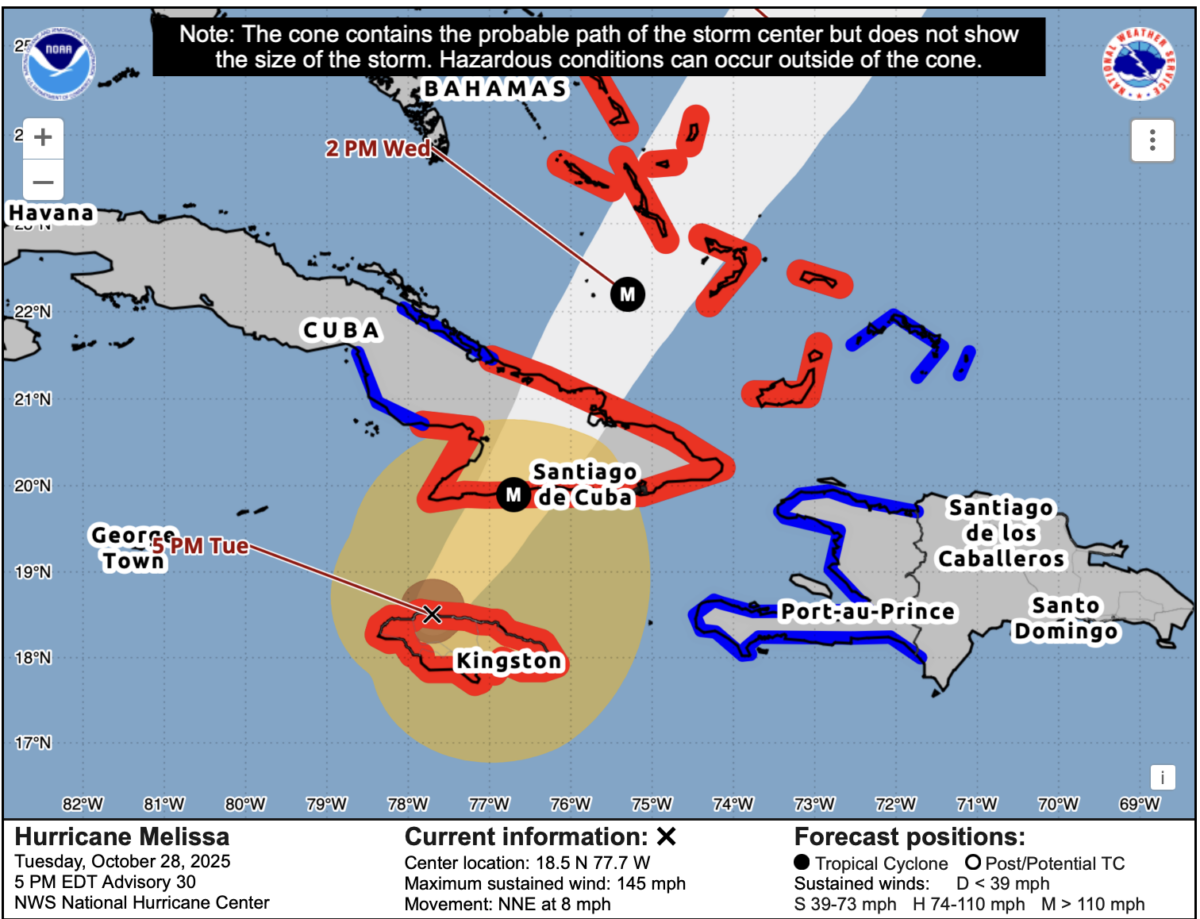
Around 5 p.m. ET, its center began to emerge from the northern coast of the island as a strong Category 4 hurricane with sustained winds of 145 mph.
At least seven storm-related deaths were reported before it even made landfall: Three in Jamaica, three in Haiti, and one in the Dominican Republic.
Now, with the eastern edges of Cuba in its sights, authorities are working to evacuate more than half a million people.
By 8 p.m. ET, Hurricane Melissa’s center had moved 50 miles east-northeast of Montego Bay, and its sustained winds dropped to 125 mph, making it a Category 3 hurricane.
“Melissa is expected to remain a powerful hurricane when it moves across Cuba, the Bahamas, and near Bermuda,” the National Weather Center warned in its 8 p.m. advisory.
Bermuda issued its first hurricane watch at 5 p.m. ET on Oct. 28.
Jamaicans Shelter in Place
When Melissa made landfall, it became the strongest storm to hit the island since record-keeping began 174 years ago.
While sustained winds reached 185 mph, Michael Brennan, director of the National Hurricane Center, warned that Jamaica’s highest mountains could see wind gusts of up to 200 mph.
“It’s just a catastrophic situation playing out here for Jamaica,” he said.
The National Hurricane Center sent one last warning before landfall at 12 p.m., stating, “THIS IS AN EXTREMELY DANGEROUS AND LIFE-THREATENING SITUATION.”
“Do not leave your shelter as the eye passes over, as winds will quickly, and rapidly increase on the other side of the eye. Residents should remain in place through the passage of these life-threatening conditions.”
Hurricane Melissa’s destruction began descending upon the island days before landfall, which refers to the storm’s eye coming over land. Tropical Storm-force winds (39 mph-73 mph) extended nearly 200 miles away from the storm’s center, and hurricane-force winds (74 mph and greater) were recorded 30 miles away.
The island was forecast to receive 15-30 inches of rain, with some areas receiving as much as 40 inches during its multi-day interaction with the storm through Oct. 29.
As Melissa made its way across the mountainous island, the hurricane center stated that “total structural failures” due to catastrophic winds were likely near the path of its center.
Catastrophic storm surge, winds, and flash flooding were confirmed across the island with landslides expected, as well as power and communication outages, isolation of some communities, and other infrastructural damage.
The Jamaican government accepted that fate for its infrastructure.
“There is no infrastructure in the region that can withstand a Category 5,” Jamaican Prime Minister Andrew Holness said during a press conference hours before the storm. “The question now is the speed of recovery. That’s the challenge.”
Jamaicans sheltering in place were advised by the hurricane center to put as many walls between themselves and the outside as possible to protect themselves from the wind, with the center even suggesting, “You can cover yourself with a mattress and wear a helmet for added protection.”
More than 130 shelters were open across the island as of Oct. 27, and mandatory evacuations were posted for seven communities, including Port Royal, Kingston; Portland Cottage and Rocky Point in Clarendon; Old Harbour Bay, St. Catherine; and Riverton City, New Haven, Taylor Land, Bull Bay, and St. Andrew.
Kingston’s Norman Manley International Airport and Ocho Rios’s Ian Fleming International Airport closed on Oct. 25, and Montego Bay’s Sangster International Airport has remained closed since noon Oct. 26.
Disaster response and recovery teams were able to stage themselves on the island ahead of Melissa’s arrival.
“Our teams are on the ground in Jamaica right now,” the United Cajun Navy said in an Oct. 27 X post. The U.S.-based group of volunteer boat owners assists in search and rescue efforts.
“We’re surveying neighborhoods, assessing potential needs, and familiarizing themselves with the areas that will be hardest hit. These are the communities standing in the path of Hurricane Melissa,” the group said.
Melissa’s center crossed over northwest Jamaica, passing within 10 miles of Montego Bay.
By 4 p.m., it was demoted to a Category 4 hurricane with sustained winds of 150 mph. Its winds only decreased to 145 mph as it completed its crossing.
The National Hurricane Center said in its 5 p.m. advisory that Melissa’s core will completely depart Jamaica later Tuesday evening and arrive in southeastern Cuba later that night or by early morning Oct. 29.
Catastrophic flash flooding, damaging winds, and life-threatening storm surge were still ongoing across Jamaica as of 5 p.m. Oct. 28.
Cuba Braces for Melissa
Tropical storm-force winds arrived in Cuba earlier this week with Hurricane Melissa’s outer bands ahead of her catastrophic core.
That multi-day interaction with the hurricane is expected to bring 10 to 20 inches of rain through Oct. 29 with local amounts over mountain terrain expected to reach 25 inches.
“This will cause life-threatening and potentially catastrophic flash flooding with numerous landslides,” the hurricane center warned.
Storm surge will also accompany Melissa’s arrival into Cuba, forecast to reach eight to 12 feet above normal tide levels near and to the east where the storm center is expected to make landfall.
“This storm surge will be accompanied by large and destructive waves,” the hurricane center said. “Minor coastal flooding is possible in bays and inlets along the north coast of eastern Cuba.”
Cuban officials announced on Oct. 27 that more than 600,000 people were to be evacuated from Santiago de Cuba, Granma, Guantanamo, and Holguin provinces.
“This phenomenon is very dangerous,” Deputy Prime Minister Eduardo Martínez Díaz said in a statement.
“It is unprecedented,” he said of Hurricane Melissa.
Santiago de Cuba is Cuba’s second-largest city. Along with the evacuations, storm preparations have included rounding up animals, taking measures to protect crops, removing debris, and unclogging drains.
“May God have mercy on us, because it’s coming with a lot of strength,” resident Diamon Mendoza said. “Anything can happen.”
A Caribbean Disaster
Hurricane Melissa looks to become a disaster for the Greater Antilles, a major section of the Caribbean. It was forecast to deliver severe damage to parts of southern Haiti, the western Dominican Republic, as well as the southern Bahamas.
Southern Haiti and the Dominican Republic faced torrential rains as Melissa crawled toward and over Jamaica, with the Island of Hispaniola still expected to receive up to 40 inches of rain through Oct. 29.
The storm was expected to reach the southeastern or central Bahamas by late Wednesday. Total rainfall there is forecast to reach five to 10 inches through Oct. 29, resulting in flash flooding, and storm surge of five to eight feet above normally dry ground was possible.
The National Hurricane Center noted in its 8 p.m. advisory that tropical storm conditions were expected in Haiti through Oct. 29.
The Bahamas issued a formal evacuation notice on Oct. 27 for residents of Acklins, Inagua, Crooked Island, Mayaguana, and Ragged Island ahead of Melissa’s arrival. Residents were advised to contact their Family Island Administrators for details on transportation and evacuation schedules.
“This notice is being issued to ensure that those most at risk can be safely relocated before conditions worsen,” Prime Minister of the Bahamas Philip Davis said.
He scheduled a press conference with Disaster Risk Management Authority officials at 6:30 p.m. on Oct. 28 to provide a more comprehensive update on the nation’s hurricane preparedness.
“At that time, we will outline the specific steps being taken to safeguard lives and property, including transportation logistics, shelter readiness, and coordination across all government agencies,” he said.
The United Nations was preparing to send humanitarian aid to Jamaica, Cuba, and Haiti.
The Turks and Caicos will also be affected, facing one to three inches of rain and two to four feet of storm surge.
The National Hurricane Center further forecast that Melissa could hit Bermuda as a hurricane by Oct. 30, with heavy rains possibly beginning that same day.
The state department released a statement for Americans in countries impacted by Hurricane Melissa.
“If you’re in an area projected to be in the storm’s path, depart ASAP if still possible,” it said. “Americans who decide to remain should make preparations to shelter in place.”
The Associated Press contributed to this report.
 Friends Read Free
Copy
Facebook
Tweet
Friends Read Free
Copy
Facebook
Tweet