

Indonesia will restrict access to social media platforms for users under the age of 16, officials said this week, making it the latest country to move to curb online risks faced by children.
Communications and Digital Affairs Minister Meutya Hafid said on March 6 that the Indonesian government has signed a regulation that will prevent children younger than 16 from holding accounts on “high-risk” digital platforms, including YouTube, TikTok, Facebook, Instagram, Threads, X, and Roblox.
The measure will be implemented gradually beginning on March 28, with social media companies expected to comply with new obligations aimed at protecting minors.
“Our children face increasingly real threats. From exposure to pornography, cyberbullying, online fraud, and most importantly addiction,” Hafid said, adding that the impulse behind adopting the new rule is “so that parents no longer have to fight alone against the giant of algorithms.”
Indonesia has about 229 million internet users, and nearly 80 percent of children are already connected online, according to data cited by Hafid. About half of Indonesian children who use the internet have encountered sexual content online, and 42 percent say they have felt uncomfortable or afraid because of what they experienced in digital spaces, Hafid said.
Government reports estimate that there have been about 1.45 million cases of online child exploitation in Indonesia, with Hafid saying that even when the content that they are exposed to is not problematic, “excessive use of digital platforms can also lead to addiction that affects children’s mental health and development.”
Under the new framework, access to platforms deemed “high risk” will be delayed until the age of 16, while services classified as lower risk may be accessible from the age of 13.
The rules will not impose penalties on children or their parents, Hafid said. Instead, enforcement will focus on technology companies that fail to implement required child protection measures.
“With tens of millions of children among Indonesia’s internet users, the implementation challenges here are certainly far more complex,” Hafid said. “But digital platforms operating in Indonesia must respect the laws in force in Indonesia.”
Once the new regulation is in effect, Indonesia will become the first country in Southeast Asia to restrict children’s access to social media.
More Countries Move to Ban Social Media for Kids
Indonesia’s move is part of a broader trend across a growing number of countries toward tighter controls on minors’ access to social media amid growing concerns about online safety, mental health, and screen addiction.
Australia led the trend in December 2025 when it became the first country to impose a nationwide ban on social media use by children younger than 16. The law requires platforms, including TikTok, YouTube, Facebook, Instagram, Snapchat, and X, to take reasonable steps to prevent underage users from accessing their services.
The measure was introduced amid mounting concern that social media use was contributing to anxiety, depression, and addiction among young people.
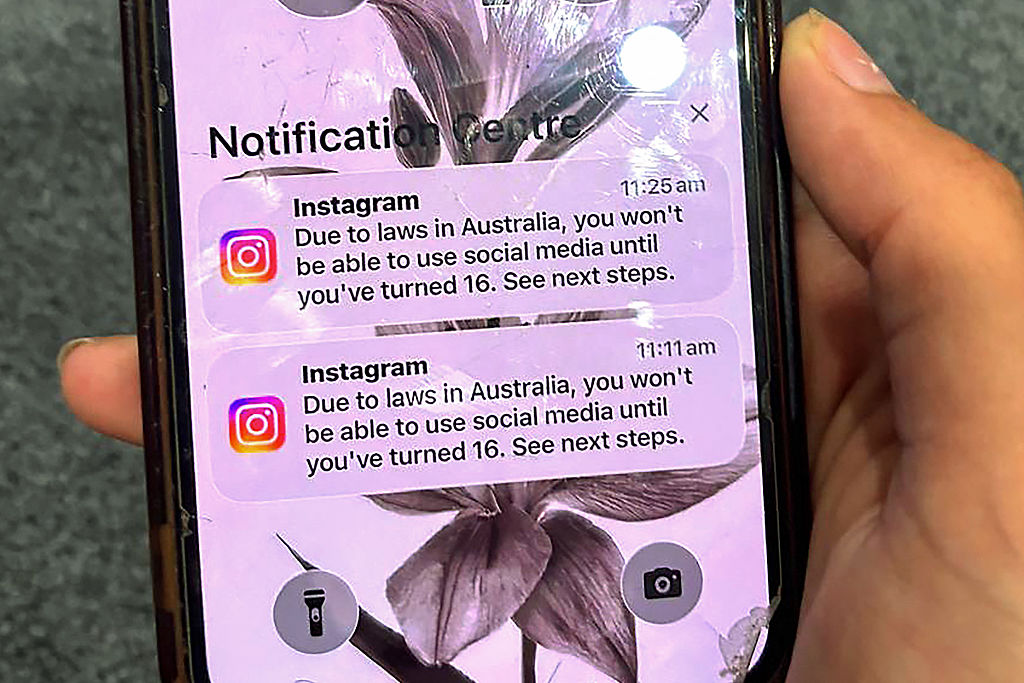 A teenager holds a mobile phone displaying a message from social media platform Instagram after the account was locked for age verification, in Sydney on Dec. 9, 2025. (AFP via Getty Images)
Across Europe, several governments are now considering similar restrictions.
In Poland, lawmakers are preparing legislation that would ban children younger than 15 from accessing social media and require companies to verify users’ ages. Polish Education Minister Barbara Nowacka said the proposed law would allow fines of up to 6 percent of a company’s turnover if platforms fail to block underage users.
Germany is also debating tighter controls. The governing Christian Democratic Union party approved a motion in February calling for a legal minimum age of 14 for social media use and stricter verification requirements for teenagers. The proposal also calls for fines against companies that fail to enforce the age limits and urges harmonized rules across the European Union.
Supporters of such restrictions say that algorithm-driven platforms expose children to hate speech, cyberbullying, and addictive content, while critics say bans may be difficult to enforce and could require intrusive age-verification systems.
Victoria Friedman and The Associated Press contributed to this report.
 Friends Read Free
Copy
Facebook
Tweet
Friends Read Free
Copy
Facebook
Tweet