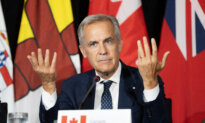

Germany’s governing Christian Democratic Union (CDU) passed a motion at its party conference on Feb. 21 to ban social media for those younger than 14 and introduce stricter digital verification checks for teenagers.
The CDU, led by German Chancellor Friedrich Merz, also called for fines against social media networks that fail to enforce those age limits, as well as backing harmonization of social media age limits across the European Union’s 27 member states.
“We call on the federal government to introduce a legal age limit of 14 for the use of social networks and to address the special need for protection in the digital sphere up to the age of 16,” reads the motion passed at the conference in Stuttgart.
Merz’s coalition partners, the Social Democratic Party (SDP), also back curbs on social media use for minors.
SPD Secretary-General Tim Klüssendorf welcomed the CDU adopting the motion, telling Redaktionsnetzwerk Deutschland on Feb. 22: “We finally need clear rules for digital platforms. Addiction-enhancing algorithms, hate speech, and bullying pose a massive problem for our entire society and can be particularly dangerous and harmful to children and young people.”
Last week, a group of SDP lawmakers and state politicians signed a discussion paper calling for social platforms to block access to children younger than 14 and to create special youth versions for 14- to 16-year-olds that do not have algorithm-driven feeds or functions such as infinite scrolling or autoplay.
Pressure from both parties in the coalition makes it increasingly likely that the federal government will push for a law on restrictions. However, Germany’s federal system assigns media regulation to the states, meaning that states must negotiate to reach nationwide rules.
The Bavarian Christian Social Union (CSU), the regional sister party of the national CDU, criticized the move.
Alexander Hoffmann, who leads the CSU in the Bundestag, told the Augsburger Allgemeine on Feb. 22 that children will not learn how to use social media responsibly through restrictions.
“This debate about banning these platforms is out of touch with reality,” Hoffmann told the newspaper.
Australia’s Ban
In 2025, Australia became the first country to introduce a law restricting minors’ access to social platforms.
Taking effect on Dec. 10, 2025, the ban requires social media platforms to take reasonable steps to prevent those younger than 16 from accessing or signing up for accounts on their websites.
Companies failing in this regard face fines of up to AU$49.5 million (US$35 million).
Since the law came into force, Facebook, Instagram, Kick, Reddit, Snapchat, Threads, TikTok, Twitch, X, and YouTube are now age-restricted platforms in Australia.
Since then, several countries in Europe and around the world have said they are considering similar measures, including France, Denmark, Malaysia, and Egypt.
Several of those governments have cited concerns over the addictive nature of social media and the effect it has on children’s mental health.
Reuters contributed to this report.
 Friends Read Free
Copy
Facebook
Tweet
Friends Read Free
Copy
Facebook
Tweet