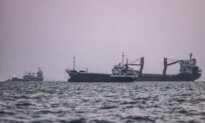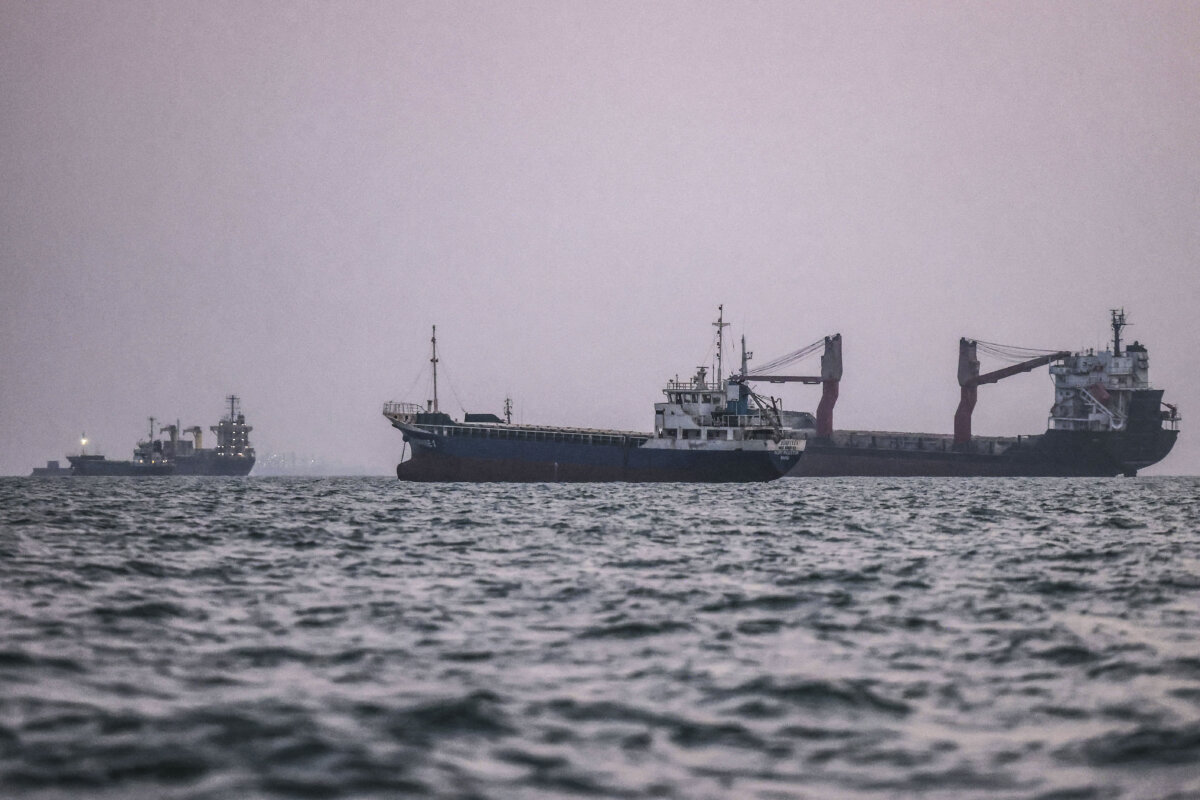

An Iranian military commander said Iran attacked a Togo-flagged oil tanker attempting to transit the Strait of Hormuz, as the Trump administration is weighing its next moves in its ongoing conflict with Tehran.
Ali Ozmaei, an admiral with Iran’s Islamic Revolutionary Guards Corps (IRGC), said through semi-official media outlet Tasnim News that the Trend tanker was struck as it “attempted to illegally pass through” the strait under the watch of the U.S. military.
“It was hit and stopped after a fire broke out on it,” he said.
“The IRGC Navy once again warns that illegal passage through the Strait of Hormuz will have no outcome other than the destruction of the offending vessel.”
The UK military’s Maritime Trade Organization said that at least three ships have been struck in and around the strait over the past two days or so, although it provided no details about the names of the vessels, whether anyone was injured, or who was responsible.
After the United States launched its first strikes against Iran in late February, Tehran has sought to gain control over the strategically important Hormuz Strait, through which roughly a fifth of the world’s oil passes in peacetime.
Iran has launched numerous strikes or threatened ships in the waterway, leading to U.S. military attacks on Iranian military targets in the region.
In recent weeks, however, the United States has launched relatively few strikes, with the last ones occurring in early September.
The military’s Central Command wrote on X that 104 ships have been redirected to comply with a military blockade announced earlier this summer.
The Trump administration has moved to economically isolate Iran’s regime through sanctions, dubbed “Operation Economic Outcast,” announced in August.
On Thursday, sanctions were imposed by the U.S. Treasury Department against a financial institution, BitBank, that it said was supporting the Iranian regime.
But in recent days, Iran appears to have gained new leverage as its Houthi allies in Yemen have captured a Red Sea port, which further caused a spike in global oil and gas prices.
As gasoline prices remain relatively elevated in the United States, Republicans are looking to hold onto control of Congress in November’s midterm elections.
The GOP currently holds small majorities in both the House of Representatives and Senate.
In an interview with Axios on Thursday, Trump said that a “big decision” is coming soon on the Iran conflict.
“I have a big decision coming up. Do I want to go in and annihilate them [the Iranian regime] or do I not? It’s a big decision. Anything could happen with me,” he told Axios’s Barak Ravid.
The U.S. president indicated in the interview that he’s happy with the blockade and said Iranian oil hasn’t been able to pass through, saying that “not one ship has gone to Iran since we started.”
Oil prices rose slightly on Friday morning.
The international benchmark Brent crude increased to $104.90 per barrel, while U.S. West Texas International rose more than 1 percent to $103.30 per barrel.
Figures released by the American Automobile Association show that regular gasoline increased around 3 cents from Thursday to Friday, now averaging out to $4.46.
A week ago, the price stood at $4.29 per gallon.
The United States and Iran have held no peace talks since the collapse of an interim agreement reached in June.
The war will come up for discussion at the U.N. General Assembly next week, and an Iranian delegation will be able to attend, according to the U.S. State Department.
 Friends Read Free
Copy
Facebook
Tweet
Friends Read Free
Copy
Facebook
Tweet