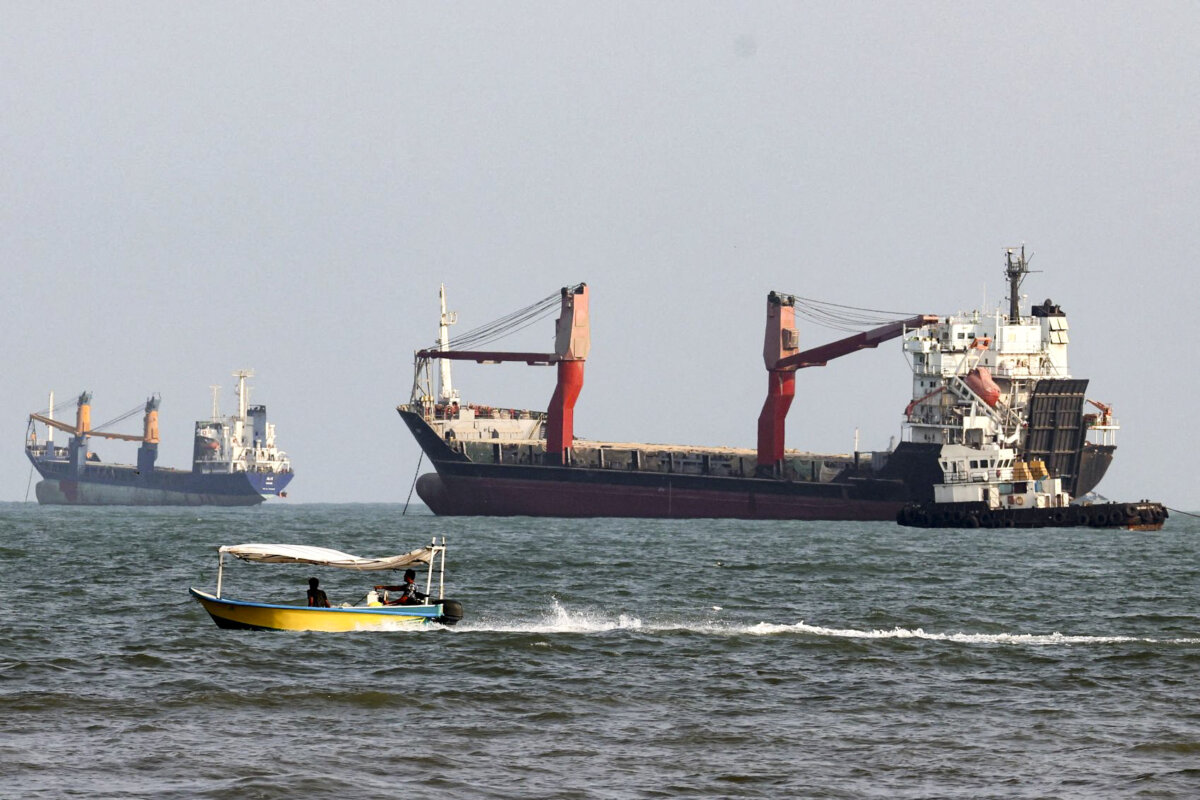

Iran threatened on Aug. 23 to fine or confiscate tankers that the regime says have violated its rules for navigating through the Strait of Hormuz as tensions over the key waterway continue to rise.
“In light of violations by certain vessels of the Iranian arrangements for transiting the Strait of Hormuz, these vessels will face restrictions in their future transits through #Strait_of_Hormuz, such as fines, seizure, or confiscation,” the Persian Gulf Strait Authority, a newly established Iranian agency for regulating traffic in the Strait of Hormuz, said in a Sunday post on X.
The Persian Gulf Strait Authority announced on Sunday that cargo owners would need to review a list of vessels Iranian authorities considered noncompliant with its regulations for passing through the strait to avoid “potential problems.”
Iran’s threat against commercial tankers in the Strait of Hormuz came just one day before the start of the Trump administration’s “economic D-Day” measures against Tehran.
Treasury Secretary Scott Bessent said last week that the United States was planning to impose the “toughest sanctions in history on Iran” as the two countries have continued to dispute control over the Strait of Hormuz following the collapse of a memorandum of understanding in July.
As part of Iran’s crackdown on commercial tankers in the strait, the Persian Gulf Strait Authority warned Sunday that vessels engaging in ship-to-ship transfers or transshipments with ships restricted by the agency would be added to the list.
The agency also noted that ships seeking to be removed from the list of “offending vessels” would need to submit a request and an explanation.
Ships on the Persian Gulf Strait Authority’s list included large crude carriers, clean product vessels, and liquefied petroleum and natural gas tankers. Some of the named ships are owned by the United Arab Emirates’ ADNOC Logistics and Shipping (ADNOC L&S), ADNOC’s subsidiary Navig8 Tankers, and Saudi Arabia’s national shipping carrier Bahri.
Traffic in the Strait of Hormuz has been reduced throughout the Iran war, which started on Feb. 28. The Trump administration has maintained that the key waterway is open and operational, while Iran has claimed the strait will remain closed until the United States agrees to a list of demands, including the removal of its naval blockade.
U.S. forces resumed a naval blockade of Iranian ports on July 14 in response to the regime’s attacks on commercial ships passing through the Strait of Hormuz in early July.
As of Aug. 23, U.S. forces had redirected 70 ships, disabled three commercial vessels, and boarded two others to ensure compliance with the blockade, according to U.S. Central Command.
On Aug. 19, Trump announced that the United States was going to target Iran with an unprecedented level of economic warfare and isolation following months of failed attempts to negotiate a long-term agreement with Tehran.
He urged America’s allies to stand together to isolate Iran and cripple the regime’s ability to spread terror across the globe.
Bessent confirmed on Sunday that the Trump administration’s plans for increased economic warfare against Iran would start on Aug. 24.
“We are now entering the endgame. At dawn begins an economic D-Day—the single greatest financial offensive ever marshaled against an adversary,” he said in a social media post.
“Our objective is to sever every economic lifeline that sustains the tyrannical regime until Tehran stands alone.”
Bessent is expected to hold a press conference on Monday to provide details on the Trump administration’s new economic sanctions against Iran.
“Iran is completely collapsing!!!” President Donald Trump wrote in all caps in a Truth Social post on Aug. 24.
Mohsen Rezaei, Iran’s top security official, warned on Aug. 23 that support for the new economic sanctions against Tehran would be considered an act of war. He also threatened to place further restrictions on oil exports in the region.
“If the economic war continues, not a single drop of oil will be exported, neither through the Strait of Hormuz nor from anywhere in the Persian Gulf,” he wrote in a post on X.
“Iran will regard any country’s participation in or support for America’s economic war against the Iranian people as an act of war.”
Reuters contributed to this report.
 Friends Read Free
Copy
Facebook
Tweet
Friends Read Free
Copy
Facebook
Tweet