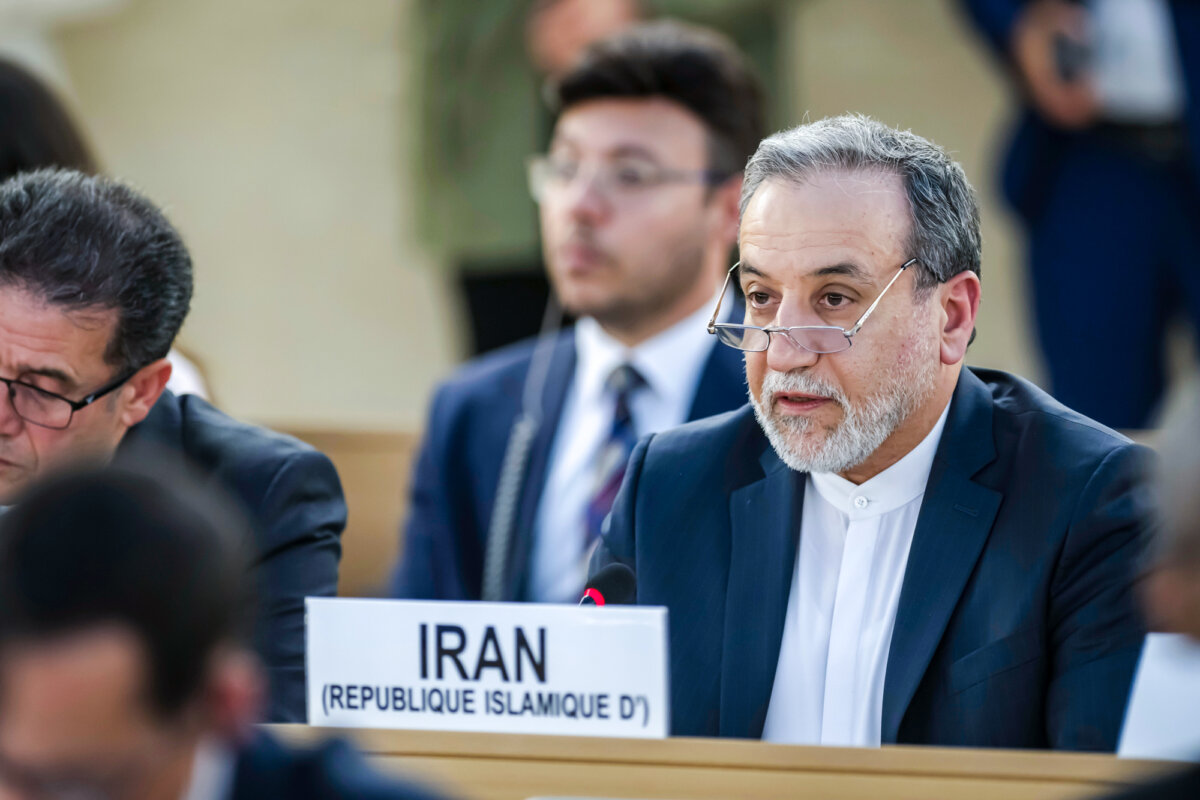

Iran will meet with France, Germany, and the United Kingdom, collectively known as the E3, in Istanbul on July 25 to discuss its nuclear program, a spokesperson for the Iranian Ministry of Foreign Affairs said on July 21.
Spokesperson Esmaeil Baqaei said the talks will take place at the deputy ministerial level.
“The topic of the talks is clear, lifting sanctions and issues related to the peaceful nuclear program of Iran,” Baqaei said at his weekly briefing.
The meeting, set to also include the European Union’s foreign policy chief, Kaja Kallas, will be the first since a cease-fire was reached following joint U.S. and Israeli strikes on Iran’s nuclear facilities in June.
The talks come after France warned Iran that the E3 could trigger the snapback mechanism in a 2015 nuclear deal, which would restore U.N. sanctions on Iran if no progress is made by the end of August.
The E3, along with China and Russia, are signatories to the Joint Comprehensive Plan of Action (JCPOA), a 2015 agreement designed to curb Tehran’s nuclear activities in exchange for sanctions relief.
The United States withdrew from the accord in 2018 during U.S. President Donald Trump’s first term. Trump called it “one of the worst and most one-sided transactions the United States has ever entered into.”
Washington said at the time that the deal failed to address Iran’s ballistic missile program, did not adequately protect U.S. security interests, and lacked robust verification measures.
In June, foreign ministers from France, Germany, and the UK, along with Kallas, met with Iranian officials in Geneva. In a joint statement, they expressed concern about Iran’s continued expansion of its nuclear program, which they said has “no credible civilian purpose” and violates most of the JCPOA’s provisions.
They welcomed U.S. efforts to seek a negotiated solution and called on Iran to cooperate fully with the International Atomic Energy Agency. The JCPOA will remain in effect until Oct. 18, 2025.
Iran Rejects E3 Sanctions Threat
In a July 20 letter to U.N. Secretary-General António Guterres and the members of the Security Council, Iranian Foreign Minister Abbas Araghchi dismissed the E3’s warnings over sanctions.
Araghchi said France, Germany, and the UK “lack the necessary standing” to invoke the JCPOA’s dispute resolution mechanism, which could lead to the reimposition of U.N. sanctions.
He called on the United States and the E3 to provide compensation for the “severe human and financial losses imposed on Iran” resulting from sanctions, military attacks, and the collapse of trade ties since 2018.
In a July 20 statement posted to X, Araghchi said that the E3 supported the recent Israeli and U.S. strikes, which he described as military aggression against the Iranian people.
“Actors with such a record ought to be the last to claim ‘good faith,’” he added.
German Foreign Ministry spokesperson Martin Giese said on July 21 that Berlin, Paris, and London are working “at high pressure” on a sustainable and verifiable diplomatic solution, in coordination with the United States.
US–Iran Negotiations
Before the conflict between Israel and Iran in July, Washington and Tehran held five rounds of indirect nuclear talks, beginning in April and mediated by Oman.
During the discussions, the United States urged Iran to halt or sharply reduce its uranium enrichment activities, proposing that a regional consortium take over enrichment responsibilities. Tehran rejected the idea, insisting that uranium enrichment is a sovereign right and a key element of its civilian nuclear program.
Following joint U.S. and Israeli airstrikes on Iran’s nuclear facilities, Trump said the attacks had “completely and totally obliterated” the three key sites of Fordow, Natanz, and Isfahan, and warned of “far greater” strikes if Iran refused to pursue peace.
“Iran, the bully of the Middle East, must now make peace,” Trump said in June. “If they do not, future attacks will be far greater and a lot easier.”
Earlier in July, Trump said that future talks with Iran would depend on Tehran’s willingness to halt uranium enrichment and allow international inspections.
 Friends Read Free
Copy
Facebook
Tweet
Friends Read Free
Copy
Facebook
Tweet