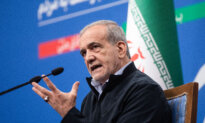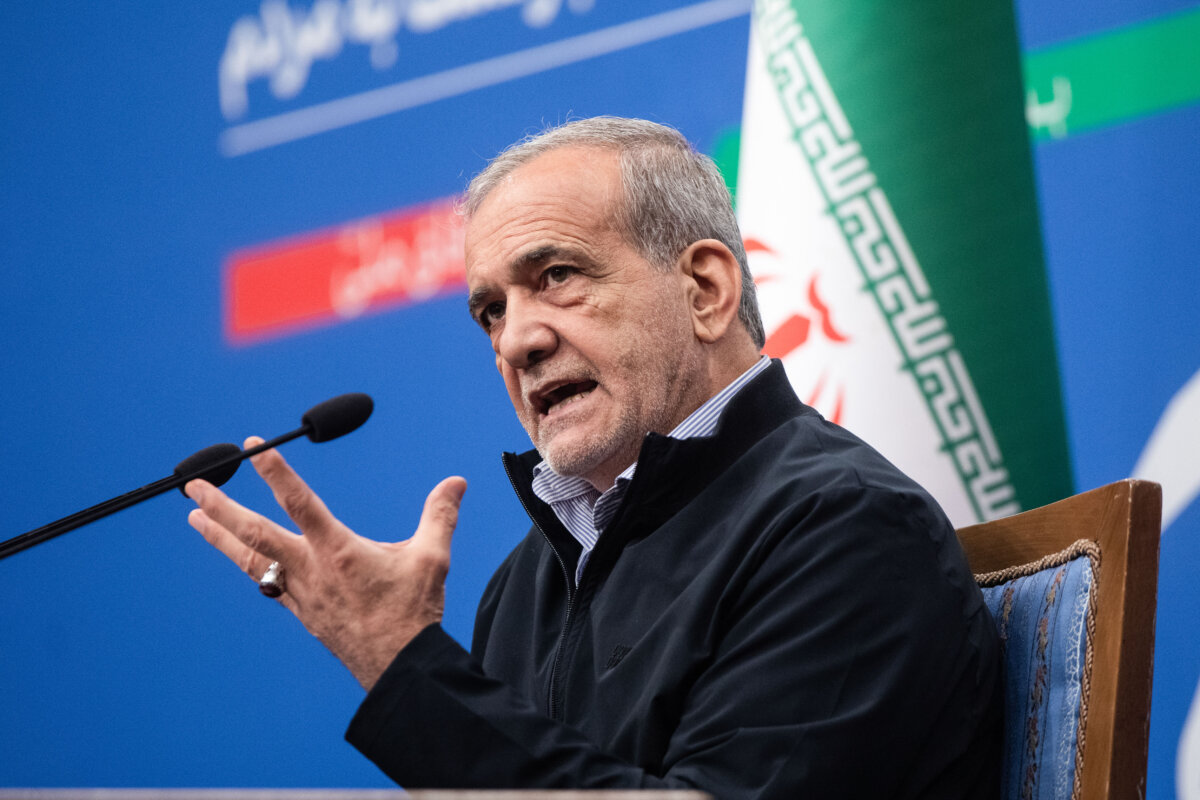

Iranian President Masoud Pezeshkian on Sunday said that Tehran will not back down from ultimately trying to continue to enrich uranium, a key point of contention between the Trump administration and the Iranian regime amid talks to end hostilities.
Iranian state-run outlet PressTV quoted Pezeshkian as saying that Tehran “has not and will never back down from its fundamental right to uranium enrichment” and he claimed that the United States “has been forced to accept” the demand.
He also said through IRNA, a semi-official news outlet associated with the Islamic Revolutionary Guards Corps, that Iran will not attempt to produce a weapon with the enriched uranium. U.S., Israeli, and European officials have long said Iran is seeking to obtain a nuclear weapon and that hundreds of pounds of enriched uranium that Iran possesses are a short step away from being processed into material that can be used in a nuclear weapon.
The remarks were made as U.S. Vice President JD Vance and other Trump administration negotiators met with Iran’s parliamentary speaker, Mohammad Bagher Ghalibaf, and Iranian Foreign Minister Abbas Araghchi at a Swiss mountainside resort near Lake Lucerne.
Mediators from Pakistan and Qatar were also in the room for the direct engagement. The U.S. and Iranian negotiating teams also held separate private talks with Pakistani and Qatari officials.
The U.S. government is looking to get Iran locked into negotiations over its nuclear program and to give up or dilute its enriched uranium. Vance also wants to push Tehran to commit to keeping open the Strait of Hormuz, the critical waterway through which about a fifth of world’s traded oil passes.
However, the on-again, off-again conflict in Lebanon between Israel and Iranian-backed Hezbollah terrorists continues to threaten to derail the U.S. effort to win concessions from Tehran on its nuclear program and keep the strait open.
During the talks, Vance cast the meeting as an attempt to reposition U.S.–Iran relations that have been adversarial since the 1979 revolution that installed the current theocratic regime as well as the American hostage crisis that lasted for more than a year.
“Can we change relations in the Middle East permanently, or do we go back to doing things the old way, which is not our preference, but is certainly very much something that can happen,” Vance said Sunday.
The U.S. vice president then said that “the opening of the Strait of Hormuz, the ending of the Iranian nuclear program, all of these things have already been accomplished. The question before us now is, how much more can we accomplish together? Can we turn over a new leaf?”
Last week, U.S. and Iranian leaders signed a memorandum of understanding that would reopen the strait, end the nuclear program, and provide a fund for investment into Iran, among other provisions. Some Republican and Democratic lawmakers were critical of the deal, which Trump has defended on multiple occasions since then, while saying that Iran’s military has been defeated by the United States in a conflict earlier this year.
Trump on Sunday left open the door to more strikes if Iran doesn’t comply with a demand to stop its proxies from launching attacks in the Middle East.
“Iran must immediately stop their highly paid PROXIES in Lebanon from causing trouble. If they don’t, we’ll hit Iran very hard again, just like we did last week, only harder!!!” he wrote in a Truth Social post.
The Associated Press contributed to this report.
 Friends Read Free
Copy
Facebook
Tweet
Friends Read Free
Copy
Facebook
Tweet