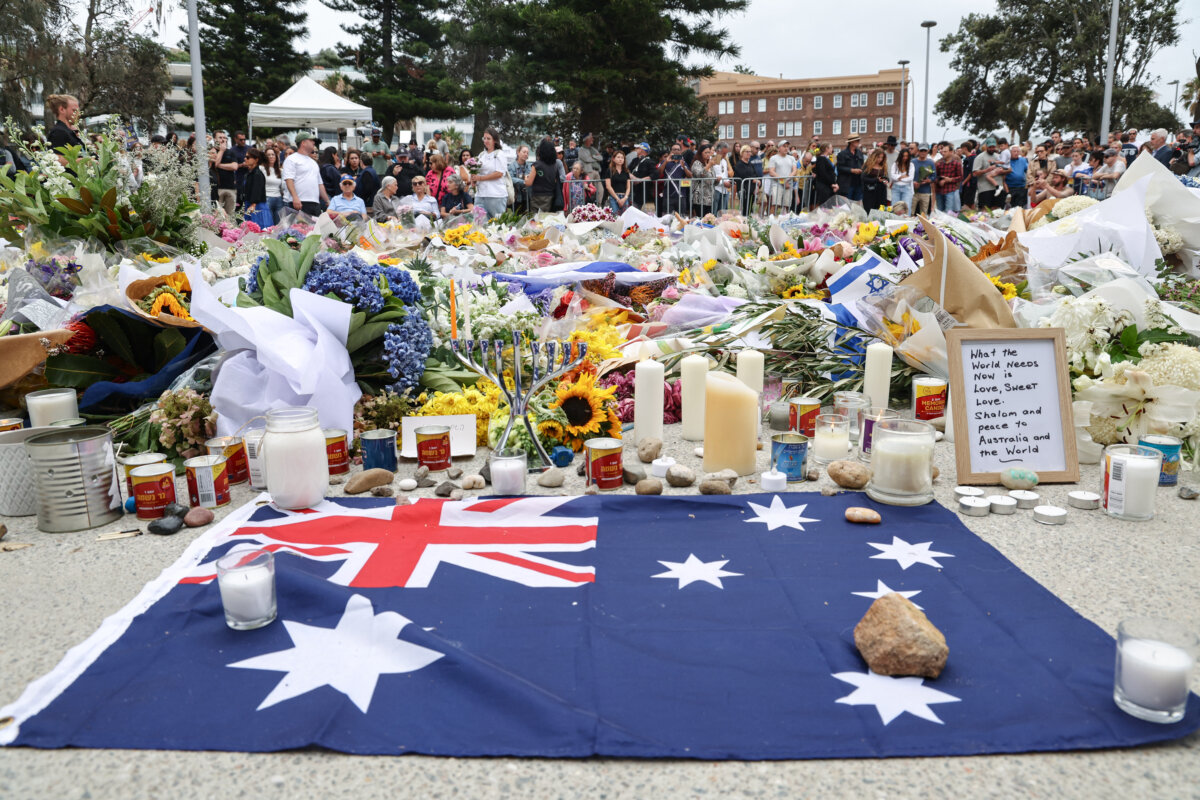

The head of New Zealand’s Security Intelligence Service (NZSIS) says violent extremist groups like ISIS and Al Qaeda closely monitored the Bondi Beach terrorist mass shooting.
The terror attack took place on Dec. 14, 2025, leaving 15 people dead and 40 others injured, and sent shockwaves around the Western world due to it being one of the largest terrorist attacks to target the Jewish community since the Hamas Oct. 7, 2023 attacks on Israel.
Following the attack, the NZSIS immediately set up an operation to assess how the event might affect the New Zealand threat environment.
The service identified a concerning trend: the mass shooting had “resonated with violent extremists from across the ideological spectrum.”
“Faith-based violent extremist organisations like ISIS and Al Qaeda paid close attention. So too did identity-based violent extremists who freely promote vile anti-Semitic and Islamophobic narratives,” NZSIS Director-General Andrew Hampton said in a statement to the parliamentary Intelligence and Security Committee.
“The Bondi attack also helped to feed and motivate anti-immigration narratives that are used by some politically-motivated violent extremists.”
Hampton described the Bondi attack as “shocking,” but said he was not surprised that such an event had occurred.
“This is the type of low capability, without warning attack the NZSIS frequently warns could happen here. It could come from violent extremists from across the ideological spectrum,” he said.
The director-general also noted that the risk of a terrorist attack in New Zealand has gone up after the Bondi incident.
“That is now reflected on the scale as possible rather than low as this level was previously described. Using the term possible is intended to focus minds on the need to be prepared,” he said.
Risks from Violent Extremists with Anti-Immigration Narratives
In addition, Hampton warned New Zealand citizens about the increased risk of a terrorist attack conducted by people who promote “anti-immigration narratives.”
“New Zealanders should be alert that it is possible someone with extreme anti-Semitic or Islamophobic views may develop the intent and capability to conduct an attack,” he said.
“Faith-based and ethnic communities feel this threat deeply and are increasingly concerned with the level of hate they face.
Risk of Foreign Interference Remains High
Outside of violent extremism, New Zealand continues to be at risk from foreign interference and espionage, and people within organisations who, wittingly or unwittingly, harm its national security.
New Zealand’s relationships with regional powers such as Australia and ASEAN countries, and as an ally of the United States, make it a target for espionage, as does its location in the Pacific and close proximity to Antarctica, the director-general cautioned.
‘There continues to be a number of states that conduct foreign interference and espionage against New Zealand. This is not benign activity,” Hampton said while not disclosing who these state actors are.
“Such actors have a voracious appetite for covert influence and non-public information that they can leverage to gain an advantage over us or our partners.”
The NZSIS has seen an increase in fake online recruitment attempts targeting influential citizens or those with access to privileged information, as well as tactics such as deception, coercion, and corruption.
To tackle the risk of foreign interference, Hampton said his agency would focus on prevention and disrupting malicious actors’ activities.
“The fact we now have criminal offences for such activities reinforces that foreign interference and espionage is unacceptable in New Zealand,” he said.
Proactive Disruption
Meanwhile, Andrew Clark, director-general of the Government Communications Security Bureau (GCSB), also gave the parliamentary committee his assessment of the geopolitical risks faced by New Zealand.
While the electronic nature of its activities means it is mostly focused outward, it has also assisted the NZSIS in its efforts to counter terrorist activity and foreign interference.
The past year had seen the increasing development of a volatile geostrategic environment, Clark said. The rapid pace of disruptive technologies has affected the Bureau’s primary activities: delivering signals intelligence and helping the government and the business sector build cyber resilience.
“This unpredictability is effectively moving the goalposts of what resilience looks like, and it requires a more proactive approach to detecting and disrupting threats in close cooperation with others,” he explained.
Recent attacks on Manage My Health, in which the medical records of hundreds of thousands of New Zealanders were stolen, and on MediMap, where sensitive data was altered, underscored how vulnerable systems remain.
Conflict and tensions can arise with little notice, Clark said, noting that the outbreak of the Iran war had prompted the GCSB to provide round-the-clock threat intelligence updates to agencies including the NZ Defence Force (NZDF) and the Ministry of Foreign Affairs and Trade (MFAT).
The Bureau is also active in combating transnational organised crime in the Pacific through a dedicated mission involving Customs, the NZDF, and regional law enforcement partners. This year, the joint operation has led to the seizure of several tonnes of narcotics at sea.
 Friends Read Free
Copy
Facebook
Tweet
Friends Read Free
Copy
Facebook
Tweet