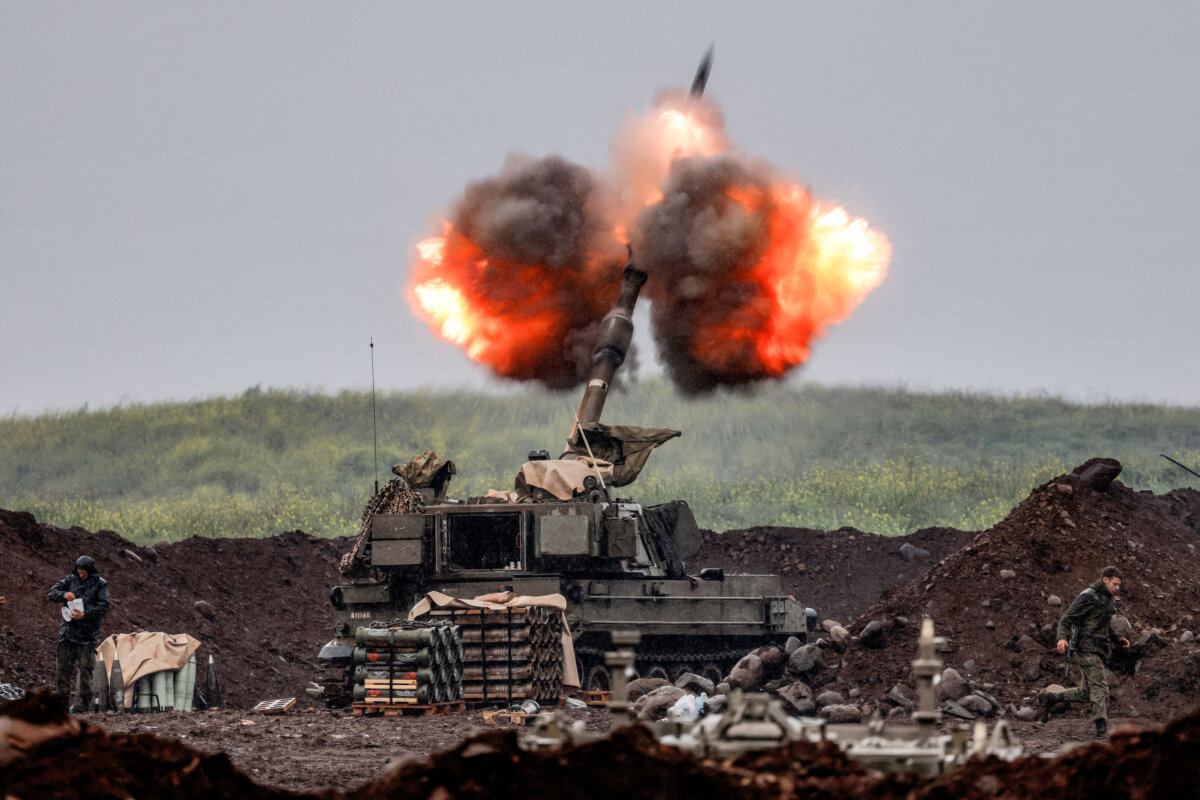

Israel and Iran continued to attack each other on March 21 as the war entered its fourth week and as shipping of oil and other key commodities remains choked off in the Strait of Hormuz, after U.S. President Donald Trump urged allies to help force the strait open and restore market stability.
The Israeli military said Saturday’s attacks on Iran included Tehran, Karaj west of the capital, as well as the central city of Isfahan.
Israel also attacked Beirut, saying it was targeting Hezbollah. Israel stepped up airstrikes targeting Hezbollah in the deadliest spillover from the war on Iran since the Iran-backed terror group fired on Israel on March 2 in support of Tehran.
Iranian forces launched a new round of missile and drone attacks overnight into Saturday, targeting five regional U.S. military bases and strategic sites in Israel, including Haifa and Tel Aviv, according to Iran’s semi-official Mehr news agency.
Iran’s Islamic Revolutionary Guard Corps (IRGC) said in a statement cited by Mehr that if the United States and Israel continue to attack Iran, they would face escalating levels of retaliatory strikes.
In what appeared to be a demonstration of the reach of its weapons, Iran fired two intermediate-range ballistic missiles at the UK military base Diego Garcia in the Indian Ocean, Mehr reported, with no indications that the missiles hit the facility.
The targeting of the Diego Garcia military installation, which The Epoch Times has been unable to independently verify, came hours after Britain approved the United States’ use of its military bases to launch strikes on Iranian missile sites that target shipping in the Strait of Hormuz.
Israeli Defense Minister Israel Katz said Saturday that attacks against Iran would “increase significantly” in the coming week.
Iran Signals Conditional Control of Hormuz
Iran has been blocking the passage of vessels through the Strait of Hormuz, a key maritime transport corridor that handles roughly a fifth of global oil flows and is also a shipping chokepoint for other critical commodities like fertilizer inputs. The disruption from the blockade has become a major concern for energy markets and importing nations, raising inflationary and food shortage fears.
Global benchmark oil prices have risen more than 50 percent to around $110 a barrel since the war started on Feb. 28.
While Iran has said $200 per barrel oil looms if attacks against it don’t stop, analysts generally see a reversal coming. ING analysts are now projecting Brent peaking at an average of $91 over the second quarter and $77 by year’s end, suggesting markets see an end in sight to the war.
President Donald Trump, who on March 20 said the United States is getting close to meeting its military objectives and is considering “winding down” the operation, has urged NATO members and other allies to help form a wider coalition to unblock the Strait of Hormuz and reestablish shipping flows. A number of countries have expressed support for the unblocking of the strait, signing on to a statement expressing willingness to help ensure safe passage through the blocked waterway.
The United States and some allies have begun trying to restore freedom of navigation in Hormuz, with Pentagon officials on March 19 announcing the launch of an offensive involving low-flying jets and helicopters, including some U.S. allies assisting by using Apaches to take on Iranian attack drones.
Admiral Brad Cooper, Commander of U.S. Central Command, said in a March 21 operational update that Iran’s ability to threaten freedom of navigation in Hormuz has been “degraded” as a result of the U.S. bombing of Iranian underground missile storage facilities that were being used to target ships.
“Iran’s ability to threaten freedom of navigation in and around the Strait of Hormuz is degraded as a result,” Cooper said. “And we will not stop pursuing these targets.”
Iran has said that the strait would only be blocked to the United States, Israel, and their allies, but that transit through the waterway is hazardous for all due to ongoing military activity, and that other countries should negotiate with Tehran about safe passage.
“We have not closed the strait,” Iranian Foreign Minister Abbas Araghchi told Japan’s Kyodo News in an interview published on March 21. “From our perspective, the strait is open. It is only closed to ships belonging to our enemies—countries that are attacking us.”
Araghchi added that passage is possible for vessels other than those of “enemies,” and that Iran is prepared to provide safe passage under certain conditions.
“We will engage in discussions with them to find a safe route,” Araghchi said, adding that “they only need to contact us so we can discuss how this can be arranged.”
Araghchi previously said that, after the war ends, a “new mechanism” should be formulated to govern transit through Hormuz, one that considers the “interests of Iran and the region,” suggesting that Tehran aspires to exert long-term control over the critical maritime channel.
An Iranian lawmaker recently said that Iran is considering charging transit fees on ships passing through Hormuz, while other officials have made remarks building on Araghchi’s plans for a wider postwar strategy for control over the strait, suggesting it would involve permanent constraints on foreign powers while strengthening Iran’s regional position.
Meanwhile, multiple countries have endorsed Trump’s call to ensure freedom of navigation through the Strait of Hormuz and have expressed “readiness to contribute to appropriate efforts to ensure safe passage,” though it remains unclear whether they will ultimately contribute military assets to force the strait open.
Trump told reporters on March 20 that Iran is “from a military standpoint … finished,” but they’re “clogging up” the Strait of Hormuz. He said it would be a “simple military maneuver” to keep shipping lane open but it requires more “volume,” adding that “it would be nice” if the countries that rely on the strait would help keep it open.
Jack Phillips contributed to this report.
 Friends Read Free
Copy
Facebook
Tweet
Friends Read Free
Copy
Facebook
Tweet