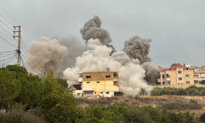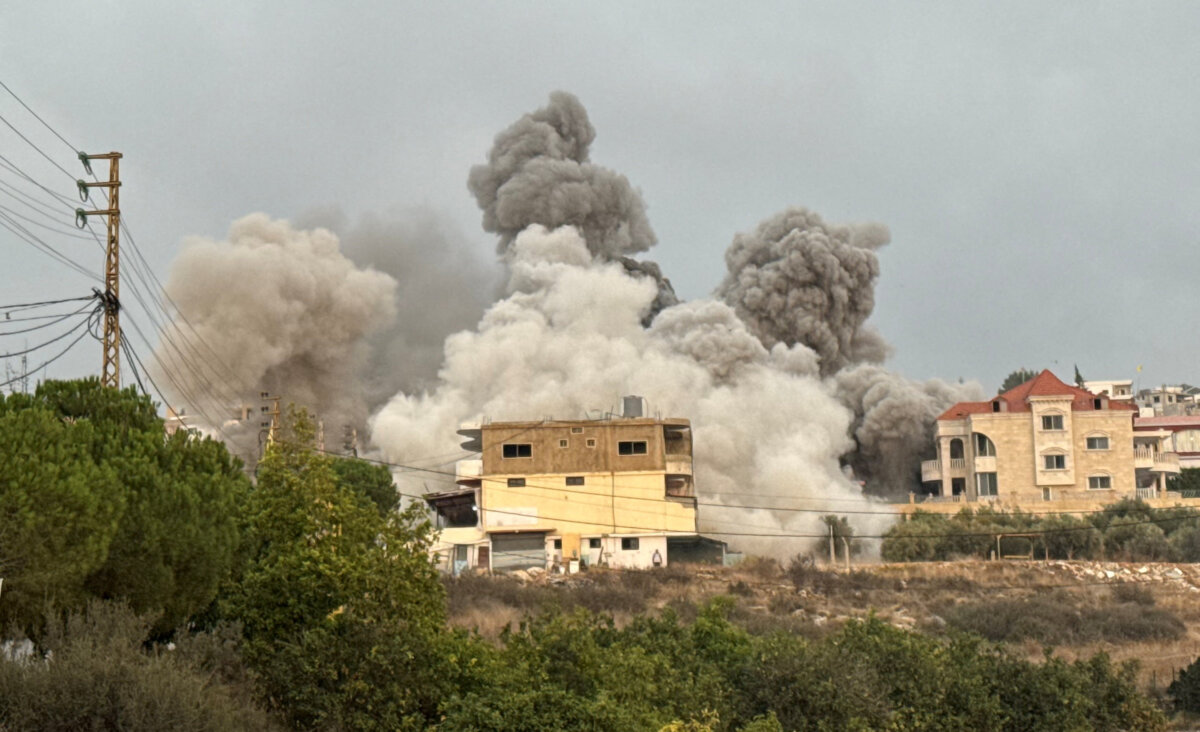

The Israeli military said on Nov. 6 it carried out airstrikes on Hezbollah targets in southern Lebanon, hitting what it described as terrorist infrastructure and several weapons storage facilities belonging to the group’s Radwan Force unit.
The Israel Defense Forces (IDF) said in a statement that the Radwan Force “continues to reestablish terrorist infrastructure in southern Lebanon with the intention of harming Israel,” adding that it would “continue to remove any threat posed to the State of Israel.”
Military activity and tensions between Israel and Lebanon have persisted despite a 2024 cease-fire agreement mediated by the United States and France.
Under the accord, Israel was to withdraw its forces from Lebanese territory, while Lebanon pledged that its army would take over efforts to dismantle Hezbollah fortifications near the Israeli border.
In August, Lebanon’s government authorized its army to draft a plan to restrict all weapons in the country to six official security agencies by year’s end.
The decision came shortly after a visit by U.S. envoy Tom Barrack, who urged Beirut to assert control over all armed entities.
The U.S. State Department designated Hezbollah a terrorist organization in 2014.
Impact on Civilian Areas
According to the Israeli military, the facilities targeted in Thursday’s strikes were located in civilian-populated areas.
“This is yet another example of the Hezbollah terrorist organization’s strategy to cynically and brutally exploit Lebanese civilians as human shields,” the IDF said.
It added that the sites violated existing understandings between Israel and Lebanon and endangered local residents.
The military had taken steps to reduce harm to civilians, including issuing evacuation warnings, using precision-guided munitions, and conducting aerial surveillance before the strikes, according to the IDF.
Israeli military spokesperson Avichay Adraee announced multiple evacuation orders on X around 3 p.m. local time on Thursday, directing residents of several southern Lebanese towns to move at least 500 meters (1,650 feet) from specific sites marked on maps.
The locations ranged from about 4 km (2.5 miles) from the Israeli border to nearly 24 km north of it.
The raids on the town of Tura in the Tyre District killed one person and wounded three others, the Lebanese Health Ministry said.
Reactions From Beirut and Jerusalem
Lebanese President Joseph Aoun condemned the strikes as a “fully-fledged crime.”
In a post on X, he accused Israel of violating international humanitarian law and U.N. Security Council Resolution 1701, which ended the 2006 Lebanon War between Israel and Hezbollah.
“Every time Lebanon expresses its openness to peaceful negotiations,” Aoun said, “Israel intensifies its aggression against Lebanese sovereignty.”
He added that nearly a year had passed since the cease-fire took effect, and Israel had “spared no effort to demonstrate its rejection of any negotiated settlement.”
In a meeting with World Bank delegates in Beirut on Friday, Aoun reaffirmed Lebanon’s commitment to the cease-fire agreement.
In Israel, Defense Minister Israel Katz said last week that Lebanon is stalling in efforts to disarm Hezbollah.
“Hezbollah is playing with fire, and the Lebanese president is dragging his feet. The Lebanese government’s commitment to disarm Hezbollah and remove it from southern Lebanon must be realized,” Katz said.
“Maximum enforcement will continue and deepen—we will not allow a threat to the residents of the north.”
The latest strikes follow the IDF’s announcement a day earlier that it had “eliminated” Hussein Jaber Dib, a Hezbollah Radwan Force member accused of advancing attacks against Israel.
The military said it had killed about 20 Hezbollah fighters in recent weeks for violating the understandings between Israel and Lebanon.
 Friends Read Free
Copy
Facebook
Tweet
Friends Read Free
Copy
Facebook
Tweet