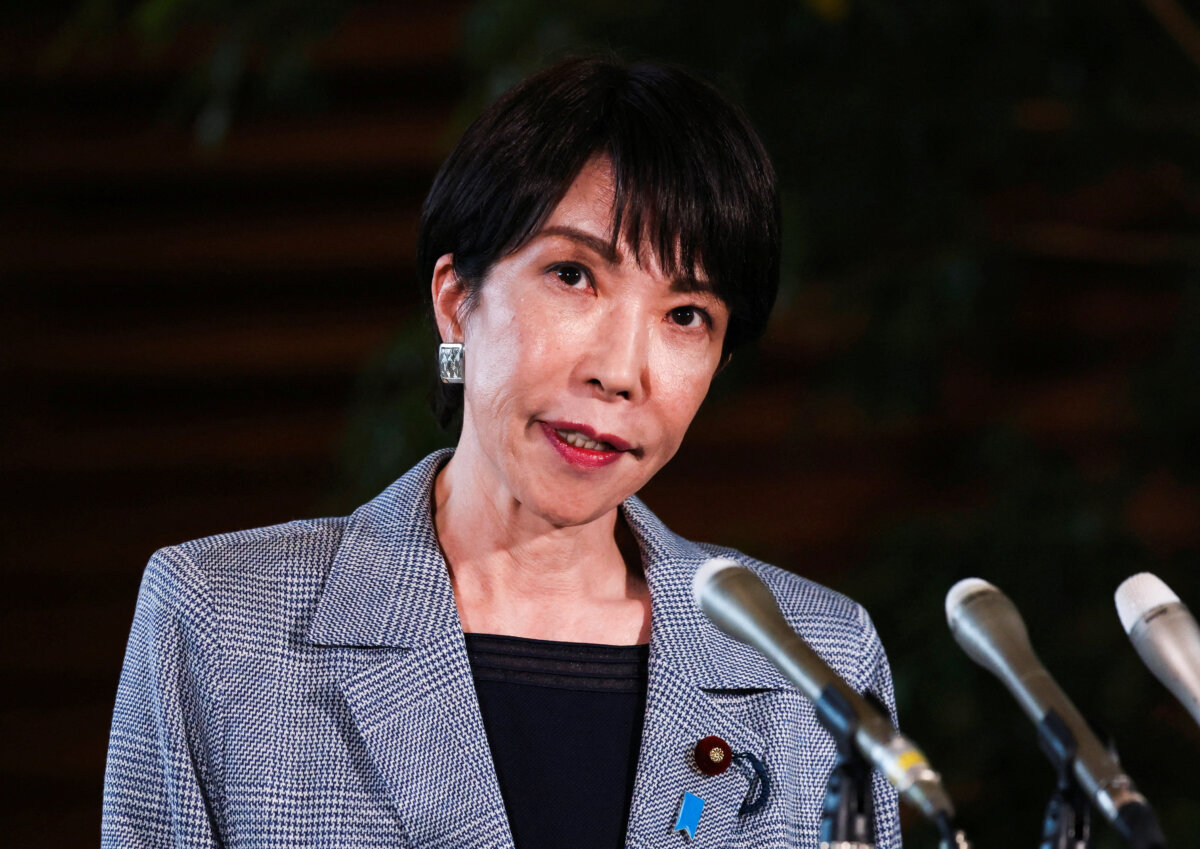


U.S. President Donald Trump and Japanese Prime Minister Sanae Takaichi spoke by phone on the evening of Nov. 24 amid tensions between Tokyo and Beijing over Taiwan.
“President Trump gave a brief explanation of the recent state of U.S.–China relations,” Takaichi told reporters following her call with Trump on Nov. 25, providing no further details, according to The Japan Times.
Earlier this month, Takaichi, in response to a question in Parliament, said that a hypothetical Chinese attack on Taiwan could constitute an “existential threat” to Japan that would prompt a military response.
Beijing considers the self-governing democratic island its own territory, and the Chinese communist regime has not ruled out taking control of the island by force.
In response to Takaichi’s remarks, China imposed a travel boycott on Japan.
The White House did not immediately return a request for comment on the phone call.
Speaking to reporters about the call, Takaichi said, “President Trump mentioned that he and I are extremely good friends and that he would be delighted to receive a call from me at any time.”
Takaichi said the call was requested by the U.S. president, just one day after Trump spoke by phone with Chinese leader Xi Jinping.
According to China’s Foreign Ministry, Xi told Trump that the “reunification of Taiwan” is a key part of the post-World War II international order and urged the U.S. to help “safeguard the victory” of the war.
In a Truth Social post, Trump said they discussed a range of topics, including the Russia–Ukraine war, fentanyl, and soybeans, but he made no mention of Taiwan.
Japanese Chief Cabinet Secretary Minoru Kihara told reporters on Nov. 25 that stability in U.S.–China relations is “extremely important” for the international community, including Japan.
Kihara also noted that Japan will continue to press China to “fulfill the responsibilities appropriate to its role,” local news outlet Kyodo News reported.
The Chinese Communist Party (CCP) has demanded that Takaichi retract her remarks suggesting that potential Chinese military action against Taiwan could pose a threat to Japan. Takaichi defended her remarks, saying on Nov. 10 they were based on the assumption of a “worst case” scenario.
The CCP has in recent weeks dispatched its armed coast guard vessels to waters near Japan-administered islands in the East China Sea, which are called Diaoyu by Beijing and Senkaku by Tokyo, asserting that the patrols were intended to uphold China’s “rights and interests.”
Japanese Defense Minister Shinjiro Koizumi said on Nov. 23 that Japan will deploy surface-to-air missiles to Yonaguni Island, just 68 miles off Taiwan’s east coast, calling it a defensive move. Beijing has criticized the move, warning that it would lead to regional tensions.
The U.S. State Department has reaffirmed its commitment to Japan’s defense and said it opposes any attempts to alter the status quo in the Taiwan Strait and the East China Sea through force.
“The U.S.–Japan Alliance remains the cornerstone of peace and security in the Indo-Pacific,” State Department spokesperson Tommy Pigott said in a Nov. 20 post on X.
Dorothy Li contributed to this report.
 Friends Read Free
Copy
Facebook
Tweet
Friends Read Free
Copy
Facebook
Tweet