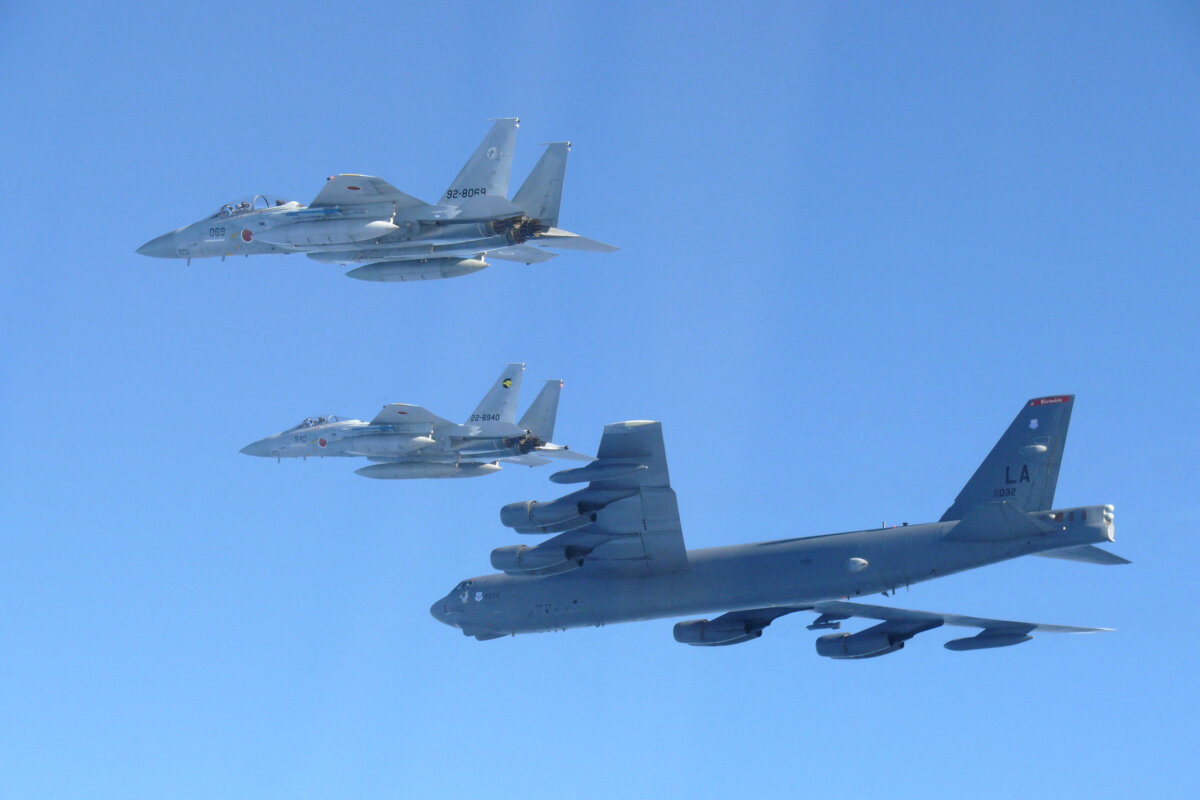

Japan’s cabinet on Dec. 26 approved a record $784 billion budget for the next fiscal year that includes all-time-high defense spending, underscoring Prime Minister Sanae Takaichi’s push to accelerate military expansion amid rising regional tensions with China.
The draft budget for the fiscal year beginning in April, which still requires parliamentary approval, sets defense outlays at about $64 billion, the largest in Japan’s history.
The increase is part of a multiyear plan to raise annual military spending to 2 percent of its gross domestic product, a benchmark Japan pledged to meet by March—two years earlier than initially planned—under pressure from the United States and amid a deteriorating security environment in East Asia.
The Japanese Defense Ministry stated in a recent defense budget briefing document that “the security environment surrounding Japan is becoming increasingly and rapidly severe,” while the country’s national security strategy—revamped in 2022—describes China and its military activities as presenting “an unprecedented and the greatest strategic challenge” to Japan’s security. The new budget marks the fourth year of a five-year buildup designed to fundamentally strengthen Japan’s deterrence and response capabilities.
Defense Minister Shinjiro Koizumi said the spending level was “the minimum needed” to protect Japan and its people, noting that the country remains committed to its postwar identity as a peace-oriented nation.
“It does not change our path as a peace-loving nation,” he said, even as Japan continues to loosen long-standing constraints on the use of force, including bolstering its offensive capability with long-range missiles.
Long-Range Missile and Drone Buildout
A significant share of the new defense budget increase will go toward long-range strike capabilities and the protection of Japan’s southwestern islands, which lie close to potential flashpoints in the East China Sea and the Taiwan Strait.
The budget allocates roughly $6.2 billion to increase so-called standoff missile capabilities, including about $1.1 billion for the purchase of upgraded, domestically produced Type-12 surface-to-ship cruise missiles with a range of roughly 620 miles. The first batch of those missiles is set to be deployed in southwestern Japan by March, a year earlier than originally planned.
Unmanned systems also feature prominently in the new defense budget. With Japan struggling to recruit and retain sufficient military personnel amid a rapidly aging and shrinking population, defense planners increasingly view drones as essential force multipliers. About $640 million is earmarked for the deployment of a large number of unmanned aerial, surface, and underwater vehicles under a new coastal surveillance and defense framework that is scheduled to be operational by 2028.
The budget also supports Japan’s ambition to strengthen its domestic defense industry and expand international cooperation. Tokyo plans to spend about $1 billion next year on the joint development of a next-generation fighter jet with the UK and Italy, targeted for deployment in the mid-2030s. Additional funds will go toward research into artificial-intelligence-enabled drones designed to operate alongside manned aircraft, as well as to promote arms exports following the easing of Japan’s export restrictions in recent years.
The defense-heavy budget comes against a backdrop of intensifying friction with Beijing. Tensions flared earlier this month after a sharp rise in Chinese military and coast guard operations in East Asian waters, including over an incident in which a Chinese jet locked its radar onto a Japanese aircraft—an action viewed as a possible precursor to missile targeting.
Beyond defense, the broader $784 billion budget reflects higher spending on social welfare and rising debt-servicing costs as borrowing rates climb. To reassure investors, the government has pledged to keep new government bond issuance below $190 billion and reduce the share of spending financed by fresh debt to the lowest level in nearly three decades.
The Associated Press contributed to this report.
 Friends Read Free
Copy
Facebook
Tweet
Friends Read Free
Copy
Facebook
Tweet