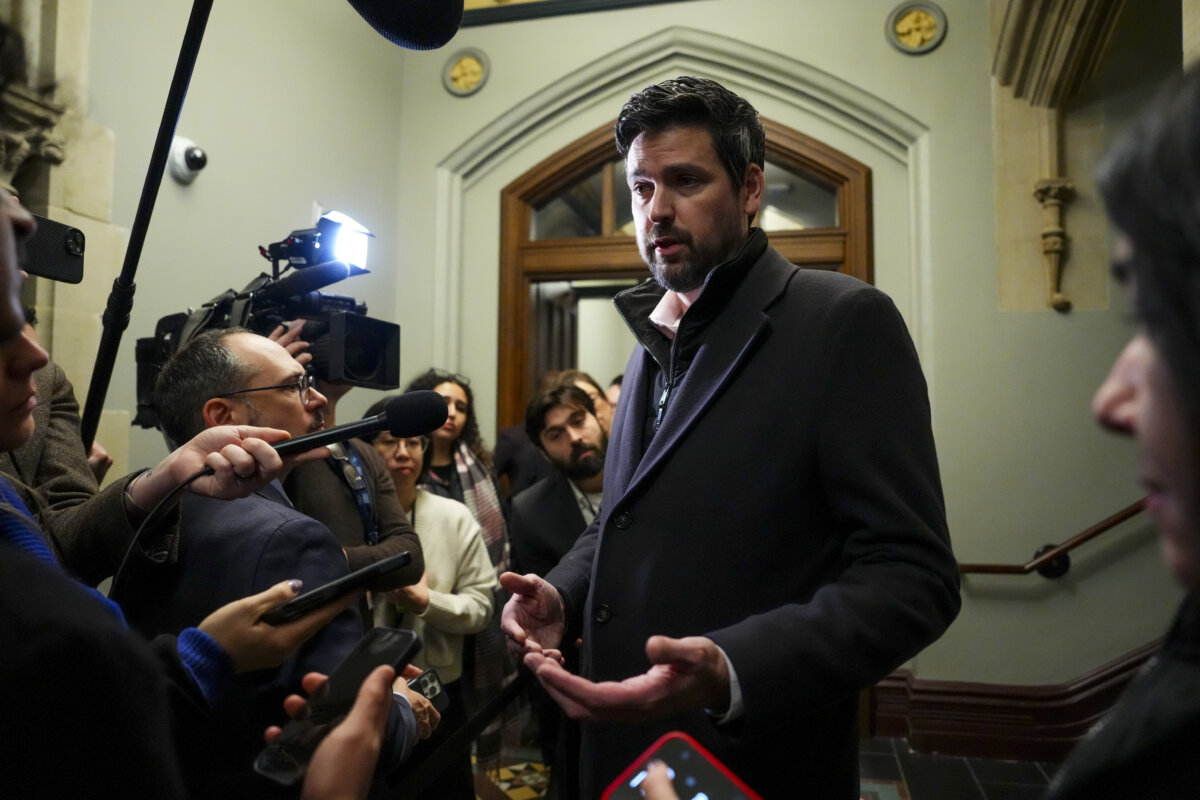

Justice Minister Sean Fraser said the federal government will continue with its current process for selecting judges, after Alberta Premier Danielle Smith said the province would cease funding for new judicial appointments unless it was given more influence over selection.
“I’m planning to maintain the process that we have in place that has independence, that has rigour, that has led to stellar candidates being appointed, including as recently in Alberta,” Fraser told reporters in the Parliament on Feb. 4.
Fraser said an independent judiciary is a “hallmark of democracy and a key part of the rule of law,” and said the protection of that independence means “ensuring that there’s not political threats about the resources that are going to be made available to them to do their jobs.”
The justice minister said the government has independent judicial advisory committees with appointees that “factor in feedback” from the provinces and territories. He said the feedback Alberta has given to the government has been “uniquely helpful in pointing us in the right direction” when it comes to judicial appointees.
“We welcome the feedback from representatives of the Alberta government through that process, and they’ve participated. It’s been very helpful. I hope that they continue to participate so we can continue to make stellar appointments,” he said.
In a Jan. 23 letter to Prime Minister Mark Carney, Smith said her province would withhold funding for any new judicial positions in the province until Alberta is given a “formal and meaningful role” in the process of appointing judges.
Smith noted that there are currently three vacancies on the Alberta Court of King’s Bench, and that Justice Sheilah Martin plans to retire from the Supreme Court of Canada in May, creating a potential vacancy.
Smith’s letter called for Alberta to be consulted on future judicial appointments to the Alberta Court of King’s Bench, the Alberta Court of Appeal, and the Supreme Court of Canada. The premier said this collaboration would ensure that future appointments “appropriately reflect Alberta’s distinct legal traditions.”
Smith proposed a special advisory committee made up of four non-partisan experts—two appointed by Alberta and two appointed by the federal government—that would assess judicial candidates and ensure they are qualified. For King’s Bench and Alberta Court of Appeal vacancies, the candidates recommended by the committee would be presented to Alberta’s justice minister, who would then “work collaboratively” to identify the successful appointees.
The letter also asked for the federal government to loosen rules around bilingualism for federal judicial appointees, saying this requirement “further entrenches systemic barriers and alienation” for western Canadians who only speak English.
All three of the courts mentioned by Smith in her letter have judges appointed by the federal government, although the processes and extent of consultation vary. The Alberta’s Court of King’s Bench and Alberta Court of Appeal generally assess judicial appointee applicants through independent advisory committees.
These committees are formed by four legal professions at the provincial and three at the federal level, which all act under the authority of the Office of the Commissioner for Federal Judicial Affairs Canada, and assess the applicants’ qualifications and pass their findings to the federal justice minister.
While provinces are usually informally consulted for this process, they are not in charge of who is appointed. The formal appointment is made by Canada’s governor general.
 Friends Read Free
Copy
Facebook
Tweet
Friends Read Free
Copy
Facebook
Tweet