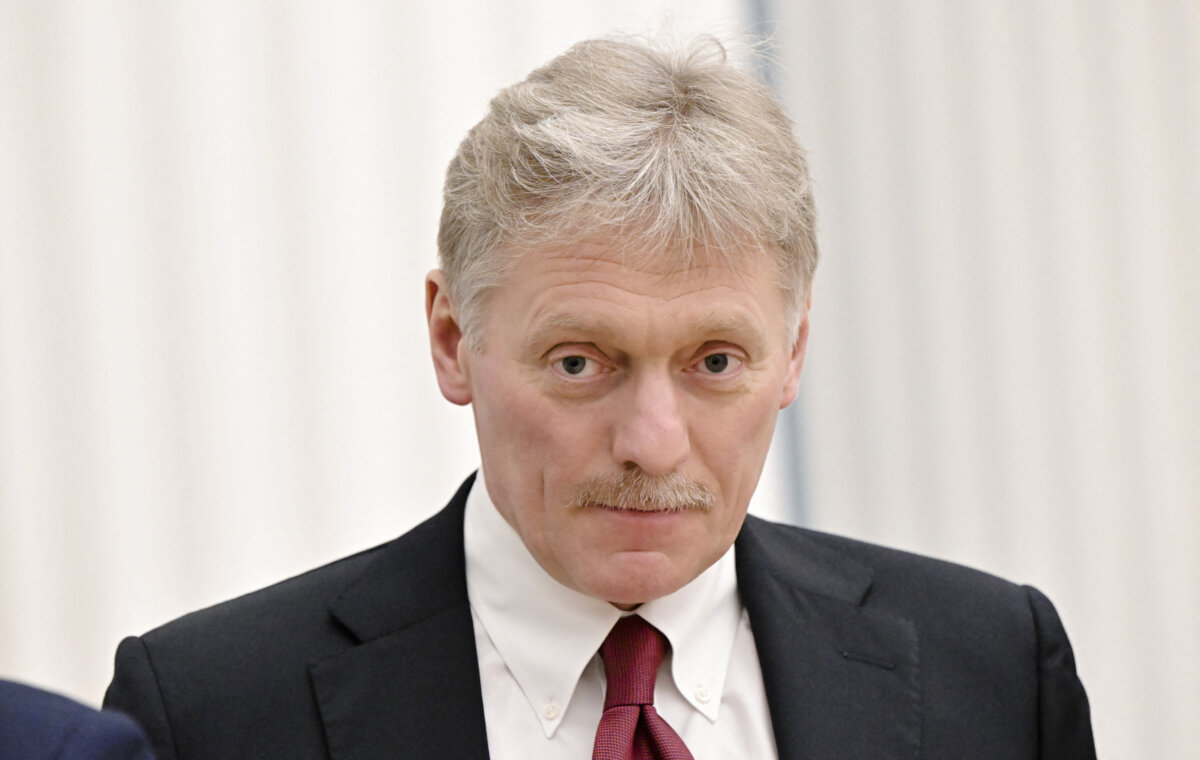

The testing of Russia’s new long-range nuclear-powered Burevestnik missiles should not affect relations between Moscow and Washington, Kremlin spokesman Dmitry Peskov said on Oct. 27.
“There is nothing here that could or should further strain relations between Moscow and Washington, especially since they are already at a minimum,” Peskov said, according to Russian state media outlet TASS.
“So far, only the first tentative steps have been taken to bring these relations out of their previous state of stagnation.”
Peskov went on to say that Moscow remains open to strengthening relations between itself and Washington.
That said, he stressed that Moscow proceeds on the basis of its national interests.
“This process [of improving ties with the United States] is being hindered precisely by those actions against us that we are talking about,” Peskov said about U.S. sanctions and threats.
“Nevertheless, we still, proceeding from our own interests above all, remain open to improving relations.”
Russian President Vladimir Putin said on Oct. 26 that “decisive tests” of the nuclear-capable weapon had been completed and that the Russian military could begin preparing the infrastructure for its deployment.
“I have received a report from the industry and I am aware of the assessments made by the Ministry of Defense—this is indeed a unique weapon that no other country possesses,” he said during a visit to a joint force command post, according to a statement released by the Kremlin.
Gen. Valery Gerasimov, Russia’s chief of the general staff, told Putin during the visit that the missile flew about 8,700 miles and spent 15 hours in the air during the test on Oct. 21.
President Donald Trump subsequently told reporters on Air Force One on Oct. 27 that Putin should be ending the war in Ukraine instead of testing the missile, adding that the United States had a nuclear submarine positioned off Russia’s coast.
“It doesn’t have to go 8,000 miles,” Trump told reporters when asked whether Moscow was saber-rattling with the test.
“I don’t think it’s an appropriate thing for Putin to be saying, either, by the way: You ought to get the war ended. The war that should have taken one week is now in … its fourth year; that’s what you ought to do instead of testing missiles.”
In response to Trump’s comments, Peskov told reporters in Russia that “this is the point of view of the American head of state, and it is important.”
The Russian test comes as the New Strategic Arms Reduction Treaty (New START), the nuclear arms pact between Washington and Moscow, is set to expire on Feb. 5, 2026.
Signed in 2010, it caps deployed long-range weapons and allows inspections to ensure that both sides comply.
Without it, the world’s two largest nuclear powers would face each other with no binding limits for the first time in decades.
The renewal treaty, like the ongoing war in Ukraine, continues to hang in the balance after a meeting between Trump and Putin in Budapest, Hungary, was called off last week.
The decision followed a phone call between U.S. Secretary of State Marco Rubio and Russian Foreign Minister Sergey Lavrov, who had also been expected to meet to prepare for a possible summit.
“Secretary Rubio and Foreign Minister Lavrov had a productive call,” a White House official said in a statement to The Epoch Times. “Therefore, an additional in-person meeting between the Secretary and Foreign Minister is not necessary, and there are no plans for President Trump to meet with President Putin in the immediate future.”
Aldgra Fredly, Tom Ozimek, and Evgenia Filaminova contributed to this report.
 Friends Read Free
Copy
Facebook
Tweet
Friends Read Free
Copy
Facebook
Tweet