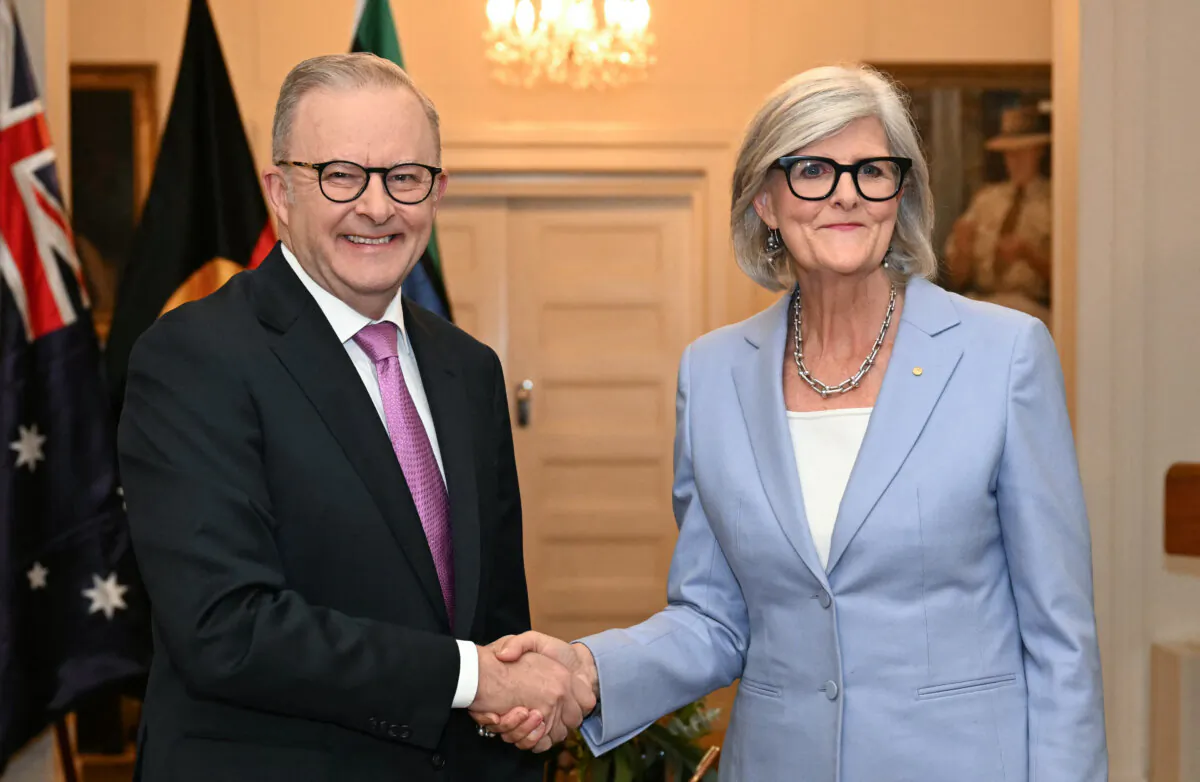

Energy transformation, cost-of-living relief, and national security will headline the Albanese government’s second-term agenda, Governor-General Sam Mostyn told Parliament as she opened the 48th Parliament on July 22.
Central to the government’s priorities is the transition to an 82 percent renewable electricity grid by 2030.
“Decarbonising Australia’s electricity grid is vital to achieving net zero targets, and the government will continue pursuing its goal of 82 percent renewables by 2030 backed by batteries, hydro and gas,” Mostyn said in her first major address post-election.
To unlock private sector capital and reduce reliance on fossil fuels, an additional $2 billion will be injected into the Clean Energy Finance Corporation to leverage $6 billion in private investment.
She said the government has also rolled out a $2.3 billion programme to reduce home battery installation costs by 30 percent, expecting more than one million new installations by 2030.
To support the energy transition workforce, a $40 million National Training Centre in new energy skills will be co-funded in Melbourne. There, tradies will be upskilled to help the country’s renewable transition.
The government is also bolstering disaster resilience and delivering targeted support to those affected by natural disasters.
Critical Minerals, Manufacturing and Gas Strategy
In a bid to leverage Australia’s natural advantages, Mostyn said the government will push for greater domestic processing of critical minerals vital for clean technologies.
Through new production incentives, it aims to scale up Australian-made green metals such as aluminium and iron.
A critical minerals strategic reserve will be established, alongside the expansion of the critical minerals facility to attract local and global investment.
The Future Made in Australia agenda will continue to underpin this term’s approach—supporting domestic manufacturing and reducing vulnerability to global shocks.
Government will also shift its focus on recognising gas’s role in a stable energy transition and affirmed its commitment to the Future Gas Strategy.
“Recognising the important role that Australian gas has to play in an orderly global and domestic energy transition, the government will strengthen and strengthen Australia’s standing as a reliable energy partner for our region,” she added.
Foreign Policy to Reflect Values
Facing global uncertainty, Mostyn said the government will pursue deeper engagement across the Indo-Pacific and maintain calibrated diplomacy with China.
In its first term, it bolstered ties with traditional partners—the United States, UK, Canada, New Zealand—and regional powers such as Japan, India, and ASEAN nations. Relations with China stabilised, and that pragmatic approach will continue.
Canberra also reaffirmed its support for Ukraine and committed to upholding the international rules-based order.
“Ultimately, the government’s foreign policy is an expression of our national values, national interests, and national identity,” she added.
Defence Boost
The new government aims to deepen defence ties through the AUKUS partnership, launch local missile manufacturing, and negotiate a defence pact with the EU.
Mostyn said the Albanese government is “positioning Australia to meet the growing global and regional security challenges we face.”
Annual defence spending will rise from $59 billion to $79.6 billion by 2029–30, with nearly 80 percent of that investment directed at the local defence industry.
This is despite the Trump administration urging Australia and other Indo-Pacific allies to increase defence spending to 3.5 percent of GDP, following a breakthrough agreement with NATO partners.
However, the Albanese government has said it will not make the commitment, noting that the latest boost already represents the largest increase in peacetime defence spending.
Missile manufacturing will commence this year, and continuous naval shipbuilding will be driven by an Australian workforce.
The ACE defence agreement with the UK and the United States will progress, while a new EU partnership is also on the table. Defence cooperation with key neighbours such as Indonesia and Papua New Guinea will also deepen.
As for internal security, Mostyn said the government “will work side by side with law enforcement and communities to defend every Australian’s right to feel safe through violence and bigotry.”
Health, Housing and Education
On the health front, the government is expanding bulk billing, adding 50 new Medicare urgent care clinics, and funding an extra 18 million bulk-billed visits.
It will legislate a $25 cap on PBS medicines and freeze script prices for concession holders until 2030.
The scheme is facing a potential 200 percent tariff by the Trump administration.
Treasurer Jim Chalmers has said the PBS, which keeps medicine at an affordable price for Australians, is not up for negotiation.
In addition, women’s health will receive $790 million, while a new rebate will be introduced for menopause assessments. A $1.1 billion package will fund Medicare mental health centres, youth services, and train 1,200 workers in the sector.
A 24/7 “1800-Medicare” phone service will provide health advice to reduce pressure on emergency rooms.
To address housing, the government plans to build 1.2 million homes under its $43 billion Homes for Australia plan. It will expand the home guarantee scheme, deliver 80,000 build-to-rent homes, and invest in modular construction and training 6,000 tradespeople.
However, soon after the election, the treasury warned the federal government, saying its current policy settings are insufficient to deliver 1.2 million new homes by 2030.
A forecast by the Housing Industry Association (HIA) notes the same issue—that the number of new builds simply isn’t enough, hampered by complex planning systems and low land supply.
“There were only 168,050 dwelling commencements nationally in the 2024 calendar year. If we continue at this pace, Australia will fall well short of the 1.2 million homes target,” HIA Managing Director Jocelyn Martin said on July 1.
Indigenous Policies
Mostyn highlighted that in its second term, the government will continue to close the gap for Indigenous communities through a standalone plan to address family violence, economic empowerment, and cultural partnership.
It will develop a First Nations Economic Partnership and embed community-led decision-making into key programmes.
 Friends Read Free
Copy
Facebook
Tweet
Friends Read Free
Copy
Facebook
Tweet