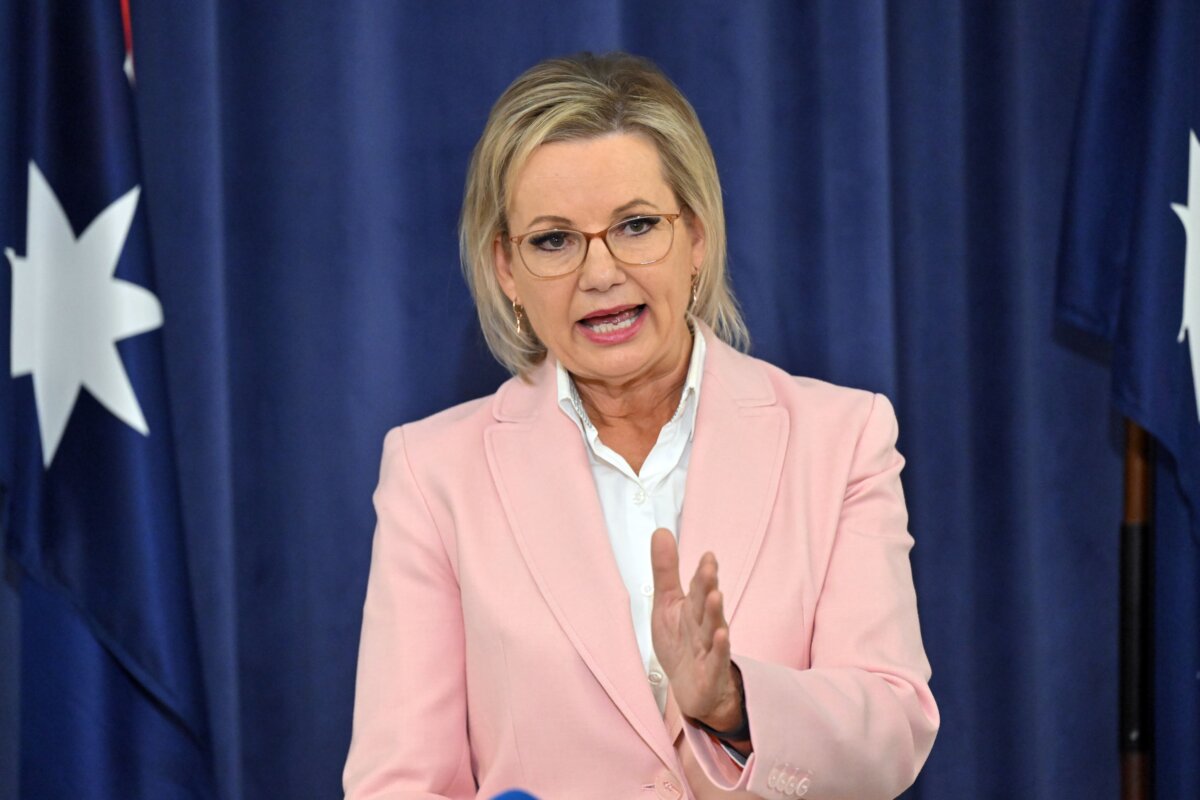

Opposition Leader Sussan Ley has vowed to reverse Australia’s recognition of Palestine if the Coalition wins power at the next election.
Her pledge came in letters sent to senior U.S. Republicans and Israeli officials, and comes after Prime Minister Anthony Albanese just hours earlier announced the country would officially recognise the Palestinian state, in coordination with the UK, France, and Canada.
Albanese made the pledge prior to his speech to the U.N. General Assembly, saying it reflects Australia’s “longstanding commitment to a two-state solution, which has always been the only path to enduring peace and security for the Israeli and the Palestinian peoples.”
“The terrorist organisation Hamas must have no role in Palestine,” Albanese and Foreign Minister Penny Wong said in a statement.
“Further steps, including the establishment of diplomatic relations and opening of embassies, will be considered as the Palestinian Authority makes progress on its commitments to reform.”
In her letter to members of Congress, Ley stressed the recognition did not carry bipartisan support.
“The federal opposition opposes this decision and would reverse it should we form government,” she wrote.
“It is our view that Australia’s national interest is best served through a two-state solution underscored by America’s proactive engagement in the region. The path to a two-state solution can only be achieved after Hamas has been removed from power in Gaza and all hostages have been released, not before,” the letter, seen by the Australian Broadcasting Corporation, said.
Later, speaking to media, Ley said Labor’s move was misguided.
“The prime minister has got this all wrong, I mean he’s talking big, delivering nothing and letting Australians down.
“He’s claiming that unilateral recognition of Palestine will somehow help the hostages be released or deliver peace to that troubled region. We all want the war to end but recognition has to come at the end of a peace process,” she told Nine’s Today program.
Support from Israel, Pushback at Home
On Sept. 22, Ley spoke with Israeli Foreign Affairs Minister Gideon Sa’ar, who praised her stance and invited her to visit Israel.
“I expressed our appreciation for her position opposing the government of Australia’s recent decision,” he said in a statement on X.
But Foreign Affairs Minister Penny Wong accused the opposition of “running a rogue foreign policy not in the nation’s interests.”
“We are at our strongest when our country speaks with one voice, and I think Australians know that. It is possible to back Australia and still be an effective opposition,” Wong told ABC radio.
Acting Prime Minister Richard Marles also criticised the move.
“The opposition has its right to have its view … but to start writing to representatives of countries abroad, that is ultimately a matter for the opposition,” he told reporters.
Ley’s move came after 25 senior congressional Republicans, including Senator Rick Scott and Representative Elise Stefanik, warned leaders of Australia, Canada, France and the UK that recognising Palestine was a “reckless policy” that undermined the peace process.
Gordon Flake, CEO of Western Australia’s Perth USAsia Centre, said the Coalition’s intervention broke with diplomatic convention.
“When I was in Washington, there was a mantra that politics stopped at the nation’s borders. You could have robust policy disagreements internally, but externally it was always in the interest of the nation to have a unified front,” he told ABC radio.
Ley’s Colleagues Say Decades of Bipartisan Politics Overturned
Ley found support within her party with Liberal senator and former ambassador Dave Sharma backing her decision.
“It’s perfectly appropriate,” he told ABC Radio National Breakfast.
“I’d say two things. Firstly, it’s the Labor government that has overturned decades of bipartisan foreign policy consensus on how a Palestinian state should come about. It’s not the Liberals, it’s Labor that’s done that.
“And secondly, it’s perfectly appropriate and normal for opposition politicians to have relationships with parliamentary counterparts in other parliaments around the world.”
Shadow Foreign Affairs Minister Michaelia Cash also criticised Albanese for recognising Palestine, particularly his statement that it reflected “the same hope that sustained generations of Jewish people.”
Cash called that “appalling judgement.”
“He has diminished the unique historic plight of the Jewish people and given legitimacy to extremists who openly reject Israel’s right to exist,” she said.
“Mr. Albanese has shattered decades of bipartisanship by unilaterally recognising a Palestinian state before any peace process has been secured, rewarding terrorists while hostages remain in Hamas tunnels.”
Greens Want More Sanctions on Israel
The Greens welcomed recognition but said it was only a first step.
“Statehood and the right to self-determination are fundamental rights of all people. Recognising this right of Palestinians is long overdue,” Greens foreign affairs spokesperson Senator David Shoebridge said.
“But today’s actions will not end the genocide, it will not stop the starvation or the occupation—material action is needed.”
The party has called for sanctions on Israel and an end to the arms trade. “It’s a brutal fact of this appalling genocide that Israeli F-35 fighter jets are being used in Gaza, and they can only operate with Australian-made parts,” Senator Shoebridge added.
Labor defector Senator Fatima Payman also endorsed the move while urging further steps.
“Let’s not stop here. End the occupation, end the violence, end the genocide,” she wrote on social media.
 Friends Read Free
Copy
Facebook
Tweet
Friends Read Free
Copy
Facebook
Tweet